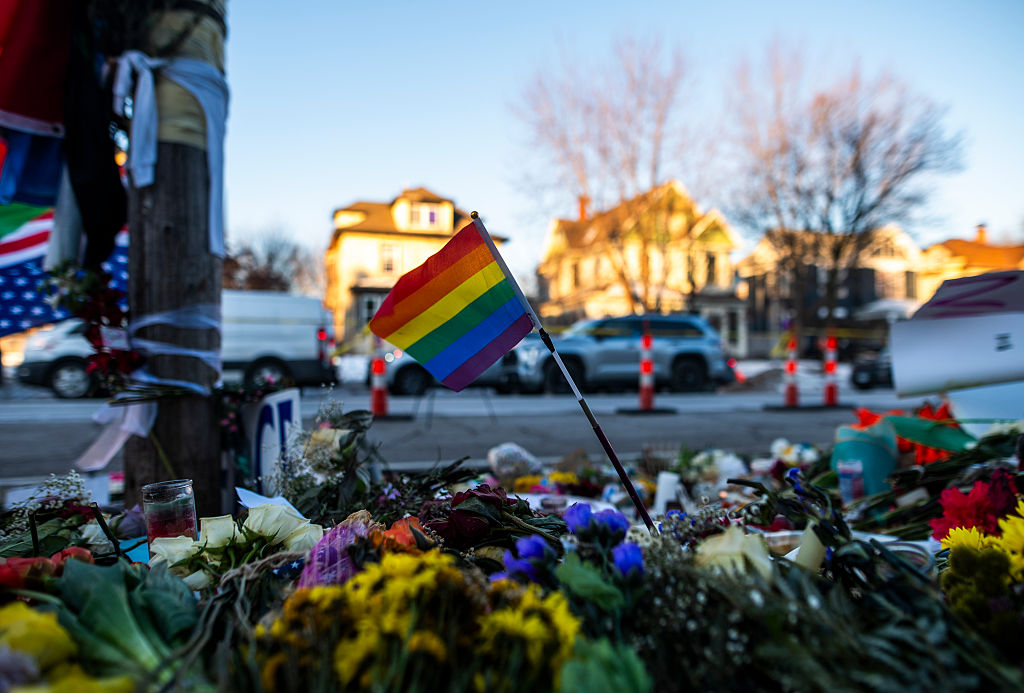
Renee Nicole Good’s murder was a homophobic hate crime. That much, by now, seems clear. Contempt for her queerness is reflected in every part of this story: in the conservative pundits mocking the pronouns in her social media bio, in the killer’s supposedly “exonerating” footage of her visibly queer wife and in the taunts uttered by ICE officers after her death. Last Tuesday, Patty O’Keefe, another lawful observer who was pepper-sprayed and dragged out of her car by ICE, told Minneapolis Public Radio that “the ICE agent who had pepper-sprayed into the vents of my car said, ‘You guys gotta stop obstructing us, that’s why that lesbian b—— is dead.’”
The outrage and grief that has followed Good’s death is only natural. It’s right to feel these things; there’s not much else you could feel. They’re also part of a much larger story. As Katelyn Burns writes, mainstream media and Democratic politicians mostly chose to erase Good’s queerness after her death—most egregiously, one of her children, whom she was raising with her wife Becca Good, was referred to in the press as an “orphan.” It was a messaging decision: They could generate more outrage if this was a story about a “normal,” heterosexual white mother. Mentioning Good’s queerness would make her feel more disposable to their intended audience, and might even lead some to believe her death was a good thing.
ICE violence is gender violence, and it is homophobic violence. We just don’t always see it because the victims aren’t always white suburban moms.
That exact same calculus is being used to erase and hide many, many other queer and trans victims, both on the streets and in ICE detention centres. Renee Good died protecting those people, and we owe it to her to connect that death to the wider cause she served. ICE violence is gender violence, and it is homophobic violence. We just don’t always see it because the victims aren’t always white suburban moms.
ICE was created in 2002. The first known case of a trans woman dying under ICE custody happened five years later. Her name was Victoria Arellano, and she had been living in the U.S. with her mother since she was seven years old. She was also HIV-positive. At the time ICE detained Arellano, there was no procedure for trans prisoners; as such, she was sent to a men’s facility. ICE also did not track the number of detainees with HIV or AIDS, so watchdogs could not get reliable figures on abuse. Even so, it was known, anecdotally, that many people were being denied medication.
That’s what happened to Arellano. Her requests for medical care were refused; her mother’s offer to bring her AIDS medication to the detention centre was turned down; when she became so sick that she couldn’t keep food down or leave her bed, every man in the facility gathered around her cell, chanting “HOSPITAL, HOSPITAL, HOSPITAL.” None of it worked: Arellano was taken to the hospital only on the verge of death, and died there on July 20, 2007.
It’s been 19 years and two Democratic presidencies since Victoria Arellano’s death, and stories like hers keep coming. According to a June 2024 report from Immigration Equality, the National Immigrant Justice Center and Human Rights First—assembled and published, you will note, during the Biden administration—one-third of LGBTQ2S+ and HIV-positive ICE detainees reported “sexual abuse, physical assaults or sexual harassment,” and a majority of HIV-positive individuals “received inadequate medical care or were denied care altogether.” Other reports indicated that trans detainees, specifically, experience the highest rate of rape, with trans women being at particularly high risk.
@xtramagazine 2025 was a rough year for queer and trans people. So let’s name and shame the individuals and organizations that made headlines for the worse. From Bari Weiss’ rise to the top of CBS News, to Action4Canada’s anti-LGBTQ2S+ advocacy, and ICE wreaking havoc across the U.S, these are some of Xtra’s “shady bitches” of 2025. #lgbtqnews #yearinreview #queernews #lgbtq ♬ original sound – Xtra Magazine
On top of this, many LGTBQ+ immigrants and refugees are fleeing corrective rape, homophobic violence or the criminalization of queerness in their countries of origin; even if a queer or trans person is not abused under ICE custody (although they almost certainly will be) deporting them can, in and of itself, constitute queerphobic violence. It can also cause their death, as in the 2025 case of Britania Uriostegui Rios, who was deported to Mexico in violation of a court order under the United Nations Convention Against Torture, which stayed her deportation on the grounds that she would likely be tortured and killed.
Isa Noyola is a director of the Border Butterflies Project at the Transgender Law Center. The project was established in 2014, and, though Noyola is clear that the overall goal was to end immigrant detention for trans people, they had only gotten a few key concessions by the time Trump took office.
“During the Obama administration, there was an LGBT liaison that ICE had, who was kind of our main contact,” she tells me. “Our bottom line was to end the practice of detaining trans asylum seekers and folks living with HIV. But they didn’t want to do that because it’s not profitable for [private detention centres] and it would create a crack in the logic of why anybody needs to be detained.”
Instead, ICE set up a trans advisory council, composed primarily of non-trans academics and doctors, who created a set of best practices for dealing with trans detainees. “Everything from pronouns to access to mental health and trans-related healthcare to data collection,” Noyola says. ICE agreed to set up a “trans pod” in detention facilities, where trans people would be kept separate from the general population. They agreed to keep track of how many trans people were detained.
None of this was remotely enough, says Noyola—even being put in the “trans pod” required self-identifying to a guard as trans, which many people were too afraid to do—but under Trump, even these minor and inadequate protections have been stripped. Guidelines for preventing rape in detention centres were rescinded. Trans people are now housed in prisons with people of their assigned gender. Under Trump, ICE has been selectively disobeying the Prison Rape Elimination Act, which requires it to provide a yearly statistical report and analysis of sexual assaults reported at its facilities. It has also stopped recording the number of trans people detained—a number that has been rising at a disproportionate rate since at least 2021; in reports we have, trans people were also kept in detention over twice as long as cis prisoners—making it that much harder for advocates to track gendered abuse.
This is what leads to horror stories like the one that recently emerged from the ICE detention centre in Louisiana, where staff carried out a campaign of sexual assault, sexual harassment and forced labour with dangerous chemicals. The campaign was, according to Sarah Decker of the Robert & Ethel Kennedy Human Rights Center, “designed to target vulnerable trans men or masculine-presenting LGBTQ people.” The survivors who have come forward—three transmasculine people and one cis queer woman whose gender presentation the warden apparently found objectionable—say they were groped, verbally harassed, surveilled in the shower and shown pornographic images of the guards against their will. The female prisoner was forced to perform oral sex on the warden, who took the lead in most of these incidents.
Fascism, as an ethos, is deeply obsessed with gender and sexuality—it needs to regulate them both in order to control the mechanisms of white reproduction.
This all casts a particularly grim light on the killing of Renee Good, and the conservative taunting of Becca Good for looking like a “small and weak man.” It is almost certainly not the only story of its kind, and we will not hear all of the others. We can only know that these things are happening, to queer people of all stripes, because this is how ICE works.
“All detention is violent,” Noyola reminds me. Many people have reported experiencing mistreatment and even torture at ICE facilities, including cis straight men. But it matters to say that queer and trans detainees are vulnerable in particular ways, and to say that policing queerness is one of the things ICE sets out to do.
Fascism, as an ethos, is deeply obsessed with gender and sexuality—it needs to regulate them both in order to control the mechanisms of white reproduction. It’s also a highly efficient ideology, collapsing racism and sexism and homophobia and transphobia and xenophobia into one coherent ideology of white male rule. Increasingly, you cannot pull on any one string without pulling all the others: ICE exists to police America’s racial makeup. ICE commits disproportionate sexual violence against queer and trans people. ICE has also been committing increasingly public violence against women, including cis and straight women.
If we as queer people oppose sexual violence, if we oppose gender violence, if we oppose homophobic violence; if we want freedom of sexuality and of gender, those freedoms are incompatible with a world in which ICE exists. White queer people living relatively safe and comfortable lives—a group that absolutely includes me, for the record—can’t afford to tune out until the violence reaches people who look like us.
Renee Good didn’t tune it out. Neither do the people carrying on her work. Days after Good was killed, a 21-year-old trans man in Los Angeles was shot in the eye at close range while protesting ICE with the organization Dare to Struggle. According to his aunt, who spoke to the Los Angeles Times, the officer who shot him pressed his face in the pool of his own blood. The other officers “were mocking him, saying, ‘You’re going to lose your eye.’” He did lose it. He also suffered several other injuries, including a slice of metal embedded so close to his carotid artery that doctors didn’t dare to remove it for fear he would bleed out.
“There is no such thing as a safe protest,” says Connor Atwood of Dare to Struggle. “I mean, if it’s safe, it’s not a protest. Let’s be real.” Many if not most of the people in Dare to Struggle are queer, he tells me, himself included, which was not an intentional choice so much as a reflection of who felt drawn to the work. Atwood says that their chapter head, a non-binary person, was arrested at the same protest where the young man was shot.
I try to ask Atwood about the risks he and the other protesters are taking—facing off against armored men with guns, days after one of them shot a woman to death for looking at him funny—but he genuinely seems not to mind. If anything, it is a duty: “We have a tremendous faith in the masses of people that they can change the face of everything,” he says. “We have a responsibility in this moment to go to them, to unite with them and to integrate with them and, if necessary, to fight and die alongside them.”
That fight is a queer fight; it is a trans fight; it is also everyone’s fight. Members of our community are dying, in ICE facilities and in the streets. We can honour them best by making sure they don’t fight alone.

 Why you can trust Xtra