On a fall afternoon in 2017, after classes were done for the day at Garth Webb Secondary School in Oakville, Ontario, history teacher Ian Duncan tuned in to a live broadcast from the House of Commons.
What he heard from the prime minister that day was a revelation.
“I watched the apology for the 2SLGBT Purge live from my office at school,” Duncan recalls, referring to then prime minister Justin Trudeau’s formal apology for Canada’s history of pushing queer employees out of government jobs through firings, discharges and systemic intimidation from the 1950s to the 1990s. Trudeau also apologized for the prosecution and conviction of queer people for having consensual sex with same-sex partners.
As Trudeau spoke about the government’s plan to expunge these convictions from official records and the recent addition of specific language about gender identity and expression to the Canadian Human Rights Act, Duncan found himself looking from the broadcast footage to the photos of himself, his partner and their son that he keeps above his desk.
“I realized this was my first lesson in Canadian queer history,” Duncan says. Despite his passion for teaching, his years of higher education and his own curiosity, he had almost never learned any LGBTQ2S+ history, let alone Canada’s.
After that day, Duncan began teaching queer and trans history as part of his Grade 10 history classes. But as each school year passed, Duncan found that the curriculum available to him “was starting to feel really limited.”
He would teach about the introduction of Bill C-150 in the 1960s, an omnibus bill that would legalize consensual sex between two adults in private and led to then minister of justice Pierre Trudeau famously saying, “There’s no place for the state in the bedrooms of the nation.” He’d teach about the 1971 We Demand rally, the first major gay rights demonstration in Canada; and the 1981 Toronto bathhouse raids, and the protests that followed. He’d teach about landmark court cases like 1995’s Egan v. Canada, where the Supreme Court ruled that the Canadian Charter of Rights and Freedoms prohibits discrimination based on sexual orientation. And he’d teach about the Civil Marriage Act of 2005, which legalized same-sex marriage in the country.
But Duncan knew queer history in Canada was so much bigger than “this very Ontario-centric kind of treatment [that] doesn’t really diversify a story for a very diverse community.” He decided that if the stories and resources he wanted to share with his students didn’t already exist in an accessible classroom-ready format, he would simply have to make sure they did: and it would be the students themselves taking the lead.
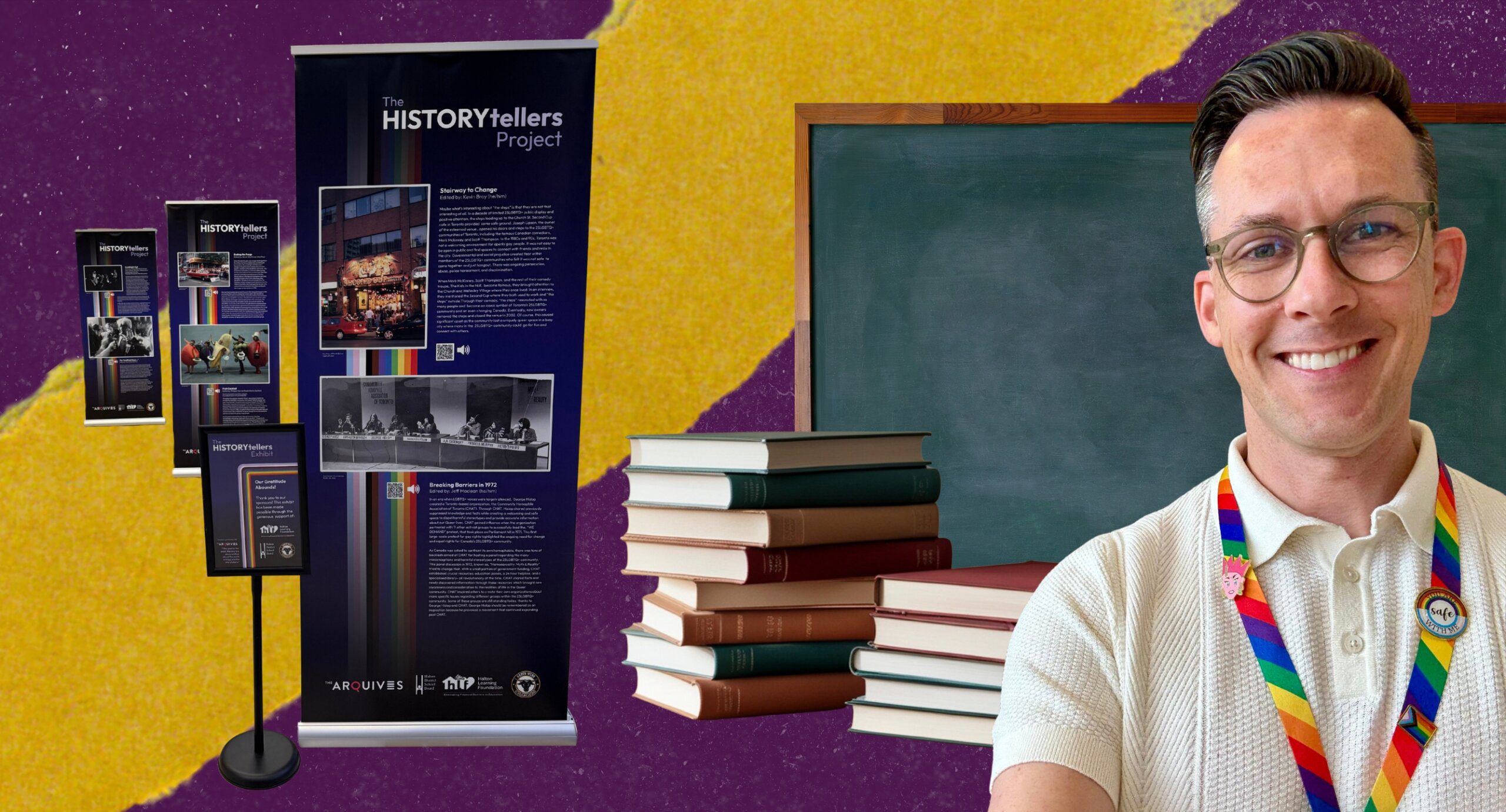
In 2024, working with the ArQuives—the largest independent LGBTQ2S+ archives in the world that focuses on Canadian history—Duncan presented students with a selection of photos representing various facets of Canada’s queer history. There were images from Pride parades and protests; pictures of LGBTQ2S+ families, friends and lovers; and shots of drag queens and performers. Students chose the photos they wanted to learn more about, delved into the background and context behind each snapshot and wrote about those stories to share what they’d learned.
The final project includes stories about Canada’s first Pride Week; a 1977 protest in Saskatoon, Saskatchewan; and Zami, a Toronto-based organization created by and for Black queer people. The students’ work is now accessible as a digital exhibit hosted on the ArQuives website.
In January, Duncan was awarded the Governor General’s History Award for Excellence in Teaching in recognition of his work on what became known as the HISTORYtellers Project. Duncan hopes this sort of recognition will lead to broader curriculum changes. “When people don’t know our history, we don’t end up written into the resources and curriculum that define our courses,” he says.
He also hopes to inspire other teachers to share this material with their students. “I think a lot of teachers may edit their choices, because they think this history will not be well received in the classroom,” says Duncan. “And I now know students from every identity you can possibly imagine, in a very diverse classroom, who embraced and continue to embrace the telling of 2SLGBTQ+ history in Canada and beyond.”
@xtramagazine Did you know that kissing can be a form of activism? The first documented kiss-ins took place in 1970 in New York City during a gay liberation march commemorating the first anniversary of the Stonewall Riots. While the use of kiss-ins petered out after the late 1970s, they became an organizing strategy among ACT UP chapters in the U.S. and Canada in the late 1980s and early 1990s—including at the historic HIV/AIDS protest at St. Vincent’s Hospital in New York. While more recent kiss-ins have taken place from 2002 up until 2018, they have once again become a less common form of activism. But its history and impact should not be forgotten 👨❤️💋👨 #lgbtqhistory #activism #queerhistory ♬ original sound – Xtra Magazine
Erica Gilchrist was one of Duncan’s history students last year. She says she had never had the chance to learn about queer Canadian history in any of her classes before Grade 10.
Back in September 2024, as she and her classmates walked around Duncan’s history classroom looking at photos for the project, some of them were drawn to a snapshot taken at a panel discussion in 1972. In the image, half a dozen people are seated behind microphones and seem to be having an animated discussion, with signs reading “Community Homophile Association of Toronto” and “Homosexuality: Myth & Reality” on display behind them.
“This one just grabbed our interest with how many people were gathered around this organization and in this environment,” says Gilchrist, now in Grade 11. For her and her teammates, the photo became a jumping-off point to learn about how the Community Homophile Association of Toronto (CHAT) organized educational panels and a 24-hour helpline for the LGBTQ2S+ community in the Toronto area. They also learned that CHAT had partnered with 11 other activist organizations to organize the We Demand rally on Parliament Hill.
“We found it interesting to work with one of the earliest organizations in Canada that was confronting queer myths and stereotypes, and supporting queer identity in a time when it was really just not very widely accepted,” says Gilchrist.
Now, Gilchrist says what she learned from this project—about queer history, archival work and how historical narratives can be shaped and shared and better understood—has inspired a deeper love of the subject as a whole. “[I learned] to always try to proceed with an open mind, be open to new perspectives and be open to understanding events that may have been left out of history in the past,” she says.
Duncan says that to the best of his knowledge, the vast majority of the approximately 110 students who participated in the HISTORYtellers Project are not out as part of the LGBTQ2S+ community. In a way, he says, it was all the more meaningful to see them embracing this work.
“What was really cool was that all of the students are investing with integrity and effort in telling a story they are connecting with, in a way that is not necessarily a direct connection,” he says. “I know it meant something to the queer and trans students who did contribute to the work.
“I think this speaks to where a new generation of Canadians are at, what they’re willing to be curious and ask questions about, and how they’re feeling safer to ask questions that even ten years ago, students may not have asked. I like that. I think it speaks to positive change.”
Duncan is keen to continue this work of “trying to fill some of those gaps in the way our history is being told” with his students. He says that for people of his generation and previous ones, the idea of queer history being taught in a high school classroom still feels new and revolutionary: “We were never taught in secondary school about queer and trans history.”
But he hopes, for his students and for students of his son’s generation, that this will be just another day in Canadian history class.

 Why you can trust Xtra