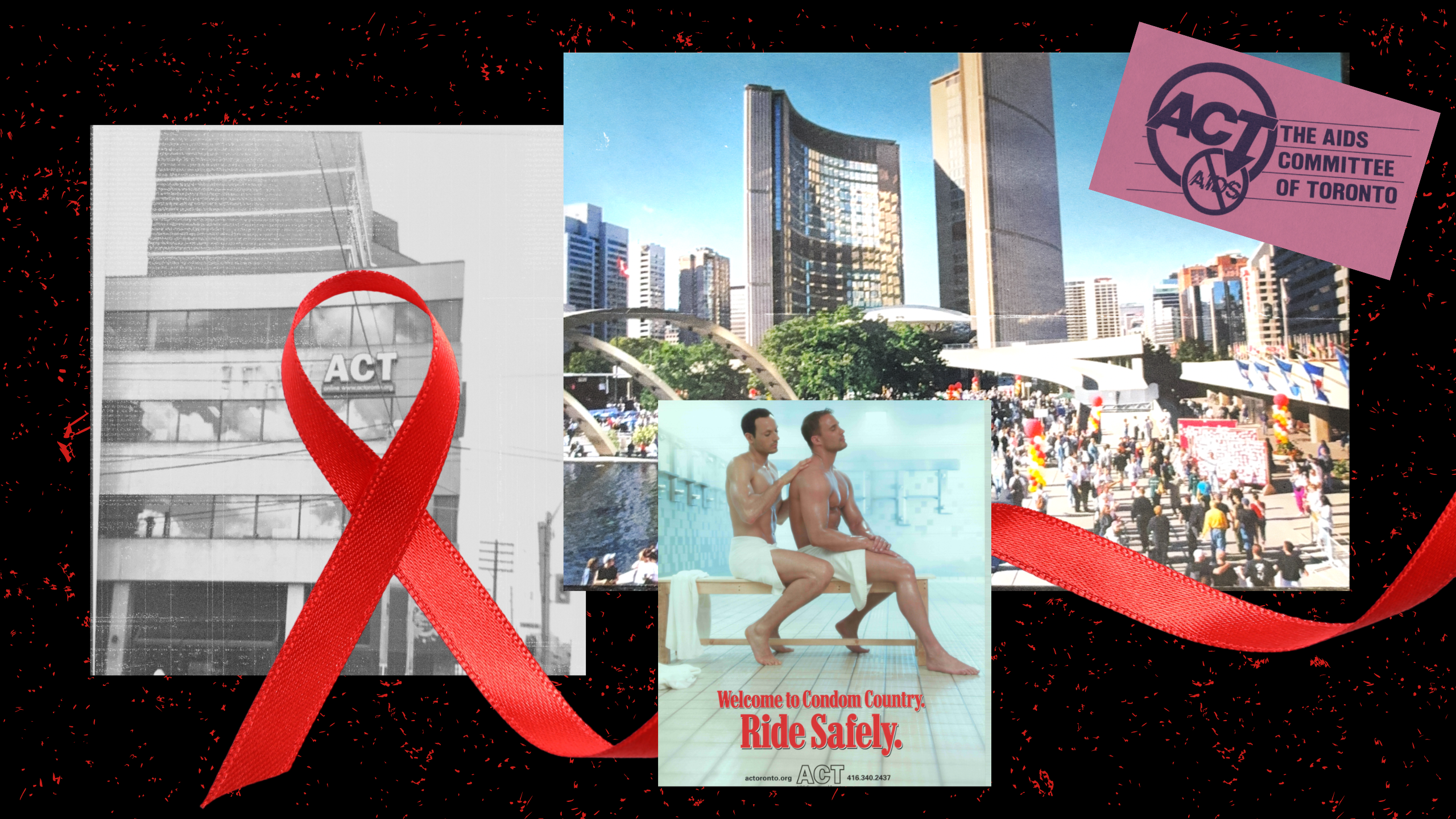
HIV has loomed over the queer and trans community for decades.
It’s there in our classrooms and bedrooms, our bars and clubs. It’s in our books and magazines, our TV shows and movies. It’s there when we come out, when we try to give blood, when we fill out a dating app. It’s with us, and—for some—it has been with us for our entire lifetimes.
Since the virus’s first reported incidents among gay men in the 1970s, HIV and AIDS has never been far from queer sexuality, health, joy and community. From early days of confusion and denial, to those of mourning and loss. As years passed, our medical and scientific understanding of the virus grew. We learned enough to keep people with HIV healthy throughout their entire lifetimes, and how to suppress the viral load enough that it can’t be passed on through sex.
But while HIV’s intensity and urgency in our lives has subsided, it has not gone anywhere. In Canada, more than 2,400 people were newly infected, with one-third happening between men who have sex with men, according to the most available health data. Canada is also the only G7 country whose HIV transmission rates are on the rise. Just south of the border, an estimated 31,800 Americans were newly infected with HIV, two-thirds of them men who have sex with men.
And yet Canada’s oldest HIV service organization is closing its doors this March. In a September 2025 press release announcing their closure, the AIDS Committee of Toronto (ACT), founded in 1983, says that the needs of people with HIV have evolved beyond their original mission, and that it no longer makes financial sense to remain open.
To understand what that means, to reflect on ACT’s legacy and to explore why now—while HIV transmissions are on the rise—they are walking away, Xtra reviewed decades’ worth of archival records and news coverage and spoke with more than a dozen key players in ACT’s timeline.
A call to action
In the ’70s and early ’80s, there was a lot of confusion about the disease that would become known as AIDS, and HIV, the virus that causes it. Many consider the now famous July 1981 New York Times “gay cancer” story as a launch point for public discussion. AIDS would initially be called Gay-Related Immune Deficiency (GRID), based on the then widespread belief that this was something that only impacted us.
“It wasn’t called HIV then because we didn’t understand what was causing it,” says John McCullough, a longtime HIV and community activist who moved to Toronto from England in 1972. “Nobody was really interested in gay cancer, learning more about it. The church considered us sinners, the healthcare system called us sick and the government called us criminals.”
McCullough recalls that, due to the lack of information, a lot of men in Toronto didn’t yet consider AIDS a serious issue. Since New York was the most vocal city about this new disease, McCullough’s friends would assume that as long as they avoided sex with Americans, they’d be okay. Canada would report its first case of the disease less than a year later in 1982.
As such, it was up to the community itself to find and share more information.
“We tried to record as much about that as possible and follow what was going on,” says Ed Jackson, another longtime activist and writer. In 1971, Jackson became one of the first editors at The Body Politic, one of Canada’s first and most influential gay publications (which was published by Xtra’s parent company, Pink Triangle Press).
For example, a 1982 Body Politic article attempted to quash a popular perception at the time that AIDS was caused by poppers, instead pointing to the research that correlated AIDS with sexual partners. The article also references the gay-led AIDS groups popping up in places like New York and San Francisco, noting, “sooner or later, every city with a large gay population will have an AIDS crisis … It will be important to establish information centres which gay men can quickly turn to.” This desire to brace Toronto for the impact was felt among the gay writers at the Body Politic and the community as a whole, says Jackson.
“Michael Lynch was one of the people who was very involved; he went to New York a lot, and he could see what was happening in New York,” Jackson says about a fellow Body Politic writer who would go on to become a founding officer of ACT. While all of Canada reported fewer than 100 AIDS cases in 1983, New York City alone saw more than 2,000. “We knew that this may be coming to Toronto, and we needed to try to prepare for it.”
Lynch was part of dozens of gay men, lesbians and allies, who saw the writing on the wall and began organizing around the Hassle Free Clinic—a Toronto clinic that opened in 1973 initially to offer low-barrier sexual health support to low-income and housing-insecure people, but which would quickly pivot to HIV/AIDS when the need became apparent.
In April 1983, Hassle Free would join with community activists to host a health forum about AIDS at Toronto Metropolitan University (then called Ryerson Polytechnical Institute). From this April meeting, an ongoing committee was struck, and by July of that year the “Toronto AIDS Committee” elected its first officers: Body Politic writer Lynch, lawyers Douglas Elliott and Harvey Hamburg, Dr. Randy Coates and Robert Trow of the Hassle Free Clinic.
After a near immediate name change to the AIDS Committee of Toronto, ACT was born—initally working out of Hassle Free and then leasing space by the city’s gay village at 66 Wellesley St. E.
Getting the message out, our way
Though ACT was a newly formed group, it wasn’t as though the queer community in Toronto was unfamiliar with organizing. Toronto’s bathhouse raids—where police stormed some of the only safe places for men to be intimate with each other, arresting them half naked and publicly outing them in the papers—took place in 1981, just a few years prior to ACT’s formation. The raids and subsequent protests were a pivotal moment for the community, considered by many as “Canada’s Stonewall.”
“After the bathhouse raids, we were seeing so much trauma amongst our friends,” says McCullough. “Not only those who’ve been arrested, but those of us who think we might be next.” He says responding to the raids was many people’s first “taste of activism,” generating call lists and a road map for community action.
Those connections would come in handy when ACT was formed. According to its first-ever annual report, between 1993 and 1994, ACT recruited more than 230 people in its general membership, had over 75 volunteer staff and raised nearly $30,000 from the community and more than $60,000 from the Canadian government—nearly $300,000 in today’s buying power.
This fuelled dozens of initiatives. Phone lines were established, both to answer calls from community members in need and from straight cis people with questions about HIV/AIDS. ACT became the de facto media contact for journalists of the time, and several programs were launched to get food and meds to people who were homebound.
Many of ACT’s early projects would also go on to have decades-long lives—like the first AIDS Awareness Week in 1984 (eventually adopted Canada-wide) and the first AIDS Vigil in 1985, which continues to this day. An AIDS hospice started by June Callwood was initially under ACT’s umbrella and would go on to become Casey House—a first-of-its-kind specialty hospital for people with AIDS that is still in operation today. Princess Diana famously visited Casey House in 1991, which marked a turning point for how people viewed those with the disease.
In these earliest days, much of ACT’s focus was on getting information out. ACT would create and host hundreds of events, panels, posters, brochures, videos and more. They were willing to try anything to get the community talking about HIV, how to avoid it, how to get tested and what to do if that test was positive.
An ACT brochure from 1983
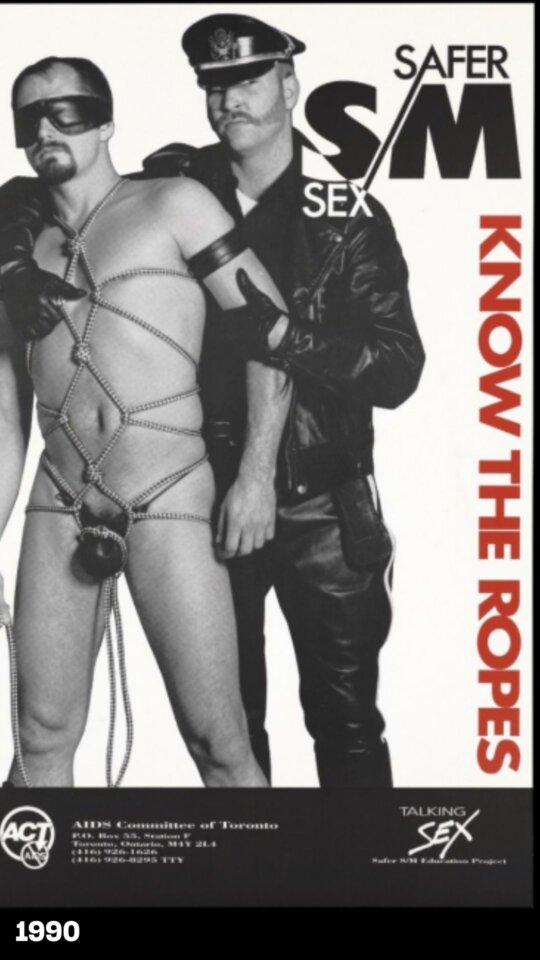
But these were not just any campaigns. Throughout the ’80s and early ’90s, ACT quickly became notorious for public health messages that either suggested sex or explicitly showed it—featuring sex acts and near or completely naked men. This flew in the face of public health messaging, which promoted abstinence for sex of all kinds—even low-risk. Popular gay subcommunities–like those into leather or sadism/masochism—were also spoken to through ACT campaigns.
These materials were plastered in the bars and baths gays liked to frequent, but also spilled over into the consciousness of wider Toronto.
“I went to high school at Jarvis Collegiate in the ’80s, literally a block away from where [ACT] offices were,” says John Miller, a non-profit consultant and novelist. “I was 15 years old and starting to come out as a gay man … ACT was giving me that information in a way that was connecting with me as a young man.”
Not everyone appreciated the authentic and eye-catching messaging. People would often send ACT materials into the police, sometimes mere hours after publication, complaining about their explicit nature.
A 2000s “Condom Country” campaign depicting gay men as cowboys (before the well-known association with Brokeback Mountain) would earn ire from Philip Morris, the company behind Marlboro cigarettes. The company—which used cowboy imagery heavily in their ads—even went as far as to send a cease and desist letter to ACT, which the org refused to capitulate to.
The sexiness and authenticity of ACT is what compelled Miller and other young people like him to get involved in the organization—doing simple yet impactful tasks like picking up people’s AIDS medications, driving them to appointments, handing out condoms at frequent gay gathering points or helping to run one of their many support groups dealing with grief, new diagnoses or fears around sex.
“For gay men and lesbians of that generation, it was what they wanted to see. It told us we could have sex without being ashamed of it,” Miller says.
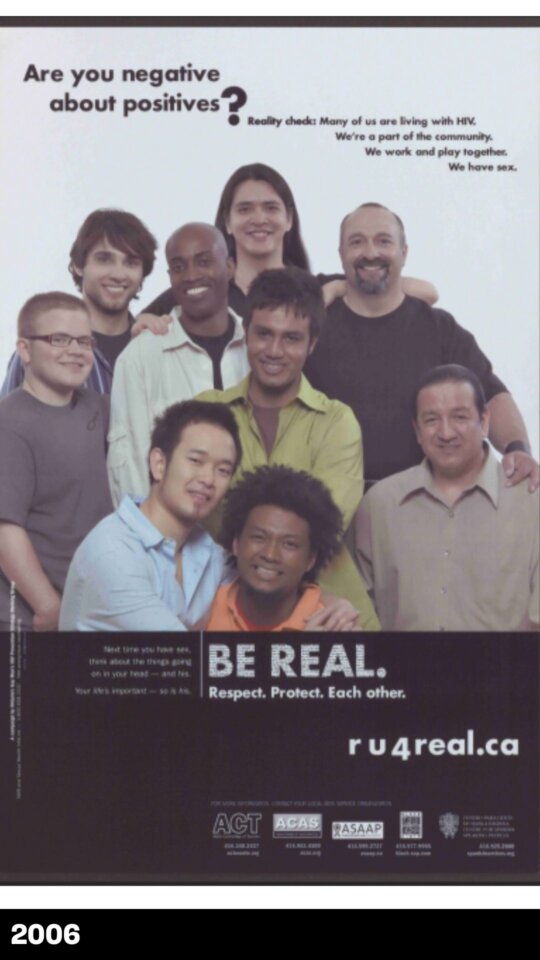
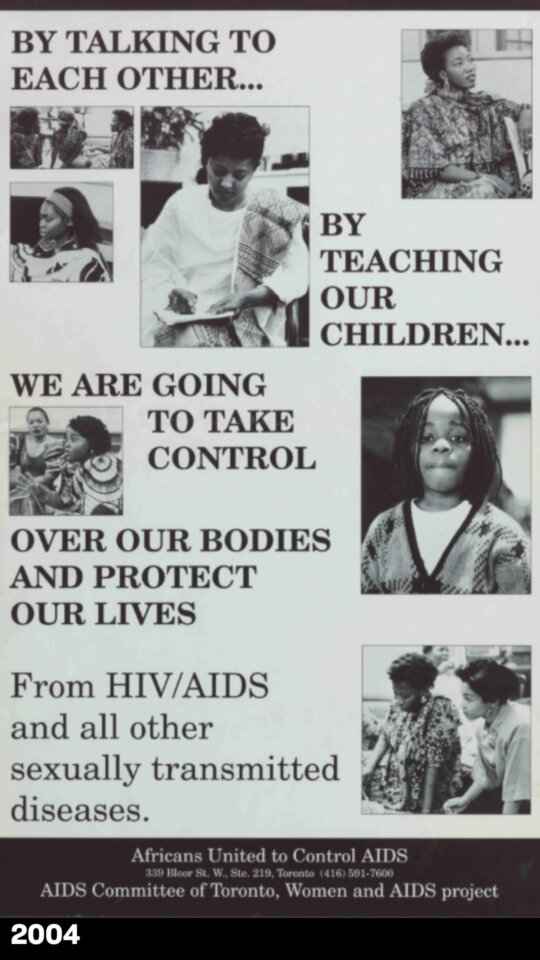
ACT posters and advertisements from over the years:










“Why wasn’t ACT doing more?”
Yet while ACT was spreading information and aiding those with the disease, some in the broader queer community began to get restless.
“ACT staff seemed to be mostly social services kind of work, they didn’t have a real political edge to them,” says longtime HIV activist Tim McCaskell. He explains that as ACT UP (New York’s AIDS Coalition to Unleash Power—no official connection to ACT, despite the similar name) started creating waves south of the border. ACT UP was demanding more action, investment and accountability from the government and public health officials—the question became, says McCaskell, why isn’t that happening here?
“It’s really fucking depressing that all we do is talk about how sick we’re getting and it’s just, that’s not helping me at all, so some people would just say, ‘fuck this,’” says McCaskell of the support groups ACT offered. “Why wasn’t ACT doing more?”
McCaskell was part of a group of volunteers and people in ACT’s orbit who began to meet separately, eventually forming AIDS Action Now in 1988—focused on organizing protests and generating political pressure. “We needed to go after the politicians, but then we can’t do social services—for that you need an office, you need professional staff, you need income,” he says. “So we did the politics and we let ACT continue with the work that it was doing.”
Many of AIDS Action Now’s demonstrations were focused on medications—demanding that the government fund their development to make AIDS treatments better, more available and more affordable.
In 1988, AIDS Action Now memorably burned in effigy the then federal health minister, Jake Epp, who at the time avoided even saying the word “AIDS.” The group would also coordinate “die-ins” and protests around then prime minister Brian Mulroney’s events. Later that year, Mulroney would swap Epp as health minister for the much more AIDS-sympathetic Perrin Beatty, which many in the movement credit as a response to the activists’ pressure.
Such antics grabbed the attention of many ACT supporters, including Miller. “It felt exciting to be part of those demonstrations, and also necessary. Because the politicians didn’t want the pressure from the streets,” he says, though he’s quick to note that not all the people leaving ACT to join groups like AIDS Action Now did so out of spite.
“ACT’s work was on the front lines of the community, so they were the ones who were seeing, through their staff and their volunteers, the real needs of people living with HIV and AIDS,” Miller says. “So their stories of people getting sick and dying in those days—and they were dying in great numbers—were absolutely critical to informing the activist approach.”
Nonetheless, AIDS Action Now splintering off was a blow to confidence in ACT—and not the last. That same year another group had similarly left ACT to create the Toronto People with AIDS Foundation (PWA) out of frustration that too many people who worked at ACT did not have HIV themselves, and that their focus was too split between preventing HIV transmission and serving the people with the virus. There’d be so much debate around this division that ACT would explore re-merging with PWA at several points in its history, though no such rejoining ever took place.
Despite these satellite groups popping up and theoretically serving some of the same community, ACT continued to be overwhelmed with demand. Throughout the late ’80s and ’90s—with AIDS-related deaths peaking in 1995—wait-lists for ACT counselling outpaced availability. ACT quickly went from seven full-time staff to 30: managing phone lines, running counselling sessions, organizing events and coordinating with hundreds of volunteers. At the same time, anger at the organization for not being more political grew. Donations dropped, according to archival records. Staff became overwhelmed and tensions arose, with several either leaving the organization under pressure or being fired. In one ACT archival document, then ACT’s then director of development Lorne Fox described meetings as “bloodletting—a primal sport to see who could be ripped apart.”
By the mid-’90s, ACT was facing a nearly $250,000 deficit—more than half a million in today’s terms.
Bring in the money managers, and the money
In several archival materials, Charles Roy—hired as ACT’s executive director in 1996, a role he would continue to hold until his AIDS-related death in 2002—is credited as turning the organization around financially. Coming with a doctorate in social work, Roy was described in ACT documents as both shrewd and bold. First, he reduced the overwhelming load on ACT by pivoting to short-term vs. long-term support programs. Then he increased ACT’s capacity by bringing more money in.
In fact, if sex-positive campaigns and service work defined the first era of ACT, then effective fundraising would be at the core of this second phase.
ACT hired media and communications staff. Fundraising events like the AIDS Walk (1989-2021, first called From All Walks of Life), Dancers for Life (1988-2001) and Fashion Cares (1987-2012), surged in popularity. Fashion Cares, in particular, became a major cultural touchpoint for the city—charging tickets for runway shows featuring celebrity performances.
“I loved Fashion Cares, I miss it actually,” says Barbara Hall, Toronto’s mayor from 1994 to 1997, and following that, chief of the Ontario Human Rights Commission. “It was wonderful to see all the leading Canadian designers come together and put considerable resources into raising money for ACT and HIV/AIDS.”
Over its 25-year run, Fashion Cares garnered the support of brands like MAC and raised over $10 million for ACT and the Elton John AIDS Foundation. A number of celebrities made appearances or performances at Fashion Cares, including Elton John, RuPaul, Linda Evangelista and k.d. lang. “Those events made a big difference,” says Hall.
Indeed they did. By the turn of the century, ACT’s revenue’s had grown to more than $5 million—with two of those millions coming solely from Fashion Cares.
“ACT was so good at fundraising because it was a tapping into a moment where there were corporations were starting to see the community suffering, their own staff suffering, and they were looking to give back,” Miller says. “ACT had attracted people, donors and volunteers, in their fundraising department, as well as staff who were really connected to raising money.”
A 20-year history of ACT compiled in 2003
A time for diversifying
With this new spending power, ACT was able to grow their variety of internal programs while also acting as the financial partner for smaller HIV/AIDS organizations—like the Black Coalition for AIDS Prevention, Alliance for South -Asian AIDS Prevention and the Asian Community AIDS Services—all of which are now outlasting ACT. Much of this spending included efforts to reach people who had or were at risk of HIV, but didn’t associate themselves with the largely white and gay men who ran the organization at the time.
Internally, ACT made a concerted effort to host spaces for Black people and publish educational material in languages other than English.
While women and people of colour have always been involved with the HIV/AIDS movement, by the 2000s, ACT took steps to serve people in these communities more directly.
One such person was Grace Chiutsi. In 2002, Chiutsi immigrated to Toronto from Zimbabwe, and that’s when—isolated from community or family—she found out about her HIV diagnosis. “My doctor shared with me about the AIDS Committee of Toronto because my mental health wasn’t stable and I needed support.”
After walking through ACT’s doors for the first time, Chiutsi felt welcomed, despite not being queer herself. “To meet other people telling me they’ve been diagnosed five years, 10 years. That had a big impact on me.”
She would proceed to spend the next two decades of her life engaging with the organization. At first it was as a service user undergoing counselling and job support. Eventually Chiutsi was hired at ACT as an admin assistant. She’d go on to run ACT’s women’s programming—offerings that engage about a third of today’s ACT service users.
“I wouldn’t be who I am without ACT,” she says. “If it wasn’t for HIV, I wouldn’t know all these folks. I wouldn’t be a good listener. ACT made me someone who has knowledge.”
In addition to more options for women, ACT would flesh out an array of supports for people at higher HIV risk beyond same-sex atttraction—like those living with poverty or precarious housing, or those engaging in substance use or sex work.
ACT event posters from over the years:


The beginning of the end
This shift in focus makes sense, considering that by the 2010s many gay men—who were once at the highest risk of HIV—were now accessing medical preventions like PrEP and PEP. On the same timeline, it was scientifically proven that someone consistently on HIV medication can achieve an undetectable viral load and would not be able to pass on the virus sexually (U=U). This meant gay men—especially those with jobs, on insurance or able to manage medications themselves—didn’t consider an organization like ACT as necessary as other demographics did.
As ACT’s clients changed, and broad public consciousness of HIV fell to the background, its fundraising power suffered. According to archival financial reports, in 2000, the AIDS Walk alone raised more than half a million for ACT. By 2019, all fundraising events for the entire year barely passed a million. In 2025, the entire year’s fundraising efforts raised ACT just over $630,000. As costs grew and interest waned, the expenses for running big events like the AIDS Walk and Fashion Cares ate up almost the entirety of what was raised—with each being cancelled in 2012 and 2021, respectively.
When asked about this fundraising drop, ACT’s final board chair Rodney Lock points to the COVID-19 pandemic. “People were out of work, certainly costs have grown, so the amount of discretionary money that went to charity organizations got smaller and smaller,” he says.
As for exploring alternative sources of funding, like corporate or government giving, Lock was skeptical. On corporate partners and sponsors, many don’t see HIV as the same issue it once was, he says. “Why are you coming up to us for a quarter of a million? They think we don’t have to manage this anymore.”
As for governments, Lock says support has stagnated—claiming that government funding hasn’t kept up with rising costs.
While that may have been true in the past—for instance, the three levels of government cumulatively gave ACT just over a million dollars in both 1991 and 2001—for the past five years, ACT has been getting around $3 million in public dollars, according to more archival ACT reports. What’s more revealing, however, is how dependent ACT is on that government support. In 1991, government contributions made up more than 70 percent of ACT’s revenues, but in 2001—when ACT was in its fundraising stride and hosted popular events—government funding was less than 25 percent of its total revenues. In 2025, government funds are back to over 70 percent of the money coming into ACT.
So if ACT could, at one point, subsist on that level of government support—why couldn’t it continue to do so? “We could do it with probably half the staff, or maybe a third of the staff, and not providing anywhere close to the services that needed to be provided,” says Lock. “Is that really what we should be doing? Shrinking ACT just so it exists?”
News coverage of ACT over the years
Closure as the only option
ACT is not alone in these broad financial challenges. Many non-profits make difficult and sometimes desperate choices to stay open. And yet despite decades of institutional knowledge and community good will, it’s ACT choosing to shut itself down.
“We got to a point where the mandate was given to the operation that says you have two choices: You either figure out a way to balance the budget or we close the doors,” says Lock. Enter Ryan Lisk, a long-time ACT staff member and the organization’s final executive director.
Lisk’s history with the organization is deep. He first came across ACT as a young man hitting up gay bars and Prides in the early 2000s. “I was seeing [ACT] posters and condom and lube packs in the Village, it felt like it was everywhere,” says Lisk. “It was immediately clear to me, ACT was something that was respected in the community, as a leader and as an organizer. As a young gay man, that was interesting and inspiring.”
Lisk became a volunteer, handing out safer-sex kits in known cruising areas. In 2013, he was hired by the organization and stayed there for 13 years—taking the helm in 2024. Very quickly, ACT’s financial reality sunk in.
“I needed to sit in a room with my staff and explain to them, this is what our timeline looks like,” says Lisk, who knew that any failed attempts to prolong ACT’s financial runway could result in bankrupcy—a much more jarring alternative in his opinion. “We made the decision to ethically wind down an organization—that means paying staff a severance, giving clients and service users and community members enough notice.”
Still, could really nothing be done to save an entity that was so ingrained into the fabric of the city’s queer history? They tried, says Lisk.
For example, they considered bringing back keynote fundraising events like Fashion Cares, but the last one—though amazing, according to Lisk—ran a $100,000 deficit. Other large-scale fundraisers had the similar risk of spending money they didn’t have since they couldn’t spend government money on fundraising. Lisk isn’t convinced a renewed fundraising attempt would work anyways.
“Over the years, there has been feedback that ACT shouldn’t run large gala events because they don’t feel community based,” says Lisk, referencing complaints he’s heard about ACT serving people in one income bracket, but doing events for those in another. This is a lesson about fundraising that other HIV leaders are taking.
“We do look at what happened to Fashion Cares and realize that these events, if they get too big, can then lead to their demise,” says Suzanne Paddock, executive director of the Toronto People With AIDS Foundation (PWA). Paddock points to PWA’s annual Friends for Life Bike Rally—where those raising money bike-ride from Toronto to Montreal—as a successful example of low-cost, high-impact fundraising.
“It’s an incredible event that brings in well over a million dollars every year,” she says. “If it wasn’t for the Friends for Life Bike Rally, PWA would have closed before the year 2000.”
@xtramagazine Canada’s oldest AIDS organization is closing its doors after more than four decades. Founded in 1983, the AIDS Committee of Toronto’s focus was on getting crucial health information out to LGBTQ2S+ communities. During its earliest days, ACT hosted hundreds of events and panels and created posters, brochures, and videos—all with the aim to get the community talking about HIV, how to avoid it, how to get tested and what to do if that test was positive. But these weren’t just any campaigns. Throughout the ‘80s and early ‘90s, ACT became notorious for its evocative public health messaging. The campaigns were in contrast to messaging efforts during that time, which heavily promoted abstinence. While ACT’s final chapter is coming to a close this month, its impact will stand in history as a testament to the many needs—and aspects—of the queer community. #lgbthistory #lgbtqnews #publichealth #lgbthealth #toronto ♬ original sound – Xtra Magazine
Another option Lisk explored was to merge ACT with HQ Toronto, a 2022-launched health hub for gay and trans men offering many of the same type of group counselling sessions as ACT, as well as HIV and other sexually transmitted infection testing and treatment. Lisk says that while conversations with HQ were productive, they ultimately didn’t lead anywhere.
“ACT had been operating under significant budget constraints for many years, including running sustained deficit budgets,” says Dr. Kevin Woodward, HQ’s executive and medical director. “As a result, the timeline required for a responsible merger, which was initially discussed as a possible two- or three-year process, was not tenable.”
Woodward also points to ACT’s current offices at 543 Yonge St. as an impeding factor. The space costs ACT an annual $650,000 in rent and is bound to its lease until 2029.
(Choosing the 543 Yonge St. space was before Lisk’s leadership, so Xtra reached out to prior executive director John Maxwell. Maxwell says the current location was chosen for its proximity to the Village and its historic importance as a former bathhouse. As well, he explains that two subtenants were supplanting the rent at the time.)
“ACT didn’t have the finances to last that long,” says Lisk, who adds that the cost of ACT’s unionized staff was another detrimental point to merging with HQ. “Benefits are 37 cents on the dollar, and the staff deserve that, but it is expensive.” ACT’s staff have been part of the Canadian Union of Public Employees—and have been since the toxic and high-turnover days of the early ’90s highlighted previously.
Still, Woodward disputes any idea that unionized staff was what killed adopting ACT. “The primary challenges to a potential merger were financial and structural, not labour related.”
Ultimately, the decision was made between Lisk and the ACT board to close—announced in September 2025 and taking place March 2026.
“We’re occupying the physical space that makes the cost per service user really high,” says Lisk. “I’ve got this many staff, we’re serving way less individuals, I’ve only seen 700 service users in a year. Those pieces led to conversations: Are we still relevant?”
ACT’s enduring legacy
Though ACT’s final chapter is coming to a close, it will stand in history as a testament to many aspects of our community.
To start, it’s compelling evidence that queer people are leaders when it comes to our own lives. When governments and public health officials make decisions impacting queer and trans people, you can and should involve us. We have much to contribute and deserve to have a voice.
ACT also represents decades of compassion and perseverance. As with Lisk and Chiutsi, there are countless stories of people walking through ACT’s doors and being changed. ACT created forums for us to mourn, to bond and to love. Those spaces are not so easily forgotten.
But just as we remember the good, so too can we learn from where ACT fell off its path. ACT went through periods of intense division and internal strife, culminating in a unionizing effort which, ultimately, would be an impeding factor in the group’s future amalgamation efforts. It grew into offices it neither needed nor could afford in the long-term, and it abandoned fundraising efforts rather than examine reasons (beyond donors’ costs of living) of why they had failed where other HIV fundraising events—like PWA’s bike rally—continued to succeed.
HIV has changed. It still looms over our community, but is quieter and more forgiving. Canada still has an HIV problem and rising rates, but large chunks of that issue are in places like Manitoba and Saskatchewan—far outside of ACT’s scope. As a queer community, we must still talk to one another about sexual safety and health, but within the context of so much else. Grassroots organizing and community care are desperately needed, but perhaps without 40-plus years of history still trying to contain it.
ACT is leaving, but the people who served and were served by ACT remain. For Lisk, the idea of disappointing people is a bittersweet pill to swallow.
“It has been a difficult time to sit in a place of leadership at an organization that has a 43-year history and to be the person who has to close it,” says Lisk. “It is hard. It is sad. This decision was not made lightly, and it was not made flippantly.”
All ACT event and campaign posters in this article appear courtesy of the ArQuives, Canada’s LGBTQ2S+ Archives.

 Why you can trust Xtra