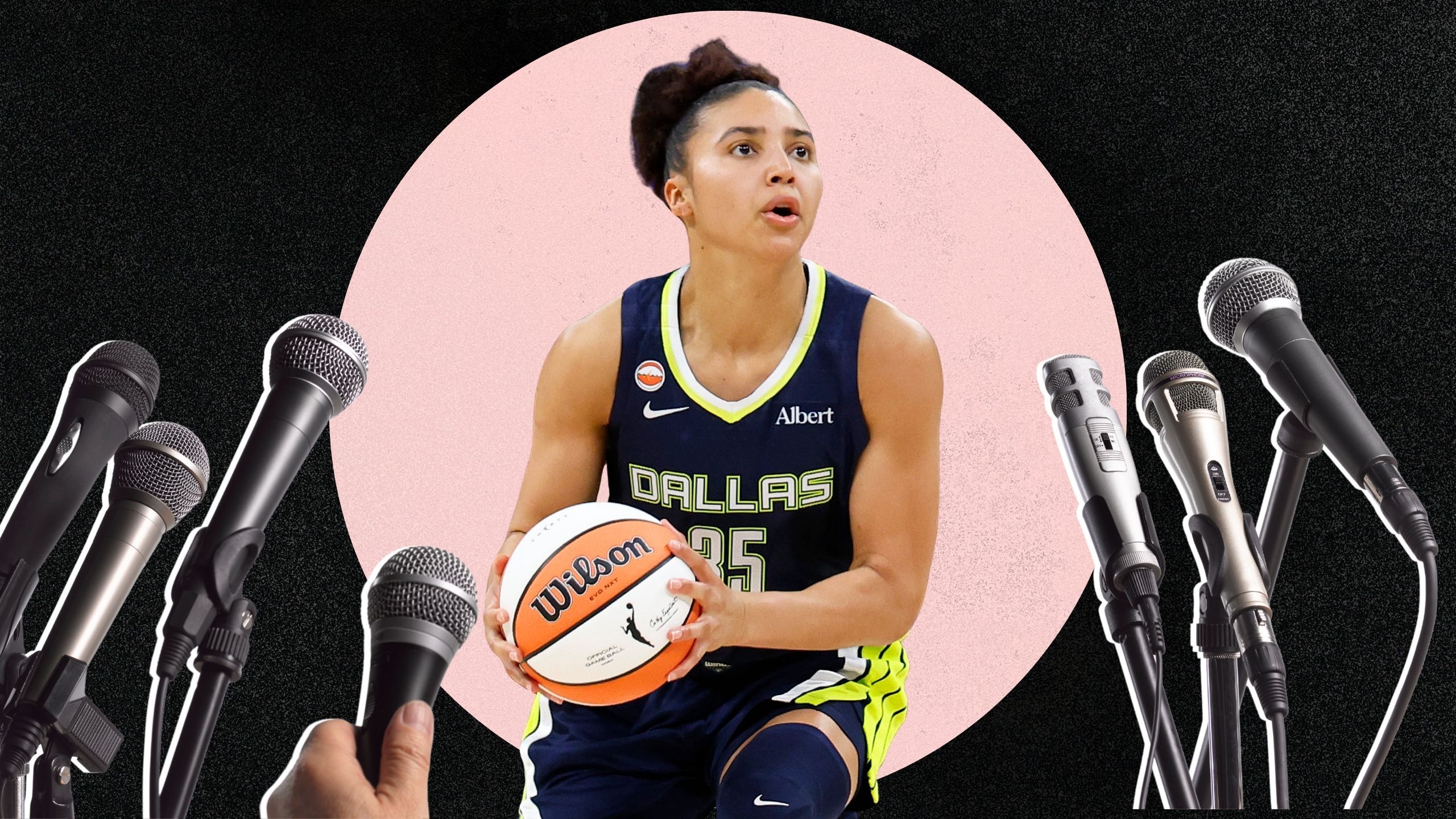
Azzi Fudd, the number-one pick in the 2026 WNBA draft, should have had an introductory press conference that solely focused on her becoming the newest member of the Dallas Wings. There was so much to talk about: being part of a young team that is in year two of a rebuild; her on-court reunion with college teammate Paige Bueckers; or whether she was excited to meet Lightning, the Wings’ pegasus mascot.
Instead, the presser was derailed by a question about her relationship status as it related to Bueckers, forcing the Wings PR person to shut down any further questions about Fudd’s personal life. A media firestorm ensued over the next week, as journalists filled both their social media feeds and their publications with arguments about whether the question was an appropriate one for the venue. Discussions about journalistic norms, queer cultural norms and what celebrities owe to the public dominated coverage that should have been dedicated to Fudd’s long-awaited arrival to the WNBA and her accomplishment of being drafted first overall.
Women’s sports have historically lacked media coverage. Now, as these athletes begin to gain mainstream visibility for one of the first the first times in history, the media is unprepared for how to appropriately cover them. Whether it’s veteran members of legacy outlets projecting outdated norms onto leagues like the WNBA or PWHL, or content creators and fan bloggers without proper skills or credentials entering the void created by a lack of coverage, there’s a huge issue when it comes to content and quality of women’s sports coverage. It’s athletes who pay the price.
In 2019, 95 percent of total U.S. television coverage, as well as ESPN’s SportsCenter, was focused on men’s sports. There was a similar disparity among social media posts and online sports coverage. These numbers were largely unchanged over the course of three decades, according to a 2021 study. And while viewership has increased exponentially over the last few years thanks to increasing coverage, the effects of the lack of media attention on women’s sports is still having an impact on how these athletes are covered.
With mainstream outlets largely ignoring the WNBA for the majority of its 30-year existence, independent outlets have largely filled the gap in coverage. Independent outlets are important to a healthy media ecosystem, especially for marginalized communities who deserve coverage that centres their lives and experiences. But alongside these small, independent publications, fan blogs and content creators stepped in as well. These accounts often have huge followings but lack journalistic skills like fact-checking and proper sourcing. Over the last few weeks, we saw several podcasts and influencers fuel rumours about Natasha Cloud being blackballed from the league for her political beliefs without any sourcing to back those claims up. The result was a media cycle dedicated to unsubstantiated rumours, forcing Cloud to debunk some of them directly on her own social media.
@xtramagazine The New York Times often writes about trans issues—but they rarely quote actual trans people in their coverage. That’s according to a new analysis by Assigned Media, which tracked news coverage of trans issues across 10 U.S. publications between January and April 2026 Assigned Media identified 214 stories from the New York Times that contained either the words “trans,” “transgender,” “gender identity,” “gender ideology” or “biological sex” during that time window. For comparison, Assigned Media found 130 stories in those same parameters by the Associated Press and 110 by the Washington Post. It’s important to note that those numbers correlate to a wide range of coverage areas: including news articles, op-eds, culture pieces and other stories that might briefly mention one of the target keywords. When it comes to stories specifically about trans issues, the NYT published 60 news stories focused on trans people, compared to 51 by the Associated Press and 25 by the Washington Post. Assigned Media was able to compare one metric across the board: how often actual trans people were quoted in stories about trans issues. The NYT came in last with just 20 percent of its news stories about the trans community quoting a trans person or representative of a trans organization. And many of the other mainstream news outlets didn’t do much better, with NBC News and the AP just ahead of them at 29 percent. This report follows a similar one from the Trans Journalists Association last year, which tracked news coverage of trans issues during Trump’s first 100 days. Their analysis found that only 30 percent of stories about Trump’s executive orders defining gender as biological sex quoted a single trans person. But not every outlet did as poorly as the NYT in Assigned Media’s findings. Fifty percent of NPR’s stories about trans issues featured at least one quote from a trans person, while independent outlet The 19th outperformed the rest with 70 percent. The New York Times has consistently been criticized for inaccurate reporting on trans issues that has had real ramifications on the rights of trans people in the U.S., so these numbers may not be too surprising. But this report helps to quantify how the newspaper disproportionately covers trans issues without trans perspectives. #lgbtqnews #mediaanalysis #transgender #assignedmedia #lgbtq ♬ original sound – Xtra Magazine Advertisement
The problem is that the line between journalism and content creation has become blurred, for both the public and the athletes. Coverage was often so focused on giving these athletes a platform that it became overwhelmingly positive; uncritically cheering on any women’s sport as Good and Worthy. Investigative reporting into the way the leagues were operating or the players’ labour conditions fell by the wayside. This has led to a fundamental misunderstanding of how the media is supposed to operate; any critical question becomes viewed as a “hit piece” and players form a distrust of the media because they had originally learned that its job was just to give them a platform for the public, rather than to ask hard questions.
When Annie Costabile became the Chicago Sun-Times beat writer for the Chicago Sky, she became one of the first full-time beat writers covering the WNBA. But players weren’t used to having a journalist hanging around all the time, and her relationship with the athletes and the organization soured as she continued reporting what she learned—good, bad and ugly. The league and its players have spent years lamenting the lack of equal coverage, but when offered that coverage, it’s viewed as an intrusion. The WNBA wants to be treated like its male counterpart, but bristles when the same level of scrutiny is applied.
And at the same time, players are right to be skeptical of the media. A new study found that during the 2024 WNBA season, ESPN publicly condemned racism while simultaneously amplifying it as entertainment via segments on shows like First Take, which capitalize on moral outrage. Analysis of the network’s coverage showed how the network deflected responsibility for racial sensationalism onto “trolls” and “the audience” while continuing to benefit commercially from the controversy it claimed to merely be reporting.
“The media has not always been great for me,” WNBA star Angel Reese, who has been the subject of intense media scrutiny and online harassment, said last month on Michelle Obama’s IMO podcast. “I’ll have a fine before I have to go to media [availability] and feel like my back is against the wall.”
In 2024, as coverage of Caitlin Clark’s rookie season had more eyes on the WNBA than ever before, the Women’s National Basketball Players’ Association (WNBPA) released a statement directed at USA TODAY’s veteran sportswriter Christine Brennan, condemning her biased and unprofessional reporting. Kevin Sherrington of the Dallas Morning News, who asked the question to Fudd about her relationship with Bueckers, is a longtime journalist, as is Gregg Doyel of the Indianapolis Star, who had his ability to cover the Indiana Fever revoked after having a creepy interaction with Caitlin Clark.
These issues are coming to a head going into the WNBA season. There are increasingly more eyes on the league as it expands to two new markets: Toronto and Portland, Oregon. The WNBA has a new media policy that seeks to address the issue of ensuring that only qualified media members are being credentialed for games and having access to players, but that isn’t a catch-all solution. But as I mentioned above, many of the problems in press conferences and scrum availability have come from the behaviour of longtime journalists who project norms from white cishet male-centred sports culture onto a league that is largely queer and non-white. Meanwhile, this new policy means longtime media members at smaller outlets who have done great independent coverage for years are now being shut out of credential access. At the same time, lifestyle accounts and influencers are being prioritized, as they were at this year’s WNBA draft, when Orange Carpet credentials were given to content creators over women’s sports outlets.
There is no easy answer to the coverage problem in women’s sports. The media is playing catch-up after decades of ignoring these leagues. But athletes and fans deserve better than biased, harmful coverage; they deserve better than coverage that is afraid to be critical of leagues who seek to profit off the labour and enthusiasm of the marginalized communities who make up the rosters and the fan bases.

 Why you can trust Xtra