“Feeling like the world is going to keep getting worse no matter what we do,” one of my mutuals posted on Bluesky the other night. I think I might have been the only person who pressed “like.”
Trump’s second election hurt. It felt worse than the first one, because you couldn’t tell yourself it was a mistake. Everyone knew exactly what kind of president Donald Trump would be when they voted him into office the second time. They knew that his most terrifying policies, like mass deportations, were not just empty promises. They voted for him because they knew he would do those things, and because those were things they wanted to do. And—if you were queer or trans, if you heard the Kamala is for they/them slogans or saw the campaign ads with trans women Photoshopped into sinister clowns—you knew that, at least in part, people had elected him to punish people like you.
It was entirely reasonable, given those circumstances, to feel beaten; to conclude that the worst and most hateful impulses of humanity would always win out over human decency; to look at the history of the world, which is (after all) one long story about powerful people exploiting and killing powerless ones, and to conclude that injustice was probably inevitable, and that there would always be more bad people than good.
This response was reasonable, but it was incorrect. I am coming to terms with hope now, as a necessity, and I am even starting to believe my hope is well-founded. I am writing this for people like my friend—people like me, around half the time—in the hopes of convincing them that hope is more than an old campaign slogan or a willed self-delusion. I don’t want the kind of hope that tells me everything is going to get better. I want the kind of hope that has teeth.
I hate being told to hope. I chalk it up to my childhood: my mother was insistently, almost maniacally optimistic, always spinning each new dire circumstance (abuse, divorce, poverty, gay kid getting picked on, etc.) into a story about how something wonderful was about to happen, and everything would be better any second now, and things work themselves out in the end, you’ll see. I once had a dream in which she and I were being herded to our execution by masked thugs, and she kept telling me that these strange armed men were probably just big fans of my writing and wanted to meet me in person. I maintain that this is a more or less accurate portrayal.
Someone had to take the view that the world was a hard place, that life was not fair, that everything didn’t always work out for the best, and in my view, as a child, that person was me. To this day, I have trouble summoning the kind of faith that fuels revolution. Something about getting together and chanting slogans like “I believe that we will win” makes me feel like I’m about to be looped into a multi-level marketing scheme for a vitamin supplement. I don’t think we’ll see utopia in our time. I don’t believe utopia can exist.
Yet activists have to give you hope—no one goes out and gets tear-gassed without it—and when they’re not doing that, they’re typically telling you to get angry. I don’t trust anger, either, not because it’s hard but because it’s much too easy. I am a naturally angry person, and I know that it’s good for quick bursts of energy, or for bravery, for the same reason it’s bad for your relationships and your health and your career and your life: anger makes you reckless. It makes you impulsive. It turns off your critical thinking, and your ability to parse nuance, and your self-doubt, until all you have is the urgent need to tear down whatever made you mad.
When political figures keep telling you to GET ANGRY GET ANGRY GET ANGRY, sometimes they really are trying to summon up outrage at injustice. More often, though, they’re trying to rile you up, because angry people can’t think clearly, and it’s easier to manipulate people who aren’t thinking. MAGA is nothing if not a cult of rage.
It hurts to be human right now, and real hope doesn’t arise from ignoring that pain. It comes from it.
I tell you all this because in politically committed queer circles, or on the endless spin cycle of social media, it can often feel like those two emotions—rage and hope and rage and hope and hope and rage—are the only permissible reactions. Either you’re mad about how bad things are, or you’re planning to make them better, and that’s it. There’s no room for the other, stickier emotions that arise in the face of fascism: helplessness, or terror, or disgust at your fellow human beings, or just the mounting certainty that you can’t take one more second of this, that you need to find some way to cut it off or numb it out so that you can get through the day.
Those feelings are unproductive. They make you feel weaker instead of stronger. Instead of speeding you up and forcing you to take action, they make you slow down and sit down and stop. For all those reasons, it is tempting to avoid them.
I am telling you: Don’t. The useless emotions, the ones that no one is telling you to have, that can’t be engineered to fit anyone else’s cause or narrative, are the ones that make you human. It hurts to be human right now, and real hope doesn’t arise from ignoring that pain. It comes from it. It comes from looking around and noticing how many people are right beside you, feeling the exact same things.
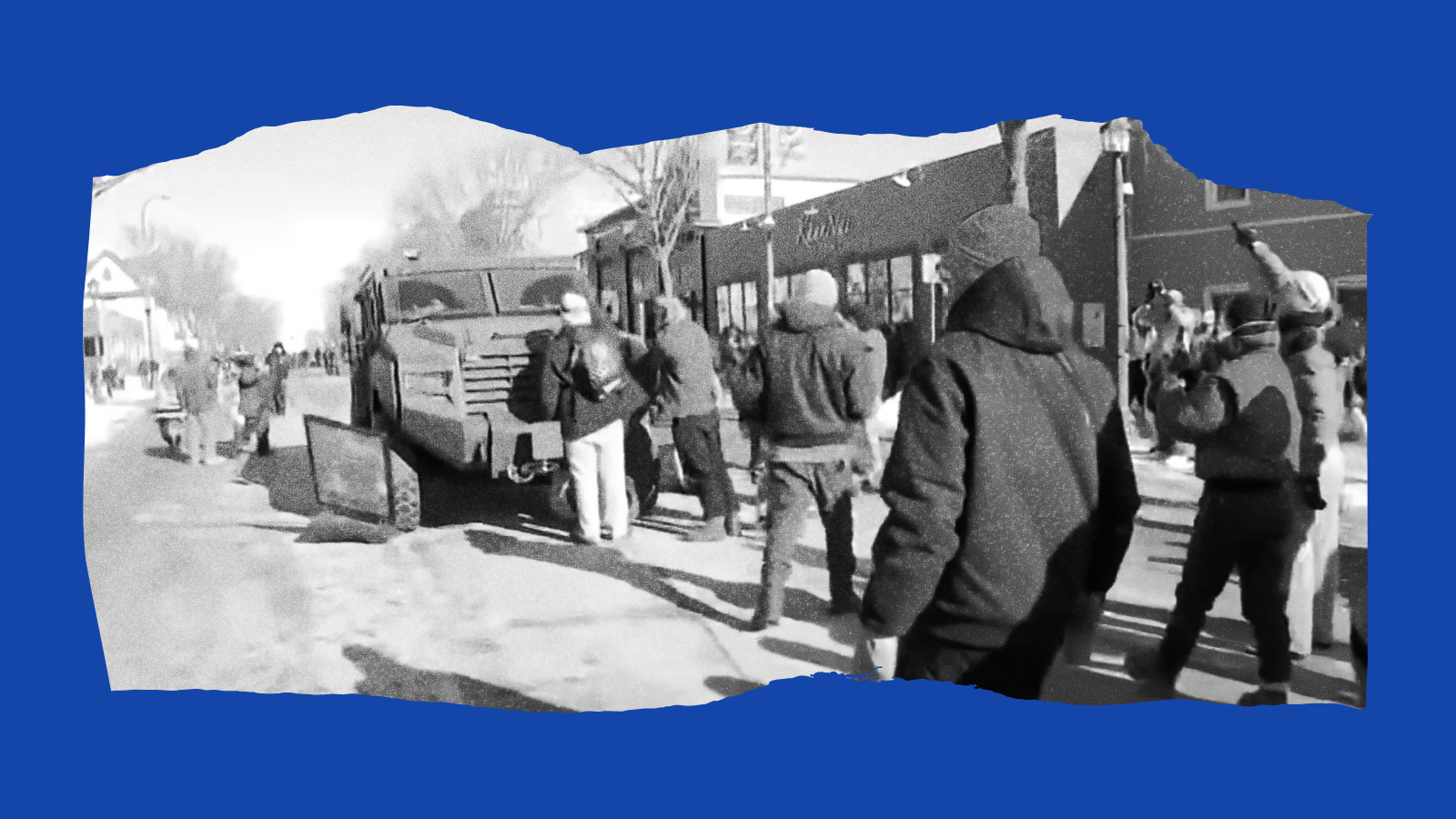
The moment it all clicked into place for me was the video of the pedestrians blocking the truck. I don’t know if you’ve seen the viral footage, or if you remember it. An armoured ICE truck attempts to go down the street, somewhere in Minneapolis. One masked pedestrian steps out in front of the truck. Then three or four more people do the same. Then several dozen people are surrounding the truck, and it cannot move.
Make no mistake: tons of organizing went into that moment. Many activists with charisma and logistical know-how and slogans and smoothly coordinated talking points (I’m guessing they were about hope—or anger, maybe) put the work into mobilizing and training the populace, until there could be a completely non-violent and effective intervention in which a randomly assembled group of unarmed civilians knew exactly how to impede the progress of an armed government vehicle.
But here is the part that mattered to me: every single person who stepped out in front of that truck did so knowing it might kill them. This intervention took place after the shooting of Alex Pretti. It took place after the shooting of Renee Good. In both cases, civilians were killed in the street simply because individual ICE agents felt threatened or angry—two things people are notoriously prone to feel when a crowd of protesters surrounds their vehicle—and there was no guarantee the agents driving the truck wouldn’t just accelerate and mow them down.
But they just stepped forward, one after another. It wasn’t an airy-fairy act of spiritual bypassing, nor was it an explosion of rage. It was just one person after another saying no, and being willing to back that no up with their lives, and sooner or later, there were too many of them for one truck to move. Sooner or later, there were too many of them for multiple trucks to move. Sooner or later, there were 50,000.
@xtramagazine 2025 was a rough year for queer and trans people. So let’s name and shame the individuals and organizations that made headlines for the worse. From Bari Weiss’ rise to the top of CBS News, to Action4Canada’s anti-LGBTQ2S+ advocacy, and ICE wreaking havoc across the U.S, these are some of Xtra’s “shady bitches” of 2025. #lgbtqnews #yearinreview #queernews #lgbtq ♬ original sound – Xtra Magazine
I’m not saying that those people fixed everything. ICE is still operating. ICE is still killing people. We may never know exactly how many people they have killed; details about shootings that were covered up months ago are still floating up into the headlines. The history of humanity is a history of violence and injustice and exploitation and oppression, and it always has been, and you and I will likely be seeing new forms of injustice and violence until we die. If we’re really unlucky, we’ll keep on seeing the old ones, too.
But the thing in me that says no, the thing in you that says I won’t permit this, the thing that put all those people in front of that truck: that’s real, too. People do not like living this way—in fear and anger and disgust, subject to the whims of powerful and terrible people who regard them as subhuman—and so, the history of human injustice is also a history of injustice continually being thwarted and met with resistance, of uprisings and rebellions and people finding small, creative ways to care for each other under the worst conditions.
I am not telling you that the world will change one day and become kind; you live here, just like I do, so you know the odds. What I am telling you is that the next time I see a way to say no, I plan to take it—and if you take the next opportunity you see, that’s two people refusing, and two is better than none, and that number just keeps growing. My hope is not for the world or the future. My hope is for us: that we can live each day refusing to tolerate the intolerable; that the worst the world can offer is powerless to drown out the best of who we are.

 Why you can trust Xtra