Just weeks after Pride Toronto revealed a nearly $1 million drop in corporate donations for this year’s festival, the Vancouver Pride Society (VPS) came out with similar poor tidings.
More than $400,000 in business contributions have been withheld since last year’s festival, says John Boychuk, co-chair of the VPS—the organization responsible for putting on the largest Pride on Canada’s West Coast. That’s about half of its 2024 total of $900,000 in corporate donations—an amount that made up a third of their total budget.
“What’s happening south of the border has had a definite impact,” says Boychuk, referring to U.S. president Donald Trump’s election and his administration’s hostility toward diversity and inclusion spending. “Prides around the world are being affected by policies coming out of our southern neighbour.”
To compensate, the VPS is shortening the parade—meaning lower fencing and security costs—as well as cancelling some events. A drop in corporate giving and the spectre of Trumpism are not the only threats to Vancouver Pride.
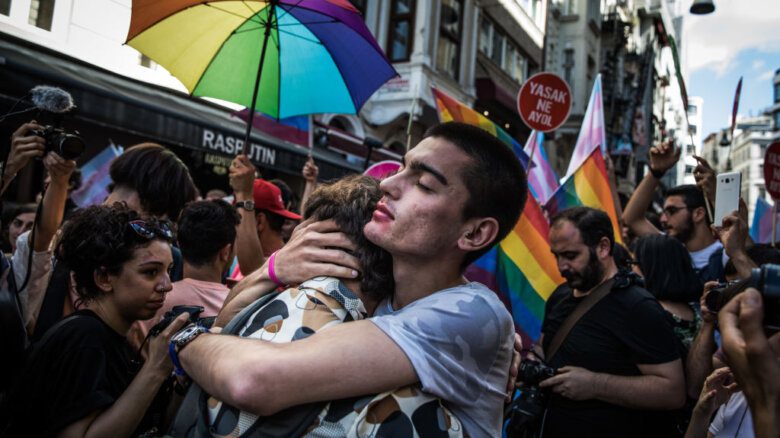
The festival’s challenges began in earnest last year when about 20 to 30 pro-Palestine protesters disrupted the parade, forcing it to end early. The protestors accused the VPS of taking money from corporations that contribute to state violence against Palestinians.
The derailing of the parade caused a several-week fallout internally with the VPS, with members and volunteers debating the decision to end the parade early and the goals of the VPS as they relate to local versus international issues, Oger and Boychuk say. These tensions culminated in members of the VPS’s leadership team and board members choosing to resign.
“It strained the board deeply and the organization kind of fell into disarray for a number of months,” says Morgane Oger, board secretary for the VPS.
Both Oger and Boychuk are part of the new wave of organizers that has come in to get 2025’s Vancouver Pride festival over the finish line.
“After last year’s challenges, there was an opportunity for individuals to come on back and provide a little of history, knowledge and experience,” says Boychuk, who first joined the VPS 28 years ago, serving for seven years first as vice-president then president.
Still, a new team and previous experience can only make up for so much. Oger says that a number of grants had been missed because of the large-scale changeover of those inside the VPS.
“These things came to a head, and we realized that there was a risk that Vancouver Pride would not happen at all this year,” says Oger.
For example, while Vancouver Pride 2023 and 2024 were able to capture about $1.1 million and $750,000 in grant funding respectively, Oger estimates that 2025’s festival only has about $500,000 of grant money to work with.
On top of that, the federal government had ended some programs the VPS had come to financially rely on—such as employment grants for staff.
Instead, new, more local partnerships were formed. Vancouver’s West End Business Improvement Association and QMUNITY, a resource centre for LGBTQ2S+ people in B.C., came in to cover the costs of a day-long festival on Davie Street—the main artery of Vancouver’s gay village—during the festival’s August 2-3 weekend.
“The people behind these organizations are coming together and working far beyond their own bandwidth to make something happen for this community, and that’s great,” says Michaël Robach, development director at QMUNITY.
It’s fitting, Robach says, that QMUNITY is re-engaging with Pride, since the non-profit used to plan the festival before the VPS grew into its own entity in 1990. However, that independence is challenged by these dwindling funds—and not just from businesses. “There’s been a pretty intense clawback in funding on all levels of government, corporate giving and individual giving,” Robach says.
But it’s the lack of support from governments that Robach finds particularly aggrieving. “None of this is possible without governments and granting bodies, because this is not work that people can do for free,” he says.
On this point, Vancouver Pride is certainly on its back foot. Last year, the VPS received $115,000 through a provincial funding program for fairs, festivals and events. This year, 2025’s festival is receiving only $45,000 from the province, says Oger. As for the City of Vancouver, this year the VPS are receiving a $75,000 grant—just 2.6 percent of their total 2024 revenues. To compare, Fierté Montréal got almost $1 million from the City of Montreal—about 15 percent of their total revenues.
While the City is giving funds to the VPS, it’s also charging. Oger estimates a $200,000 bill will come from the City for fire, police, barricading and other services after this year’s festival. The costs of all these services are also on the rise.
If the VPS’s financial and organizational issues weren’t enough, they’re also bracing for another disruption similar to last year’s protest.
“We have worked very hard to ensure that conversation and dialogue has been open, and we are doing everything we can to provide a safe, inclusive environment,” says Boychuk. “At the same time, it’s Vancouver Pride who is in control over this—nobody else. Nothing is knee-jerk, nothing is reactionary.”
The VPS has released a “parade interference guideline” detailing that any disruptors will be given five minutes to make their statements and will be able to meet with VPS leadership. If they don’t voluntarily clear the parade’s path after that, police may become involved.
Though they’re not calling for a protest or in-person disruption this year, groups like the Queer Collective for Palestine (QC4P) and Queers Against Israeli Apartheid say their conversations with the VPS have gone nowhere. As such, they are asking members of the community to boycott Vancouver Pride—a call being echoed by other organizations like Rainbow Refugee—and write in with several demands. These include that the VPS remove “carceral” (police, military, other enforcement bodies) presence at Pride, that they disclose funders or partners with any ties to Israel and that they ban “Israeli propaganda” from the parade.
“VPS has turned into this conglomerate structure, and it’s become hard to separate VPS activities from supporting drag artists and mutual aid efforts for the queer and trans community,” a QC4P spokesperson tells Xtra. (The spokesperson has asked not to be named, as pro-Palestine protesters have been targeted by academic institutions and otherwise.)
The VPS resists this characterization, saying that these types of demands—like having no police presence—could not be met because of the “constraints of the law and liability,” says Oger.
“We also have financial obligations,” she continues. Oger agrees that the VPS could host a corporate-free Pride for a few thousand people, but not for the estimated 100,000+ people who come to Vancouver to celebrate. “And so we find ourselves in this tension where we want to have a dynamic, amazing Pride event with all the rich components of our communities, while at the same time protecting the events from disruptions that are over the top.”
The QC4P spokesperson says that going smaller isn’t necessarily a bad thing, pointing out that the dyke and trans marches in Vancouver have met their conditions and are not part of the group’s boycott.
When it comes to size, though, the VPS may have no other choice than to shrink or even cancel the festival if conditions don’t change. Be it due to Trump, these protests or other influences, the fact remains that corporations and community members are reducing contributions at a time when costs are going up—and governments aren’t yet jumping in to save the day.
Despite all this uncertainty, Boychuk believes we as queer and trans people will still celebrate each other.
“Whether or not there is a Vancouver Pride Society, the Vancouver community will still march. We will still gather. We will still elevate. We’ll find a way.”

 Why you can trust Xtra