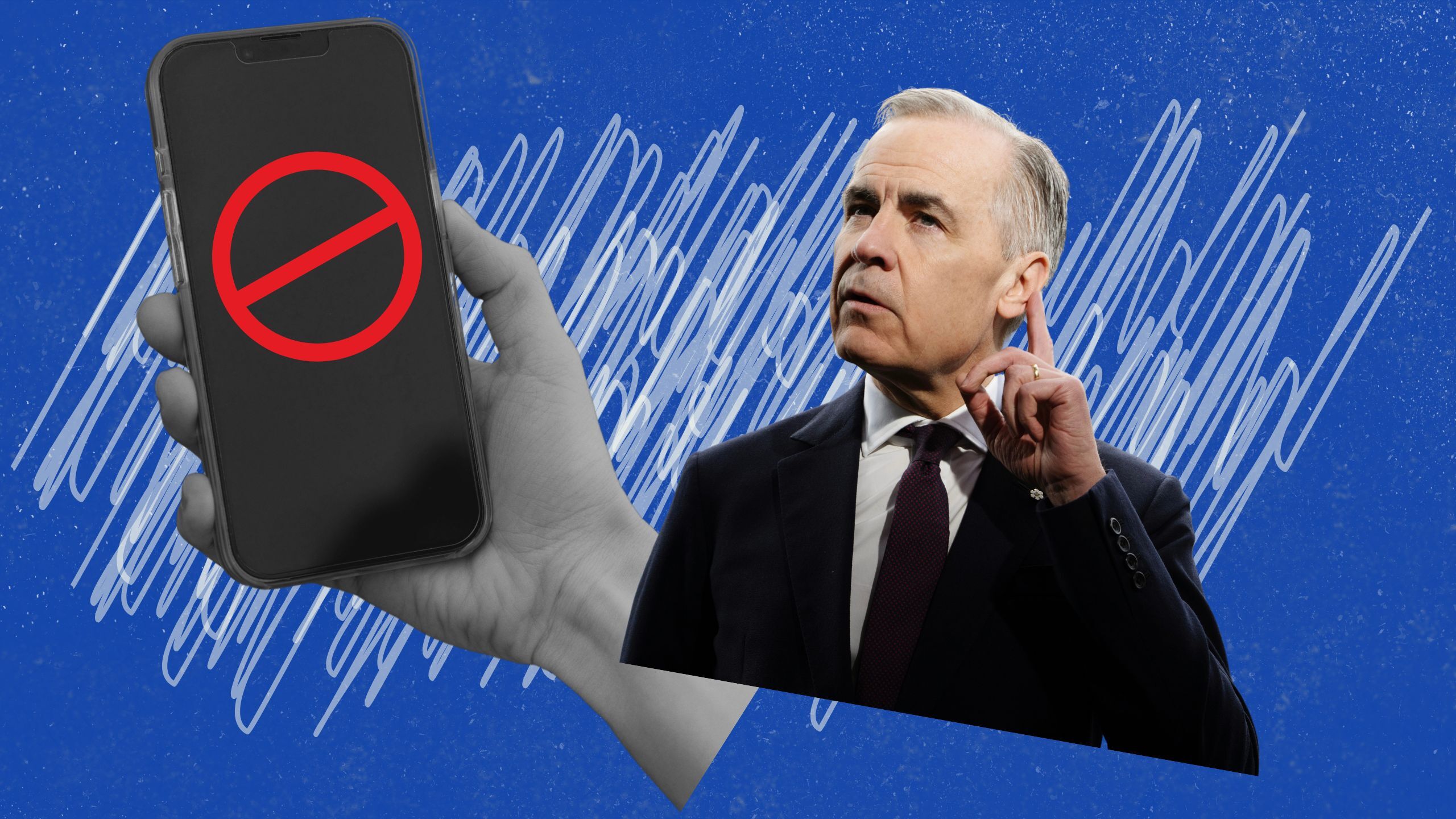
Last week, Prime Minister Mark Carney said his government is open to debate on a ban on social media for minors as part of their upcoming online harms legislation, something that other countries are also experimenting with, considering that the harms of these addictive platforms have become fairly self-evident when it comes to mental health outcomes. It may sound like it may be a worthwhile cause on the surface, but dig a little deeper, and you will see a lot of problems lurking that will affect everyone on the internet, not just children and youth, and it will most especially affect queer and trans people.
Banning social media will affect queer and trans youth disproportionately, as these platforms may be the only place where they can help figure out their sexuality or gender identity, and in some cases, the only place where trans youth have been able to access information on transitioning. This, of course, has given certain transphobes the notion that social media fuels the so-called “social contagion theory,” supposedly brainwashing teens into transitioning, even though this has been widely discredited. The flip side is that queer and trans youth also face bullying over social media, but for some, they have viewed their time on social media platforms as a lifeline.
There are a multitude of issues at play here, beyond the issue of teen mental health. Part of this has to do with the responsibility of platforms like Meta to provide a safe environment for these youth, which they are clearly failing at. Research has shown that they are not living up to their promises for safety features, which are entirely absent in many cases. And rather than actually do the work of policing their own platforms, Meta is instead trying to convince the federal government to force app stores, like Apple’s and Google’s, to do age verification for them, as though the only way to access social media is through phone or tablet apps and not on a desktop browser. But age verification itself is an enormous problem.
There is a push right now in many countries, including Canada, to force age verification onto the internet as a means of “protecting” children and youth from things like online porn. One Canadian senator, Julie Miville-Dechêne, is on her third attempt at a Senate public bill after the previous two died on the Order Paper when elections were called, and continues to both ignore the problems with age verification, particularly when it comes to the privacy implications. The technologies proposed to conduct the age verification could include facial recognition, biometrics, or “age estimation,” which is woefully inadequate when you are trying to distinguish between a 17- and 18-year-old, and is especially unreliable for people of colour and trans people. There are also concerns that trans people would need to out themselves for this verification, which is made even more vulnerable in places like Kansas where trans people’s driver’s licences were suddenly invalidated.
Privacy implications for those kinds of services are immediate, as to whether facial recognition or even “age estimation” companies are storing the information, and there have been plenty of examples of companies who claimed they were not storing that information when they were. The alternative notion that one needs to use a third-party service to show them your ID in order to get a digital token that confirms your age verification is likewise a privacy nightmare and huge vulnerability, which again gets waived away by the senator and her supporters. Recently, when Discord used a third-party service for their age verification, hackers breached that system and compromised 70,000 users’ ID. Law professor Michael Geist refers to the dismissal of these concerns as a “nerd harder” problem, where proponents believe that tech people can just fix the problem if they try hard enough, which is absolutely not the case.
@xtramagazine Advocates in Alberta are kicking off 2026 by heading back to court to challenge the Alberta government’s ban on gender-affirming care for minors. And this time around, they’re trying a new tactic to circumnavigate Alberta premier Danielle Smith’s use of the Notwithstanding Clause. Last June, the advocacy groups Egale Canada and Skipping Stone Foundation—on behalf of five Alberta youth and their parents—successfully won a court injunction to pause the law banning gender-affirming care for minors, arguing that the law violated trans youth’s rights under the Charter of Rights and Freedoms. However, that injunction was halted after Smith’s government invoked the notwithstanding clause to force through its three anti-trans laws. Eagle and Skipping Stone returned to court in Alberta this week to argue that the law targeting gender-affirming care is about criminal penalties and therefore actually falls under federal jurisdiction, not the province’s. In their application to the Alberta Court of King’s Bench, the groups argue that because the law includes criminal penalties for doctors and other medical professionals who administer gender-affirming care to youth, it’s actually federal responsibility, and Smith and her government have no business creating criminal penalties like this. And to be clear, there is precedent for this approach. In 1993, the Supreme Court of Canada ruled in R. v. Morgentaler that provincial legislation restricting abortion access was unconstitutional because it amounted to criminal law. #alberta #albertanews #canada #lgbtqnews #canadanews ♬ original sound – Xtra Magazine Advertisement
But for queer and trans people, including adults, age verification poses bigger problems. For one, even innocuous LGBTQ2S+ materials can be age-gated because companies are afraid that they will be fined by governments if there are complaints that this material is considered “adult,” even though it’s not. If you look at the current moral panic happening in Alberta over book bans, a large portion of those books that are banned have queer or trans content that isn’t sexual, but have nevertheless been the subject of complaints by far-right groups like Action4Canada or Parents for Choice in Education. There is a long history in this country of queer and trans materials being considered “obscene” by government agents, even when it’s not. When we talk about age verification for the internet, rest assured that once age verification to ban youth from social media is put into place, it will immediately be extended to keep youth from accessing online porn, at which point queer and trans people will find themselves butting up against these demands for verification for things that absolutely should not require it.
There is no doubt that more needs to be done when it comes to regulating these social media platforms, so that online harms are minimized, and there are mechanisms that force platforms to ensure that there are child-safe versions available. The Trudeau government had been prepared to impose this on platforms, but that bill died on the Order Paper, and now the Carney government is taking a different approach—tiptoeing around the tech bros, and sucking up to them wherever possible, most especially when it comes to the digital asbestos that is AI. The minister of Artificial Intelligence, Evan Solomon, went so far as to promise the digital asbestos industry that he would ensure a “light touch” when it comes to regulation, because he swallowed their claims that regulation would “stifle innovation.” It’s also why he’s been little more than theatrical when it comes to dealing with OpenAI in the wake of the Tumbler Ridge shooting, given that there is evidence that the shooter’s use of ChatGPT was raising red flags with the company. Nevertheless, Solomon is insisting that these platforms be allowed to police themselves while making the empty threat that “all options are on the table.”
At this stage, I am concerned that the government is willing to consider age verification as their way of showing that they are concerned about youth on social media, even though the Trudeau government was opposed to the Senate bill on age verification for all the right reasons. But Carney isn’t Trudeau, and he has shown no compunction on overturning long-held Liberal positions when it comes to protecting Charter rights if he feels it expedient (see: lawful access), and this very well could be another one of those reversals, no matter the consequences to those who will be severely affected by it.

 Why you can trust Xtra