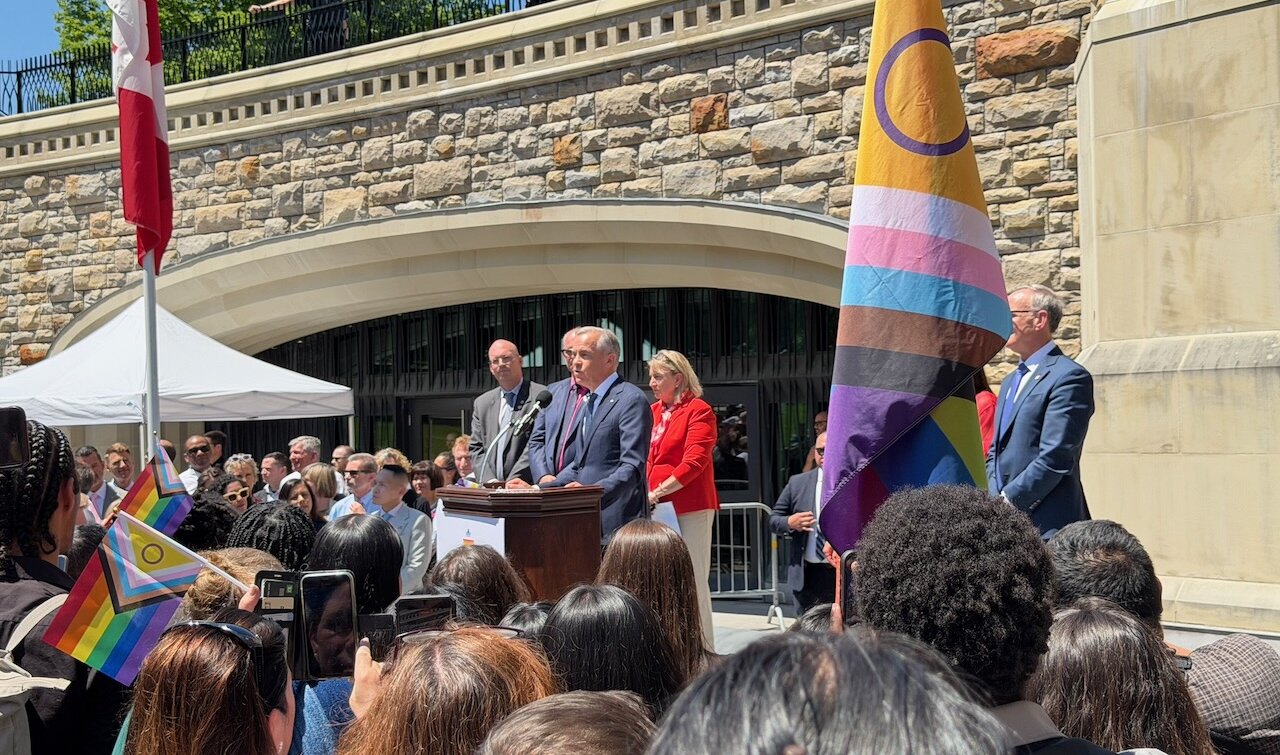
At the Pride flag raising on Parliament Hill on Tuesday, local activists and onlookers mingled with staffers, MPs and senators in the hot sun while waiting for Prime Minister Mark Carney to arrive. A group of Conservative MPs were present, including out lesbian MP Melissa Lantsman, though none would dare be photographed on stage at the end of the event. A pro-Palestinian protester tried to shout down Carney before being escorted away. At the back of the crowd, one of the dregs from the so-called “Freedom Convoy” who never really left Wellington Street, stood at the back, holding a sign that read “Trans Women Are Men” with a smug smile on her face.
Carney’s speech was fairly anodyne, praising the history of the Pride flag and its universal message of inclusion, along with a bit of self-congratulation that this was the 11th year that a Pride flag-raising had been held on Parliament Hill, and that no matter who you love, you have a place in Canada.
“Our fundamental insight as a country is that unity does not require uniformity, that our differences are strengths to be nurtured, not risks to be managed, that the visibility of our differences is not an obstacle, but the substance of belonging and our mutual respect,” Carney said.
Carney noted that the queer and trans community needed to fight for every right that they won, and that it was only in 1969 when Pierre Trudeau (partially) decriminalized homosexuality, and that civil marriage passed in 2005, making Canada one of the first countries in the world to recognize marriage equality. We now have more openly queer people in public office, including mayors, MPs and senators.
He did say that we are in a world with more division and growing intolerance, and that while Pride is a celebration, there remains a need for vigilance lest rights be rolled back.
“Our government has determined that everyone who wants to celebrate Pride can do so safely,” Carney said. “In the last budget, we committed ongoing, stable funding to ensure safe Pride parades across the country—and I’m looking forward to taking advantage of that in a few short weeks.”
But the money he spoke about is not new money introduced by the Carney government. The press release from Women and Gender Equality described it as Minister Rechie Valdez highlighting “an investment of $3 million over two years,” but if you read farther down, this is the remainder of the $7.5 million over five years allotted by the Trudeau government. It’s part of the Carney government’s pattern of giving out small pots of money that are time-limited and make it easy for them to starve needed programs for women, racialized communities, disabled people and LGBTQ2S+ communities.
There was no mention of the funds that Pride organizers were in Ottawa to ask for in March. They are facing tougher financial circumstances with growth in audiences without added revenues, and that many of their remaining sponsors are being hit hard by Donald Trump’s trade war, meaning companies have less to give to Pride organizations. Instead, it was just the government patting themselves on the back for those funds that were committed by the Trudeau government, and the “ongoing” funding is the existing $1.5 million for security, not programming or other event costs.
In a recent blog post, University of Calgary economist Lindsay M. Tedds described this as being the equivalent to the workhouse from a Charles Dickens novel—the workhouse promises care and delivers starvation.
“The state institution claiming to serve a population systematically under-provides for it. The administrators measure adequacy against their own provision—there is no external standard by which the gruel could be evaluated as inadequate, because the Board of Guardians designed the gruel allotment in the first place,” Tedds wrote.
Tedds highlighted how this works for communities—the funding is inadequate, but they are expected to thank the government for what was delivered. The political class reads the thank-you as confirmation that the file is closed, because saying “this isn’t enough” means you are “never satisfied” and moving the goalposts. The gratitude performance becomes the ceiling for the next request, and whatever was accepted as a win is the baseline for the future.
“2SLGBTQI+ organizations are expected to thank Ottawa for the line about LGBTQ+ community centres being eligible for the $75 million Canada Community Security Program, while the actual 2SLGBTQI+ Action Plan funding expires without renewal,” Tedds explained. “The acknowledgment is the gift. The funding is somebody else’s problem.”
This extends to the government’s retreating commitments internationally. As anti-LGBTQ+ laws accelerate around the world, particularly in Africa, Canada is stepping back and cutting foreign aid funding, even though Carney patted himself on the back during his speech.
Dignity Network Canada executive director Doug Kerr was at the flag-raising, along with several activists from other countries who were in town for the Network’s conference.
“I’m happy that they raised the rainbow flag, and I’m very happy that the prime minister spoke about Canada being a beacon in the world for human rights for LGBTQI people,” Kerr says. “For all of us that are here from all around the world, this is very meaningful, but one of the things we would really like to see is the Canadian government explicitly explain how it will continue to point out gay rights in its foreign policy, an international assistance policy and follow through on commitments that they’ve made.”
Kerr says that the organization remains hopeful as they have had meetings with government officials over the week, but there is a lot more for the government to do. Because the Trudeau government never went ahead to create a special envoy for LGBTQ+ issues internationally, in spite of one of his cabinet ministers lobbying hard for them to do so, we have even less of a voice internationally now that the Americans have retreated from the world stage.
Carney shows no signs that he plans to follow up any of the words he spoke with actions, making it hard to believe that his support for Pride is anything more than the absolute bare minimum as prime minister. Canada deserves better.

 Why you can trust Xtra