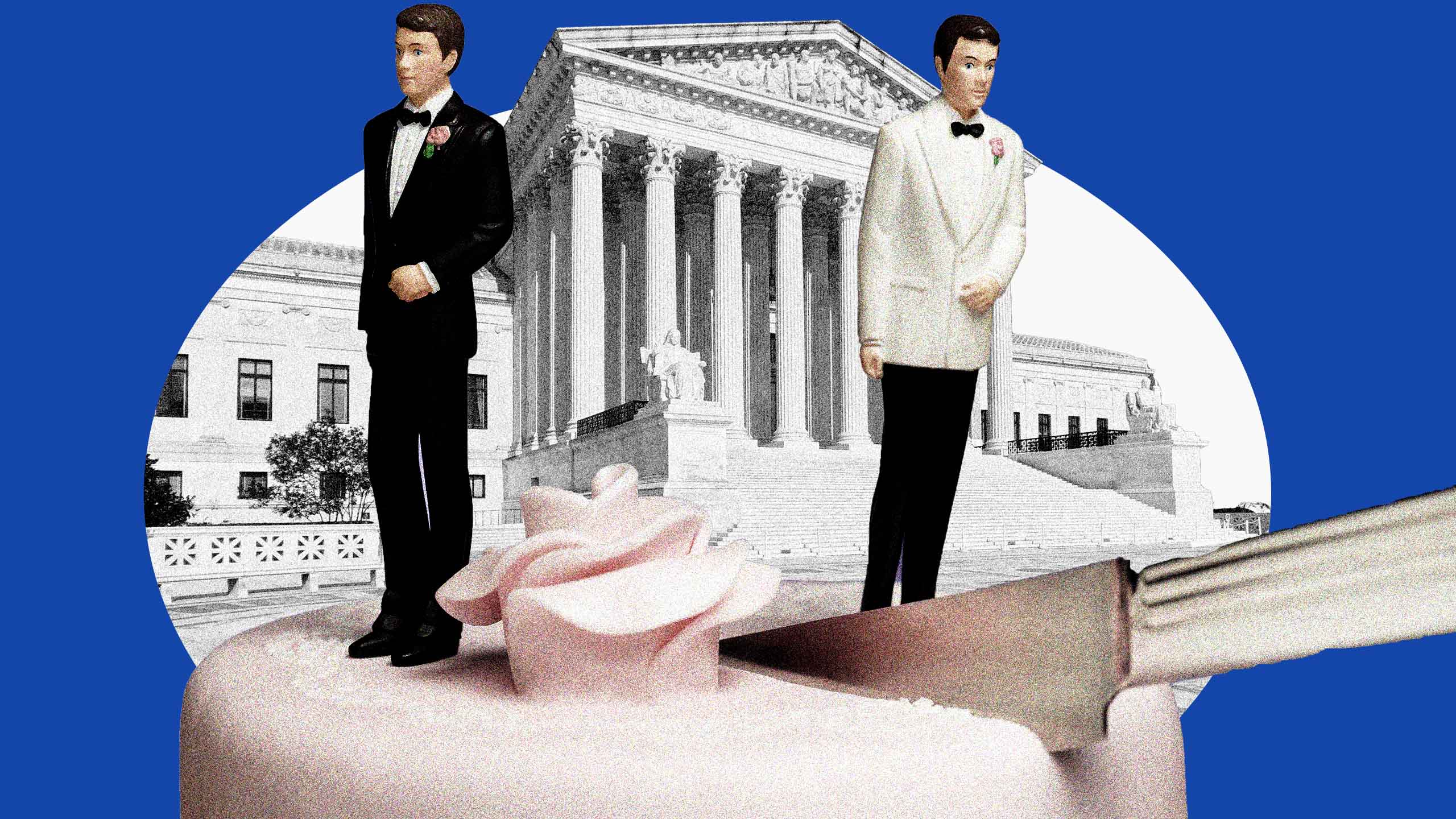
Last week, Kim Davis—famous homophobe, former Kentucky court clerk and answer to the question “What would a mushroom look like if it were poorly disguised as a person?”—formally petitioned the Supreme Court to revisit Obergefell v. Hodges, the case that established marriage equality in the United States ten years ago.
“Supreme Court formally asked to overturn landmark same-sex marriage ruling,” ran one widely circulated ABC News headline. Dozens of others—“Kim Davis wants the Supreme Court to join her crusade against same-sex marriage” (MSNBC); “Supreme Court faces decision on case urging overturn of same-sex marriage” (Newsweek); “Would this Supreme Court ever overturn gay marriage?” (New York)—soon followed.
All of this—according to the ACLU’s James Esseks, who was counsel on Obergefell and a half-dozen other landmark rulings—is a lot of noise over not much happening.
“There are thousands of petitions for review filed before the Supreme Court every year,” says Esseks. “This is one of them.” Though he warns against assuming that Obergefell is “safe”—no one’s civil rights are safe in 2025—he also believes that Kim Davis’s case is not one the court will use to overturn it.
Davis’s story, for those unfamiliar, is that in 2015, she refused to certify same-sex marriage certificates in her work as a county clerk, citing “religious objections.” The problem is that, as an elected official, she was acting on behalf of the state, which cannot hold religious preferences. This has been confirmed by multiple courts on multiple occasions. “The courts, including the Sixth Circuit Court of Appeals, which is a comparatively conservative federal appeals court, has heard her appeals on her case three times and each time said no. Her claims are very weak,” Esseks says. “So it doesn’t make sense that this would be a context in which the court would say, ‘Hey, we’re going to go and revisit whether Obergefell was rightly decided.’”
Davis is a bigot, but she’s also a chronically unsuccessful bigot, and that matters. The petition is likely frivolous; it has successfully generated a round of discussion, but outside of that, it is—like everything else Kim Davis has done with her life—a waste of time.
Still, you can hardly blame people for being jumpy. Since 2016, Donald Trump has effectively stacked the court with a conservative majority that appears poised to rubber-stamp all of his decisions. The most high-profile queer rights case of the year, United States v. Skrmetti, ended in the court upholding the constitutionality of bans on gender-affirming care for minors. The very recent overturn of Roe v. Wade in the Dobbs case would seem to signify that nothing is sacred.
Moreover, there really are conservatives who are intent on overturning Obergefell. Supreme Court Justice Clarence Thomas has expressed an interest in revisiting the case, because he is old and full of hatred. As chronicled by Samantha Riedel at them, multiple Republican legislators have also put pressure on the court to review the case.
Those who believe Obergefell is relatively safe point to its broad-based popularity, even among Republicans—in 2024, 69 percent of Americans supported marriage equality, including 46 percent of Republicans. The court would have to contravene public opinion to revoke marriage equality. But that argument is shaky, given that Roe v. Wade was also a broadly popular decision; as of 2024, 63 percent of Americans and 85 percent of Democrats believed abortion should be legal in all or most circumstances, and we lost the federal right to abortion anyway. Moreover, even though the number of Americans who support marriage equality has grown in recent years, the overall number of Republicans who support it has been going down, and is now below 50 percent.
For a queer community that is increasingly spread thin, trying to deflect multiple existential threats at once, it’s important to be able to prioritize and do triage—and Obergefell is not in critical condition at this time.
For one, says Esseks, the Obergefell ruling was heavily based on Loving v. Virginia, the 1967 case which established the right to interracial marriage—overturning one might require overturning the other, and even in an increasingly white supremacist administration, that’s a tough sell. Furthermore, the 2022 Respect for Marriage Act would preserve some marriage rights for queer couples even if Obergefell were overturned—though the bill does not guarantee the right to marry, it does mandate federal recognition for all legal marriages, regardless of where they were performed. Even if we reverted to a pre-Obergefell arrangement wherein only some states allowed same-sex marriage, a queer couple married in Vermont would still have marriage rights if they went back to Idaho after the ceremony.
If you believe, as many of us do, that the current Supreme Court mainly serves to give a veneer of legality to Trumpism, then it doesn’t make sense to expect it to rule from the centre. The wing-nutty, polarizing far right is where Trumpism lives, and where its decisions are made. But even those radicalized, far-right pushes require time and planning, and there is typically at least some effort made to sell them to the public. Roe v. Wade was the target of a decades-long offensive that made abortion an electoral third rail and steadily shifted the Overton window to the right on reproductive freedoms. More recently—and much more rapidly—a major media offensive against trans youth, conducted by the New York Times and others, successfully polarized the public against gender-affirming care for minors, and laid the groundwork for the court’s ruling in Skrmetti.
Decades of normalization—marches, protests, memoirs, Modern Family episodes—made “gay marriage” appear uncontroversial, and thus paved the way for Obergefell. It’s not impossible that a Republican counter-offensive will sour the public on marriage equality, but if precedent holds, we could expect to see that before a formal ruling to overturn, not afterward.
“My focus right now is on how do we learn lessons from what has happened? How do we adapt to this information environment? And how do we go out and win this fight?” says communications professional Laurel Powell.
Powell knows whereof she speaks: she defended one endangered Supreme Court ruling in its final days, through her work with Planned Parenthood, and she now works for the HRC. If Obergefell were in imminent danger, I would trust her to tell me, and she doesn’t see that danger yet. Powell does point out, though, that even as Davis’s petition soaks up all the press attention, there are several other LGBTQ2S+ rights cases that the Supreme Court has decided to hear, including a challenge to Colorado’s conversion-therapy ban which could end up giving the formal stamp of approval to abuse of queer youth.
Again, this doesn’t mean gay marriage is “safe.” Nor does it mean that the attacks on it are “a distraction.” In the everything-everywhere-all-at-once madness of Trump 2.0, nothing is safe, and everything matters. What it does mean, though, is that we can expect the Supreme Court to continue targeting the most vulnerable and least-defended members of the queer community, and that rallying all of our resources and press attention behind Obergefell does a disservice to those other queers.
“We just have to stay focused on the things that we can move now. I would much rather focus on having a friendlier media environment for trans people, you know, a year or two down the road,” Powell says. “That’s something that will benefit us no matter what’s in front of the Supreme Court.”
As for marriage, get married if you want to. It’s your right, at least for the time being. But of all the things we stand to lose, as a community, this one thing is still relatively secure. Many, many other things aren’t, and we can use the few pieces of safety to give us strength for all the battles up ahead.

 Why you can trust Xtra