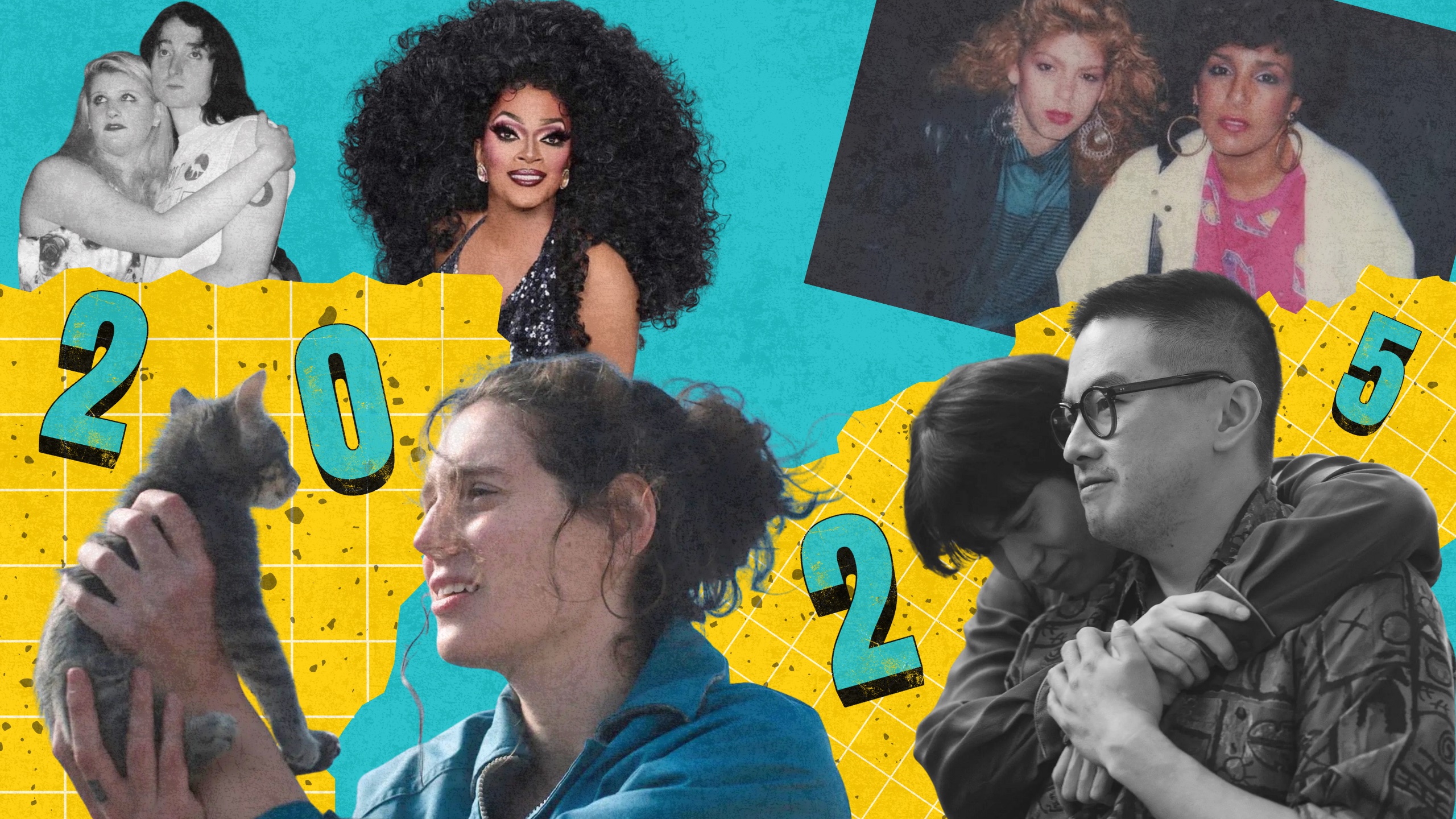
From the pain and grace of Sorry, Baby to the lovely romance of A Nice Indian Boy, 2025 has been a landmark year for queer and trans film. Here are the Xtra team’s picks for the very best LGBTQ2S+ movies of the year.
The Wedding Banquet
While 2025’s The Wedding Banquet is officially a remake of the 1993 film of the same name, there are only superficial connections between the two movies—including a green card wedding and a concealed truth. The cast of the new film is a selling point—Bowen Yang and Kelly Marie Tran are joined by Lily Gladstone and Han Gi-Chan—and the current version is much more reflective of a modern queer sensibility, particularly when it comes to Tran and Gladstone’s lesbian couple, who are dealing with the emotional and financial toll of failed IVF treatments. What I appreciated most about the new film was the kinder treatment of its characters compared to the original. The groom’s boyfriend isn’t forced into humiliating situations, and the couples aren’t ultimately manipulated by their families. Instead, this new Wedding Banquet almost has a caper quality as more characters become complicit in the charade. So much of the film revolves around the intersection between biological and chosen family, and the clash of cultures, delivered with the perfect amount of levity.
—Dale Smith, contributor
Come See Me in the Good Light
I’ll confess that I wasn’t familiar with Andrea Gibson heading into Come See Me in the Good Light, but after seeing this doc about the late poet laureate, I wish I had known them so much sooner. Ryan White’s documentary, a favourite at Sundance this year, chronicles one of the last periods of Gibson’s life after being diagnosed with ovarian cancer. Through following their work, their relationship with their partner, Megan Falley, and the ups and downs of their treatment, White seeks to show us all of Gibson as they grapple with their own mortality. Interspersed throughout are Gibson’s readings of their own work, each poem more gorgeous than the last. The doc is beautiful and devastating in equal measure; I laughed about as much as I cried, and I cried a lot. This was my favourite documentary of 2025, and while it ultimately ends in tragedy (Gibson passed in July of this year, before the film’s release in November), it is a surprisingly hopeful and life-affirming take on finding your passion even in the darkest of circumstances.
—Kevin O’Keeffe, contributor
Everything’s Going to Be Great
Under a blink-and-you’ll-miss-it limited release—in the summer, no less—it’s doubtful that Everything’s Going to Be Great is on anyone’s radar for 2025’s best in film. And yet, I still can’t shake the whimsical and heart-melting tale of Lester, a young boy with a deep desire to be his generation’s theatrical trail-blazer.
The film’s famous cast is antithetical to its small scale. Allison Janney and Bryan Cranston play Lester’s parents, oscillating between comic and tragic in ways befitting such legends. But it’s Son of a Critch’s own Benjamin Evan Ainsworth who demands the spotlight as 14-year-old theatre snob Lester, giving voice to all the little queer kids who memorize Broadway lyrics for fun, and whose imaginary friends take the likeness of Tallulah Bankhead or Noël Coward.
While Lester is undeniably queer (the film opens with him getting disciplined for saying vaginas “gross him out” in health class), Everything’s Going to Be Great is not a coming out tale. Rather, it’s a funny story about the constraints—money, location, age—placed on our emerging queer and artistic sensibilities, and how we can all break through those limitations.
—Kevin Hurren, contributor
Castration Movie Anthology II: The Best of Both Worlds
Early in transition every trans person will experience a lover holding them close and breathing into their ear, “You’re the best of both worlds.” Louise Weard captures the agony of that sentiment with rich nuance in The Best of Both Worlds, the second installment in her Castration Movie anthology, which aggressively asks the question: “Why would anyone choose to transition?”
Part I, which dropped last year, follows a production assistant descending into inceldom and a trans sex worker trying to have a baby and mentor a younger trans woman. Part II centres on Circle, a woman considering detransitioning. Circle has been living in a trans cult fuelled by hot dogs and ketamine that’s something between a right-wing fantasy of a “gender ideology cult” and the Zizians, an actual trans cult forged in part from trans women fighting for survival. On a night out in Bushwick, Circle breaks away, and every next stop shows people using her to stabilize themselves or project their own gendered fantasies and bigotries. She lives in a constant state of precarity, never finding enough safety to build her resilience, and when she ends up in the arms of arguably the least safe character, it’s very plain why that was appealing.
Weard’s movies are as rewarding as they are brutal because she has every confidence of an auteur. Using a hand-held digicam and feeding actors situations over scripts, her fast-paced, off-the-cuff filmmaking approach gives a lo-fi update to the storytelling techniques that made Jean-Luc Godard famous. Her commitment to making long, painfully intimate movies continues the spirit of Chantal Akerman, whose work aimed to make viewers “aware of every second passing through your body.” Weard demonstrates raw passion and sympathy for a seemingly dysfunctional underground subculture—one that rivals what makes rogue punk documentarian Penelope Spheeris’s earliest works so compelling—and her characters are as colourful in their offbeat interests and internal logic systems as anyone in Gregg Araki’s Doom trilogy. At the same time, the Castration Movie anthology is unlike anything ever made, and it’s worth it just for the experience. Part III drops some time next year, and my mind’s already prepared to be blown.
—Micco Caporale, contributor
I’m Your Venus
A spiritual successor of Paris Is Burning, I’m Your Venus follows members of the late Venus Xtravaganza’s chosen and biological family, who seek justice and healing after her devastating murder. Heartbreaking and uplifting in the same breath, I’m Your Venus offers a poignant look at grief that I’m not used to seeing. The film juxtaposes the reactions of Venus’s two families, inviting viewers to sit with varying displays of loss that are uncomfortable, honest and freeing to watch.
A prime example involves a scene featuring Venus’s biological siblings and her house brother/uncle unpack the emotional impact of the former’s transphobia during Venus’s lifetime. It demonstrates the devastating reality LGBTQ2S+ folks experience when they’re rejected, while highlighting the repercussions such rejection has amongst the afflicted.
I cried when I watched the film for the first time. Conversations about the acceptance of grief and the accountability needed to repair fractured relationships can be difficult to follow, but I’m grateful for Reed’s compassionate take on the subject. It meaningfully reframes the legacy of a trans icon gone before her time.
—William Koné, contributor
Michelle Ross: Unknown Icon
When legendary Toronto drag queen Michelle Ross passed away in 2021, in the first year of the COVID-19 pandemic, only about 15 people attended her funeral. The ceremony stood in stark juxtaposition to the impact that Ross had left on the city’s queer nightlife since she began performing in the mid-’70s. At a time when there were few Black drag queens on stage in bars on Church Street, Michelle created space for Black people to be in community and changed the scene for performers of colour.
Michelle Ross: Unknown Icon is a wide-ranging celebration of Ross’s life and legacy. Director Alison Duke paints a portrait not only of the grandeur of Ross’s drag career and her grace toward young queens but of Ross’s fierce love of her homeland of Jamaica and her complex relationship with her family. Weaving interviews, archival footage and the clever use of miniatures to re-create Ross’s home, the film deftly portrays the nuances of leading a double life and being queer in an immigrant family. Unknown Icon is an important addition to the growing canon of Canadian LGBTQ2S+ documentaries, taking its place alongside recent gems like Any Other Way: The Jackie Shane Story and Parade: Queer Acts of Love & Resistance.
—Tobin Ng, contributing editor
Together
Going in, I knew I would like Together. Body horror, Alison Brie (justice for GLOW!) and thorny relationships are all ingredients I’m happy to see on the big screen. And the marketing reminded me of Else, one of the underappreciated gems I caught at the 2024 Toronto International Film Festival.
This movie isn’t nearly as weird as that one, but I left the theatre pleasantly surprised by how much I ended up liking it—and how queer it was. The film follows Brie’s Millie as she and her boyfriend Tim (Dave Franco) move to the countryside after she gets a new job. The pair encounter a weird cave, mysterious stuff happens and from there on it gets plenty icky and squicky. The film is an interesting approach to co-dependency made more metatextual by Brie and Franco’s real-life marriage, while also perfectly toeing the line between the genuinely horrifying elements and both of its stars’ knack for comedy. From a pitch-perfect Spice Girls needle-drop to gay cult marriage (yup!) to a shocking use of gender-merging film technology, this movie’s really got something for everyone. Snuggle up close with your favourite person and revel in all of the ick Together has to offer—just make sure you’re able to unstick yourself when you’re done.
—Mel Woods, senior editor, audience engagement
A Nice Indian Boy
Turns out we sometimes can have nice things, and a very nice thing in 2025 was A Nice Indian Boy. Karan Soni and Jonathan Groff star in this romantic comedy that defies the genre and is a feel-good movie for people who are not generally inclined toward feel-good movies.
The film centres on Naveen, an Indian doctor, and Jay, a white artist whose parents were Indian (Jay is adopted; said parents have passed before the film begins). Naveen is navigating introducing Jay to his parents—his mother is played by comedian Zarna Garg, who is a stand-out in the film—cultural expectations and his own.
When I say the movie defies the genre, I don’t mean that it lacks in big party scenes, sentimentality, or grand gestures—we do get all of those. But there’s something very candid about this one, where the point is not to chase someone who doesn’t want you or treats you badly; viewers can actually walk away feeling good about the central couple. I remember having a similar feeling watching Always Be My Maybe, which, while not queer, takes the typical rom-com out of its comfort zone in a similar way.
I found myself looking up official social media accounts to spend a bit more time with Naveen, Jay and co and the warmth created by the cast and filmmakers.
—Tara-Michelle Ziniuk, managing editor
Sorry, Baby
Sorry, Baby is a simple story. Something terrible happens to Agnes, a New England literature professor and, though life goes on, she grapples with how the bad thing has rendered her hollow. She teaches classes and she hides in her home. She seeks connection and retreats from it. She adopts a cat; she covers up her windows.
Sorry, Baby asks big questions. How can we move on from personal tragedy? Why do we bother with life when it insists on pushing us down? Does anything matter? In offering no easy answers, Eva Victor’s brilliant debut is the wisest film of the year.
—KC Hoard, associate editor, culture
 Why you can trust Xtra