In the past few years, a handful of books have delved into the queer histories of Canadian cities. Ben Ladouceur’s I Remember Lights portrays the evolution and resilience of Montreal’s gay bars in the 1960s and 1970s, culminating with the infamous police raid of Truxx Bar in 1977. Sallie Fullerton’s Baby Face / Face de bébé draws from archival materials to piece together a portrait of Denise Cassidy, aka Baby Face, the first woman to own a lesbian bar in Montreal. David Demchuk’s harrowing Red X follows the disappearances of gay men from Toronto’s gay village over several decades, taking painful inspiration from serial killer Bruce McArthur’s murders and the police’s failure to investigate the deaths of his victims.
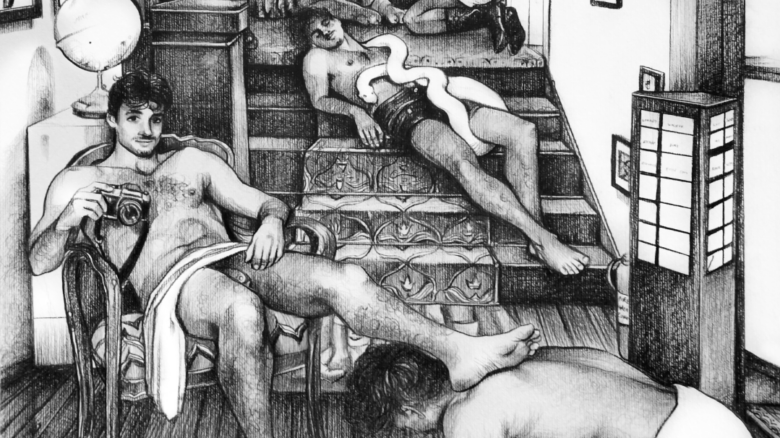
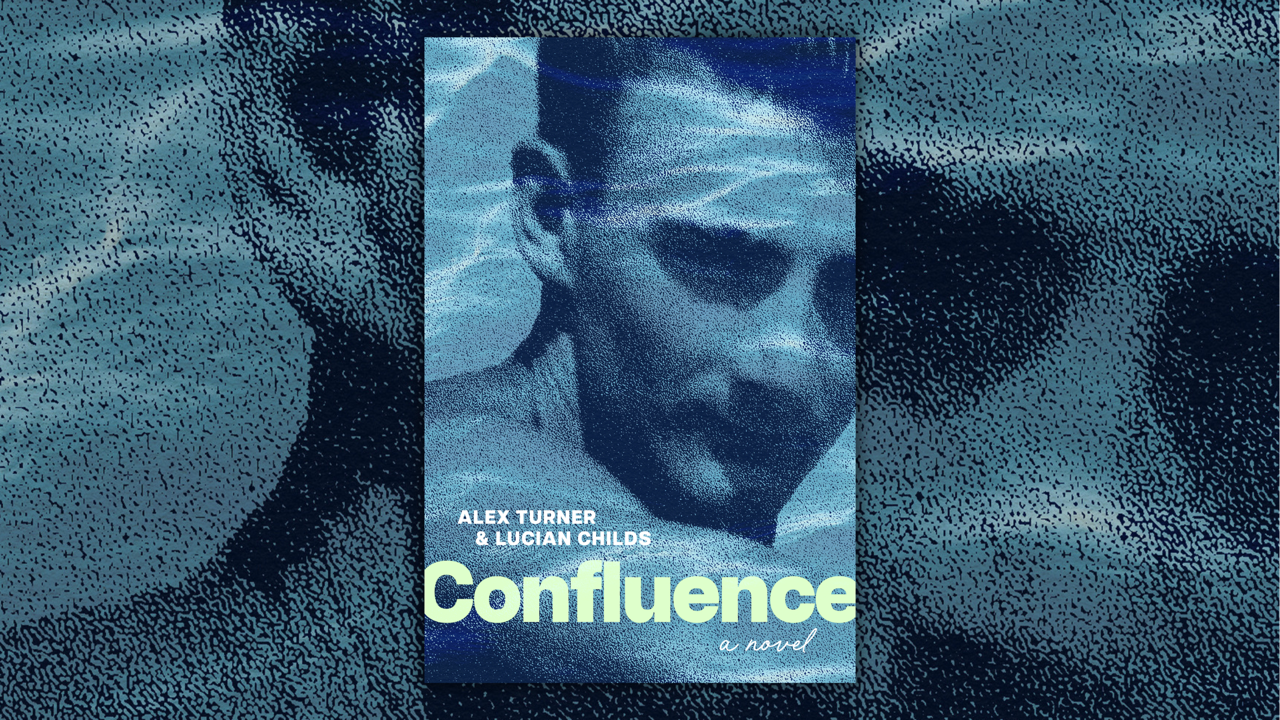
Confluence, a collaborative novel written by the late artist and writer Alex Turner and his husband, writer Lucian Childs, reveals a pre-Stonewall gay Vancouver through the eyes of Ted, a transplant from a small tourist town in the Fraser Valley. Ted is a stand-in for Turner, who passed away from cancer in 2019, leaving behind an unfinished collection of writings fictionalizing his own coming of age as a gay adolescent and young man, first in Harrison Hot Springs among the sons of loggers, and later in the queer bars and house parties of 1960s Vancouver. The old Vancouver School of Art (now the Emily Carr University of Art + Design) is also featured: there, Ted begins to come into his own as a visual artist—and appreciator of the male form.
In the closing “co-author’s note,” Childs recalls how Turner, during his last days in palliative care, entrusted him with his unfinished novel, remarking that since he would not have the time to see it through, “I guess you’ll have to do it.” Having already written his own novel-in-stories, Dreaming Home, Childs was up to the challenge. He carefully edited and restructured his late husband’s written fragments in order to best showcase the stories, characters and settings they contained, making sure to “remain true to his voice and intent.”
The book’s title can be understood as a reference to both the confluence of the Fraser and Harrison Rivers where protagonist Ted grows up, and the end result of Turner and Childs’s written collaboration across time.
Though the various haunts of queer Vancouver figure prominently in the book’s second half, it’s the first half that is the most energetic. It is anchored by the years-long unrequited crush Ted harbours for his best friend Wade. Fourteen-year-old Teddy is a bit of a loner, until he’s befriended by the slightly older boy, who’s already muscular and agile, the cigarette-smoking star athlete of the local high school. Their first encounter is imbued with the headiness of summertime. Teddy is nearly washed away by the fast-moving river near Harrison Hot Springs—he manages to resist the current, pulling himself out at the last minute, and Wade comes running over from where he’s been hanging out with a group of boys, worried and impressed. The writing in this section is immediate and frank: “I tried not to glance at his cock, contracted from the cold, a little knob pulsing against wet underwear in rhythm to his movements.”
There is an electric energy between the two boys, animated by teasing and horsing around, which propels them into a close friendship. However, for Teddy to voice his desire for Wade is out of the question, this being the 1950s in a conservative logging town. The chapters that detail their relationship and its slow, painful breakdown, are rich with sensory detail. Like the protagonist of Edmund White’s groundbreaking autobiographical novel A Boy’s Own Life, also about a queer teenage boy in 1950s Illinois, Teddy frequently seeks solace in nature. He feels much more at ease among the trees and water than in the company of other people. He likes to dwell in “that sacred slant world of silence and beauty” where he can take refuge from “the arena of ordinary boys, their bullying and hateful jibes.”
It’s when human relations intrude into the joys of the natural world that trouble begins. Some years into their friendship, Teddy and Wade cut school one day to go see the salmon spawning on the river flats. Teddy has gotten used to the affectionate way in which Wade looks out for him and takes care of him whenever he incurs minor injuries, like a twisted ankle. Wade’s attention and casual touch cause “ease to spread throughout [Teddy’s] body, the sensation of merging with moment and place.” Here again is a sense of confluence, of two people’s emotional and physical selves coming together, almost inevitably.
However, this ease is shattered when, as they’re hitchhiking back home in an older man’s car, the man makes a pass at Teddy and Teddy, believing Wade to be sleeping in the back, welcomes the beginning of a hand job. Wade is awake, however, and freaks out—not just at the driver, but at Teddy for letting it happen.
On the side of the road, their friendship breaks open. Suspicion installs itself between the boys, and Wade begins to distance himself from Teddy—and from any possible implications of queerness—by beginning to date girls, avoiding one-on-one time with his friend and even lashing out violently in order to keep their intimacy at bay. No longer able to orbit Wade, Teddy is lost. He doesn’t get the grades necessary to enter university, moves to Vancouver anyway to work a dead-end job and generally loses his mojo. Instead of embracing the possibilities of a new life in the big city, he feels like he is “walking the plank” into an empty future.
Though Teddy, who becomes Ted in his early 20s, eventually finds other gay people, including hookups, friends and boyfriends in Vancouver, the book loses some of its tightly coiled energy without Wade in the picture. Ironically, as Ted blossoms into an out gay man and a dedicated visual artist, the text takes on a somewhat hazy quality, reading more like a series of summarized recollections, rather than as the immersive, embodied narrative that Childs and Turner were able to achieve in the first section.
There are some historically interesting scenes: a house party crammed with gays and lesbians where Ted sees other queer people being openly sexual for the first time; a hot dance-floor hookup followed by a police raid at the famed Downtown Eastside gay bar, the Montreal Club; a cruisy beach party hosted by a wealthy gay man in a high-rise overlooking English Bay. However, the loss of the original love object seems to have dulled Ted somewhat, even as he comes to live a freer and more fulfilling life.
Given that Childs, in the book’s afterword, references historic queer collaborations like Gertrude Stein’s The Autobiography of Alice B. Toklas and Christopher Isherwood’s stewarding of E.M. Forster’s Maurice, I would have welcomed the inclusion of more metatextual reflections in the main body of Confluence. I found myself wanting Childs to complicate and illuminate the fraught and tender process of editing, revising and reviving his late husband’s semi-autobiographical writing.
What was it like to reshape these fragments without Turner’s input and presence? What was it like to imagine Turner’s adolescent desire for his best friend? Which parts of the text challenged Childs, which parts revealed new aspects of Turner to him? What were the intimate textures of this act of loving confluence? A recent re-engagement with The Autobiography of Alice B. Toklas, Lana Lin’s The Autobiography of H. Lan Thao Lam, provides an exciting example of what a contemporary textual collaboration between partners can look like.
Nonetheless, Confluence remains a rewarding read for anyone curious about what it was like to find one’s way in the world as a young white gay man in 1950s and 1960s British Columbia. At one point partway through the novel, Turner, or perhaps Childs-channelling-Turner, makes an interjection into the narrative, remarking that his adolescent queer shame is hard for him to fully fathom decades later, “now having lived openly for so long.” Stories like this one, shared by queer people across time, are invaluable for the ways they help alleviate the weight of this shame.

 Why you can trust Xtra