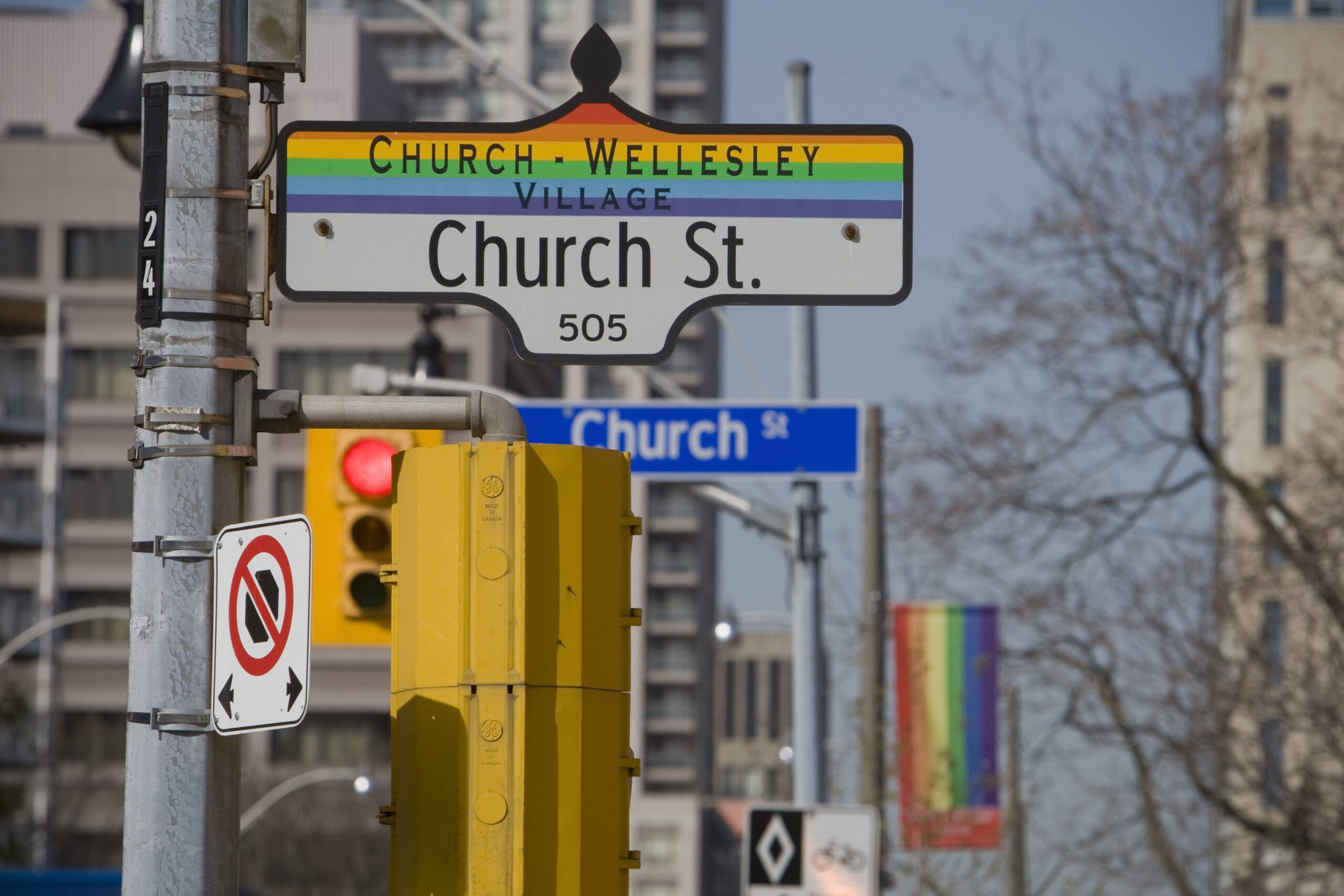
It’s Saturday night in Toronto. The city is experiencing its first hot spell of the year after months of cold temperatures and grey skies. The pleasant weather has brought out hundreds of people to the Church-Wellesley Village on this May long weekend.
The line to get into Woody’s is spilling into the street. Dozens of people squish together on a five-foot-wide sidewalk in a queue that wraps around the block. Twinks and their straight besties wedge themselves through the crowd and up the stairs into Soy Boys for a late-night bite. Cars drive by, taxis double park as they wait for passengers and people jaywalk across the street from one bar to the next.
There are a handful of men smoking cigarettes and vaping outside of Black Eagle. A few doors down at Express Pizza, customers have grabbed slices and are eating on the stoop of the adjacent building. One man sits atop of a bollard meant to separate the street from a makeshift patio set up in the curb lane.
The street is filled with baddies, muscle bros, freaks and femmes who are looking for a fun night out with their clique. But during the day—once all the glitter settles from the weekend’s shenanigans—the atmosphere in the Village is wildly different.
By Monday morning, all of the bars are closed. Yuppies who can afford to live in the newly built luxury towers that line the arterial roads next to Church Street grab $7 coffees before heading to their office jobs in the downtown core. Men in running shorts jog by. Homeless encampments that were less noticeable over the weekend are now in plain sight.
The use of public space in this historic LGBTQ2S+ district and the impact that development has had on its cultural identity have long been the topic of tense discussions over the years. In a perfect world, the Village should be a place for LGBTQ2S+ people to meet and form social bonds, whether that’s through love and friendship or political organizing and volunteer work. It should be a place where queer and trans people can find mentorship, build business relationships and seek advice from peers, or simply join a sports team or find a local gay doctor. But mounting issues—like gentrification and a housing shortage—in one of the city’s fastest-growing wards have made it challenging to bring this vision of a perfect gaybourhood to fruition.
Now, plans to revitalize the neighbourhood, including a pilot project to pedestrianize two of the busiest blocks in the Village, have started to pick up steam once again. Together, concerned citizens, advocates, city councillors and local business owners are working to return the Village to its queer and trans roots.
For some advocates, the first step to transforming the Village is improving accessibility and making it a destination for people to flock to. Rodney Chan, an urban planning student at the University of Waterloo and a regular in the Village, says he’s observed intense overcrowding in the neighbourhood, especially in the evening. But a trip to Montreal last summer opened his eyes to how things could be different.
Chan visited Montreal’s Gay Village, where a roughly one-kilometre stretch of Sainte-Catherine Street East had been pedestrianized every summer. He witnessed an area lined with public benches, trees and lush green planters that offered an oasis for queer and trans folks looking to form connections and build community. The seasonal pedestrianization was such a success that it prompted the city of Montreal to announce in August that the section would be made a year-round pedestrian zone.
It's inspired by Montreal's summer pedestrianization of their Gay Village on Rue St. Catherine.
Notice the flashing red traffic lights at intersections that let pedestrians walk through easily. (2/3) pic.twitter.com/xbIbyntRE2
— Rodney (@_ChanFace) March 16, 2025
Chan was inspired to bring the idea to Toronto. After returning home, he created a conceptual map of what the Village could look like if Church Street was car-free. He posted the images to social media and within days was contacted by City Councillor for Ward 13—Toronto Centre, Chris Moise.
“He had also been thinking about pedestrianizing Church Street, and he’s also been to Montreal and seen how successful it can be,” Chan explains. “For the last six to eight months, we’ve been working with the [Church-Wellesley Village] Business Improvement Association, with Pride Toronto, The 519 community centre and city staff to see if we can make it happen.”
In April, Chan was among a handful of advocates and local business owners who joined a community council meeting with city officials to discuss the pedestrianization plan. During the meeting, some residents grumbled about how ill-equipped the neighbourhood is to handle large crowds and how lively the area can get. Business leaders like George Pratt, the owner of Flash Nightclub, expressed how a car-free zone could maintain the vibrancy of Church Street and encourage more foot traffic in the area outside of the weekend rush. Other speakers made comparisons to Gay Villages across the country, in cities like Montreal and Vancouver, which have adopted various pedestrianization measures in recent years.
Late last month, Toronto city council formally approved the pilot project to pedestrianize Church Street. At the same meeting, Moise presented a motion to add planters, cigarette/recycling receptacles and pole wraps along the street, which was adopted by the council.
From June 19 to Aug. 21, Church Street will be car-free from Wellesley Street East to Alexander Street, with the exception of latitudinal roads that run east and west. After that, it will be up to Moise’s office to decide if it will introduce a motion to re-establish the pedestrian zone next year or make it permanent.
Advocates and business owners hope the pedestrianization pilot will help restore the Village’s role as a vibrant space for people to gather. In putting people first, the project could be a foray into returning the neighbourhood to its community-oriented origins.
Then there’s the topic of the social and cultural identity of the Village. In April, Moise brought forward a motion to unlock some of the funds that the city collects from developers and use them for a revitalization project to bring queer and trans organizations like Glad Day Bookshop and Pride Toronto, which are currently located in the west end, back to the Village.
“The Church-Wellesley Village has long served as a cornerstone of Toronto’s identity and a vital cultural and social hub for the city’s 2SLGBTQ+ community,” the motion reads. “In recent years, however, intensified development pressure within the area has significantly reduced the availability of accessible space for 2SLGBTQ+ organizations, eroding the community infrastructure that has historically supported and empowered marginalized residents and visitors alike.”
Glad Day, the oldest surviving LGBTQ2S+ bookshop in the world, moved across the city to a temporary location in the Queen West neighbourhood last summer after frequently being short on rent and facing eviction from its Church Street location.
The Village’s nightlife venues have faced similar pressures. In 2019, Toronto’s last big gay dance club, Fly 2.0, shut its doors after the building was sold to make way for a condo. In 2024, drag bar and nightclub Crews & Tangos faced a similar fate after Graywood Developments, the real estate developer that owns the building, submitted a proposal to the city to build a 48-storey tower at the site of the bar. That plan was eventually scrapped after facing community pushback and being blocked by the city.
As gentrification ramps up in the Village, remaining LGBTQ2S+ residents are worried that they too could soon be priced out of the neighbourhood. According to estimates from Canada Mortgage and Housing Corporation, the average monthly rent for a one-bedroom apartment in the Church-Yonge corridor is $1,761 as of last October. That’s a 29 percent increase compared to October 2019 when the average rent for a similar unit was around $1,361.
Moise’s motion identified more than a dozen properties in the area that will contribute funds to develop community, cultural and recreational space in the neighbourhood. It also noted that the space would be developed in an existing building in the Village that the city has been working to acquire and whose exact location is confidential. The motion was adopted by city council in late April, and implementation now lies with the city’s corporate real estate team.
In a neighbourhood where LGBTQ2S+ spaces are quickly being replaced by banks, chain pharmacies and overpriced coffee shops, establishing city-owned properties that are dedicated to queer and trans people is one way to return the Village to its roots. Welcoming back long-standing LGBTQ2S+ businesses and organizations would be another step toward that goal.
But tensions in the Village are also brewing over the status of Toronto’s AIDS Memorial, which sits within Barbara Hall Park. The memorial consists of 14 cement pillars which are affixed with stainless-steel plaques with the engraved names of nearly 3,000 people from across Canada who lost their lives to AIDS. On a warm May day, the memorial is littered with trash and dead leaves from last fall. One of the plaques is tagged with black spray paint as if to say “my name matters more than yours.”
Advocates like David, a member of the city’s HIV-positive community, say the memorial is deteriorating after years of neglect. “People who walk through the park don’t even realize that it’s a memorial,” David, who asked to only be identified by his first name due to privacy concerns, tells Xtra.
The city brought forward a redevelopment proposal last year that offered a few changes, including a paving element that would see a red AIDS ribbon painted on the ground to weave through the park and connect to the memorial, and a second ribbon with the colours of the trans flag. But some advocates like David say that plan feels disconnected from public feedback and fails to meaningfully honour those who have died. He’s now pushing the city to adopt a counter proposal called “Echoes,” which has received endorsements from dozens of HIV/AIDS organizations and other community groups across Canada. But while the city is exploring the feasibility of incorporating those elements into the final redesign of Barbara Hall Park, no further promises have been made.
What’s indisputable is the political and cultural significance of Canada’s gay villages and the need for investment. According to Amin Ghaziani, a sociology professor at the University of British Columbia and the Canada Research Chair in Urban Sexualities, gay villages are crucial places for LGBTQ2S+ people to spend time with others like themselves, a concept known as homophily.
“One of the important reasons why these neighbourhoods matter is because they provide places for political organizing,” Ghaziani tells Xtra. “And the second reason is sex and love.
“LGBTQ2S+ people may want to be around others who are like them, because it makes it easier to hook up, either for a night or for a lifetime,” he adds.
Ghaziani suggests commemorative practices and heritage preservation as a potential solution to protect Canada’s gay villages from gentrification. “When you designate a building as having particular significance for a group of people and say ‘something historic happened here,’ it guards that place from developers coming in and demolishing that space,” he says. “LGBTQ2S+ people have made significant investments in certain areas of the city, and those places are sites of significance for us, culturally, politically and otherwise.”
The mounting developmental threats, gentrification, homelessness and bureaucracy facing Toronto are not limited to the Village’s borders. In a city that’s rapidly changing, it’s difficult to imagine what the neighbourhood could look like in 10 or 15 years.
Will Crews & Tangos still be standing in the year 2040? Will Woody’s still have that musty smell when you walk in on a hot summer night? Will the streetlamps in the Village still be decorated with AIDS ribbons that light up at night? Or will the neighbourhood be plowed over for luxury towers and upscale grocery stores that only the elite can afford to shop at? Where will all the long-term residents go?
The good news is that advocates are working to make the Village a better place and to preserve its identity for the queer and trans residents who depend on the communal space it offers. In a world that tells queer and trans people to hide who they are, the neighbourhood can still represent a haven for LGBTQ2S+ people to form social connections and help one another survive. While it might not be a utopia, for some, it’s the best shot at finding a community.

 Why you can trust Xtra