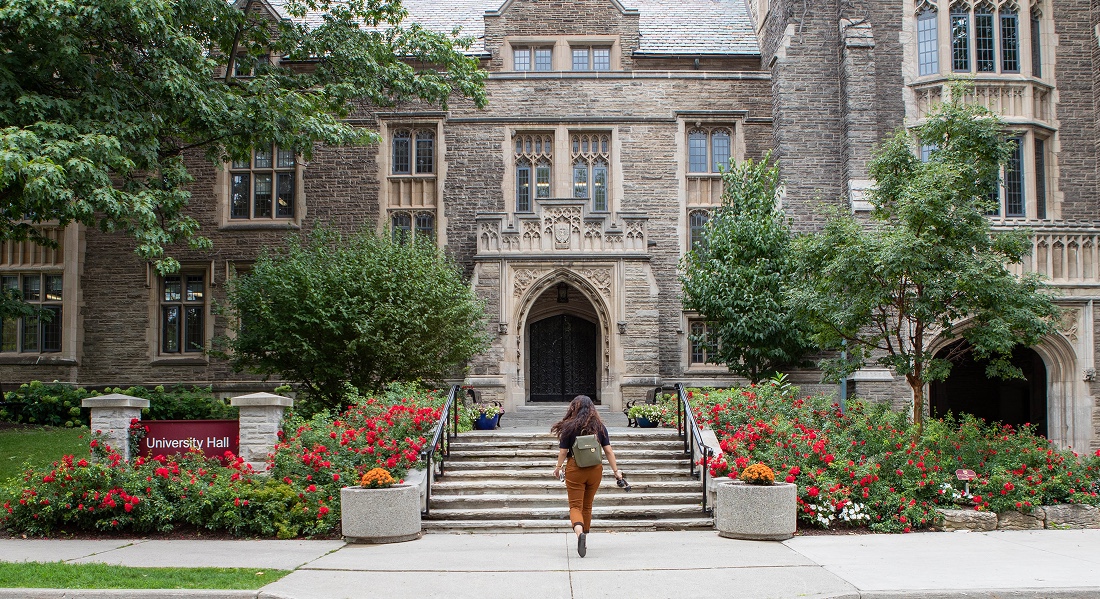
When classes at McMaster University in Hamilton, Ontario, let out for the end of the academic term last spring, the campus was expected to enter its quietest time of the year.
For most students, the summer break is typically occupied with part-time jobs, seasonal internships and time spent with loved ones. But this summer, while students were away, a controversy was brewing on campus.
Concerns began to emerge in June for Katherine Boothe, an associate professor of political science, after she received a message from a former student who wanted to know if she was aware of the university’s partnership with an “anti-trans hate group.”
“I started looking into it and everything that I learned obviously dismayed me,” Boothe tells Xtra.
Boothe came to find out that in 2021 the university had entered a partnership with an American-based group called the Society for Evidence-based Gender Medicine (SEGM), which reportedly provided the institution’s faculty of health sciences with $250,000 in funding for research on gender-affirming care.
The partnership resulted in three systematic reviews that were published in major medical journals on the heels of the Cass Review in the U.K. In all three cases, researchers found that “only low certainty evidence exists … regarding the benefits of gender-affirming care interventions” such as puberty blockers, hormone therapy and surgical procedures like mastectomies. But trans rights advocates, like Boothe, say those findings are flawed and claim the research is being used as a pretext to ban gender-affirming care worldwide.
“I read the articles that had been published out of the partnership and asked colleagues what was going on,” Boothe says. Some of her colleagues were aware of the partnership and the students’ concerns, but many of them weren’t, she says.
According to its website, SEGM considers itself an authority on trans health with a stated mission of promoting “evidence-based principles in the field of youth gender medicine.”
However, student organizers and some faculty paint a different picture of the organization, which in 2024 was designated as an anti-trans hate group by the civil rights organization Southern Poverty Law Center in the United States. SEGM has rejected that classification and called the move a “politically motivated” attack that seeks to “shut down scientific scrutiny of youth gender medicine.”
In a statement to Xtra, representatives for SEGM admitted to being involved in the selection of the researcher’s review questions, but say they “had no involvement in the actual conduct of the reviews or the publication of the results.”
“No scientific errors in the published reviews have been identified that would justify their retraction,” SEGM adds.
Growing concerns
The bombshell revelation has been a troubling ordeal for Boothe and many members of the McMaster community—including several who spoke to Xtra.
Within weeks of discovering the partnership, Boothe penned an op-ed with several colleagues titled “No pride in pseudo-science,” which was published by the Hamilton Spectator in July. The article ignited a firestorm among the university community and students immediately began pressuring the school to address the situation via social media campaigns and direct talks with administrators.
Members of the McMaster Students’ Union also passed a resolution condemning the partnership and urging the university to conduct an independent investigation.
“A lot of us were quite shocked that this was happening,” Logan McLean, a third-year political science student, tells Xtra. “We started having some meetings with the administration and essentially we were just trying to see how this partnership was initiated and what we could do to mitigate the harm that has come out of it.”
By mid-August, the university finally responded to the community’s concerns and posted a statement to the health faculty’s website that was signed by only half of the research team. In the letter, the authors argued that their research had been “misrepresented and misinterpreted.”
They went on to express concerns about how their findings are being “misused” to justify denying care to trans youth. “Indeed, our prior work has been used in exactly this highly problematic way,” the authors wrote. “It is unconscionable to forbid clinicians from delivering gender-affirming care.”
Just a few weeks prior to the university’s response, the U.S. Supreme Court ruled 6-3 to uphold a Tennessee state law that bans puberty blockers and hormone therapy for minors. In his concurring opinion in United States v. Skrmetti, Justice Clarence Thomas raised concerns about the benefits of puberty blockers and directly cited the research out of McMaster University to support his position.
“It is undisputed, however, that these treatments carry risks,” Thomas wrote. “Research suggests that, aside from interrupting a child’s normal pubertal development, puberty blockers may lead to decreased bone density and impacts on brain development.”
He added that there “remains considerable uncertainty regarding the effects of puberty blockers in individuals experiencing’ gender dysphoria.”
Meanwhile, dissenting Justice Sonia Sotomayor said the court’s decision “invites legislatures to engage in discrimination by hiding blatant sex classifications in plain sight.
“It also authorizes, without second thought, untold harm to transgender children and the parents and families who love them,” she explained.
Students advocating for change
While students at McMaster were still trying to make sense of the university’s partnership with SEGM, the Supreme Court ruling increased the spotlight on the researchers, making the issue unavoidable on campus.
“We acknowledge concerns that have been raised,” the researchers wrote in their August statement. “Our research agreement with SEGM ended in 2024. When the agreement started in 2021, the organization appeared to us as non-trans, cis-gender researchers to be legitimately evidence-based.
“We will no longer accept funding from SEGM,” they wrote.
Those assurances were welcomed by the university community as a positive first step and a rare win for student organizers. The researchers also claimed to have made an unspecified donation to Egale Canada, the country’s leading LGBTQ2S+ rights organization.
University campuses have a long history of student activism, which historians say can be traced back to the 13th century. In recent decades, student organizers have been at the forefront of major social justice movements, including the 1960s Black civil rights movement, anti-Vietnam war protests, the South African anti-apartheid movement, fossil fuel divestment, pro-Palestinian encampments and many others.
“This idea of divestment or cutting ties with different investor groups to advance a particular political or moral agenda is a relatively common experience on university campuses,” Roberta Lexier, a professor at Mount Royal University in Calgary, Alberta, tells Xtra. “This is a relatively common experience on university campuses, but the current context is different.
“Universities today are much less receptive to student pressure and student movement in general,” she adds.
@xtramagazine Pierre Poilievre and the Conservative Party of Canada are going after DEI initiatives in what they’re calling a quest to restore “meritocracy.” The Conservative Party of Canada has launched an online petition calling on Mark Carney’s Liberal government to end its diversity, equity and inclusion initiatives. It specifically calls out bureaucratic funding, research funding and “ideology” at post-secondary institutions. The petition was boosted by Conservative leader Pierre Poilievre on social media, writing “End DEI. Restore the merit principle.” And while this is unlikely to tangibly change anything, all of this political blustering still matters and is worth paying attention to as another example of Poilievre and the Conservatives looking south of the border to get their policy ideas. We break down what you need to know 🌈🇨🇦 #canada #lgbtqnews #politics #pierrepoilievre #cdnpoli ♬ original sound – Xtra Magazine
“Part of this has to do with finances. Universities are desperate for money. They have lost a lot of the government funding they had once received, so now they need to look elsewhere and that means turning to private donors and corporate sponsors,” she explains. “And so it’s hard to convince them not to take money based on ethical purposes.”
McMaster’s endowment was valued at $815.1 million in the 2023-24 fiscal year and is among the largest in the country.
Use of unreliable tools
McMaster is widely considered to be “the birthplace of evidence-based medicine,” a term coined by physician Gord Guyatt in 1990.
Guyatt is a professor at the university’s department of Health Research Methods, Evidence & Impact, and one of the lead researchers of the systematic reviews that came out of the university’s partnership with SEGM. He is sometimes referred to as the “godfather” of evidence-based medicine and was inducted into the Canadian Medical Hall of Fame in 2016.
His work has led to the development of a tool known as GRADE or Grading of Recommendations Assessment, Development and Evaluation, which researchers use to assess the quality of evidence for healthcare recommendations.
Guyatt and the seven other researchers who partnered with SEGM used GRADE in their systematic reviews of gender-affirming care, but critics like Boothe say the tool isn’t always reliable.
“When GRADE uses the term ‘low quality evidence’ or ‘low certainty evidence,’ they mean a particular thing and have a very specific definition in mind,” Boothe explains. “But when lay people hear the term ‘low quality evidence,’ we hear ‘bad’ or ‘dangerous’ or ‘unproven’ and that’s not what it means.”
According to Boothe, GRADE uses a hierarchical system to evaluate the quality of evidence and at the top of that hierarchy is randomized control trials, which works by assigning participants in an experimental scientific study into two groups: one that receives treatment and one that receives a placebo.
“If randomized control trials are the only form of evidence that is considered high quality, then you will never get that for most forms of gender-affirming care because you can’t do randomized control trials, you cannot give someone a placebo surgery,” she explains.
“It’s also impractical and unethical for many other types of gender-affirming care,” she adds. “You can’t give a teenager a placebo puberty blocker; it would be unethical to do that to a young teen and they would experience the outcomes pretty quickly because puberty blockers work and placebos don’t.
“So it’s not surprising that according to this method, the results found no high quality evidence. That doesn’t mean there isn’t valid, legitimate evidence. It’s just not captured by this type of review,” Boothe says. “It’s the wrong tool to look for evidence about this type of intervention.”
When asked about SEGM’s role, Boothe says, “It does not require expertise in the very specialized methods that these systematic reviews use to understand that if a hate group funds the research, chooses the research question, and designs the research protocol, then they’re going to influence the outcome of the research.”
Xtra reached out to Guyatt and the other seven researchers for comment regarding the GRADE system and other issues, but did not hear back.
Disregard for student demands
Guyatt has received backlash from both sides following the publication of the Aug. 14 statement. Student organizers say he is a prominent “player in the anti-trans network,” but right-wing critics claim Guyatt “turned his back on science,” and capitulated to activist pressure in what critics describe as a “fall from grace.”
On Sept. 8, Guyatt made an appearance on a podcast called Beyond Gender in which he was repeatedly questioned about the August statement and his position on evidence-based gender medicine. The podcast is produced by a group called Genspect, which is also listed as an anti-trans hate group by the Southern Poverty Law Center.
In an email to Xtra, a representative from Genspect rejected the hate group classification and wrote that “anyone who thinks we are evidently does not know our work … we help trans identified people every week. We also help detransitioners.”
During the episode, hosts Mia Hughes and Stella O’Malley asked Guyatt about the August statement, which used the phrase “medically necessary” in reference to gender-affirming care.
“How ridiculous!” Guyatt quipped. “I would never use that term.”
The hosts proceeded to point out the last line of the statement, which described Egale Canada’s litigation efforts as “aimed at preventing the denial of medically necessary care for gender-diverse youth.”
A shocked and confused Guyatt said he didn’t recall writing that specific paragraph and offered no explanation for how that phrase made its way into the statement.
“You’ve kind of discredited yourself by signing something that clearly you don’t hold with,” the hosts said.
“I was a dope. Okay? Sometimes I’m a dope,” Guyatt added.
His flip-flopping position and appearance on what students describe as a right-wing podcast further enraged campus organizers, who were already ringing alarm bells with the school’s administration. That same week, the university received an open letter that called for a formal investigation into the faculty of health sciences’ partnership with SEGM. It was signed by hundreds of concerned individuals including McMaster faculty, students and local community groups.
Despite the university’s assurances that it would no longer accept funding from SEGM, students are still outraged about the research that came out of the partnership and that it is still accessible online without any disclosure or acknowledgement that it was funded by a known hate group.
“We want the university to pursue a retraction of the research and acknowledge the harm that has come from it,” McLean says. “We think that’s some of the first steps in rebuilding the relationship with trans people on campus and beyond.
“We would also like the university to issue a public apology that recognizes SEGM’s status as a hate group and commits to remediating the harms caused by the research,” she adds.
The university has not yet responded to the students’ demands.

 Why you can trust Xtra