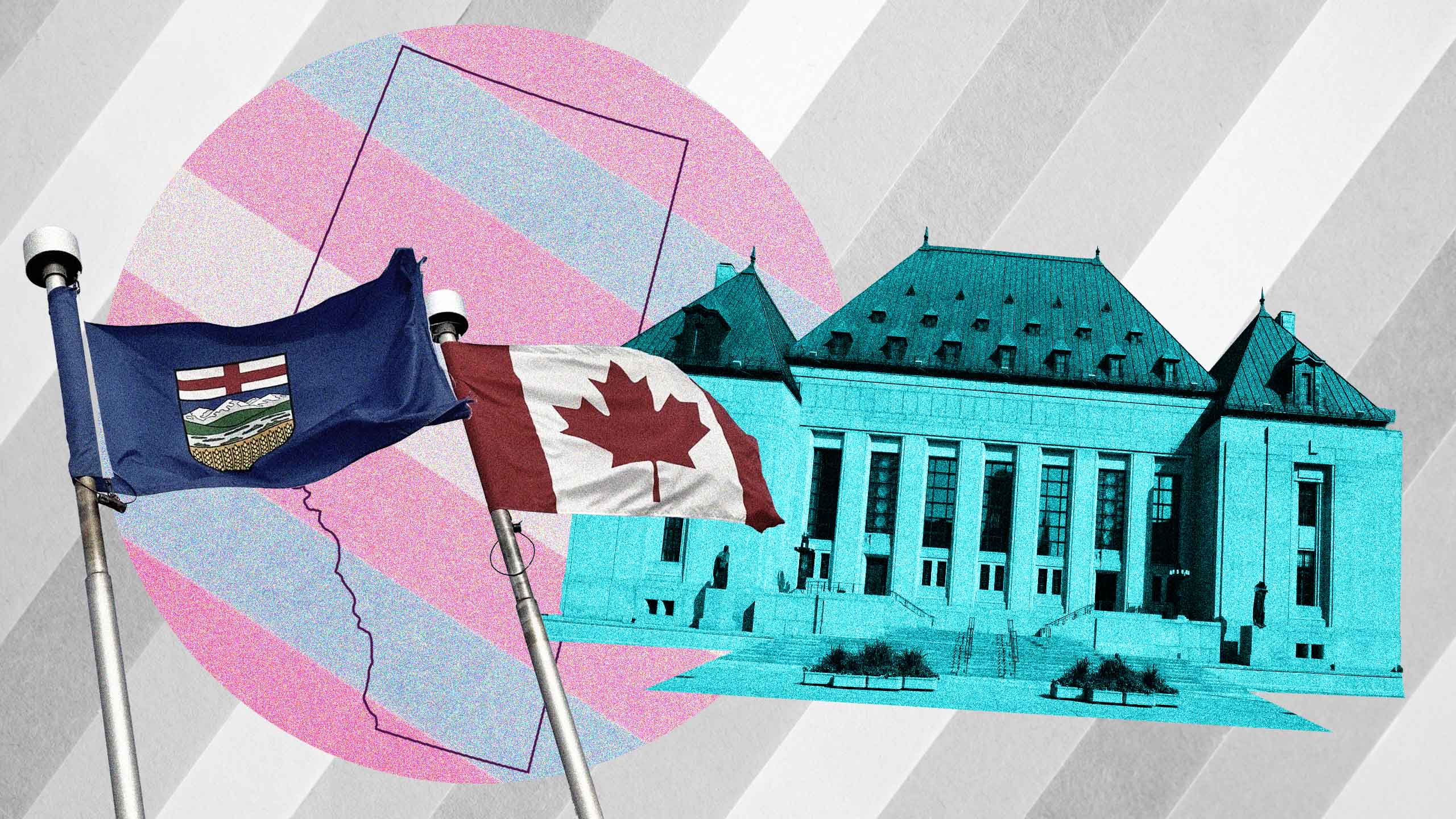
Canada’s courts aren’t going to solve the problem of Alberta’s anti-trans laws.
Since Alberta premier Danielle Smith first announced, in January of last year, that her government would try to limit trans women and girls from participating in gender-congruent sports leagues, children and youth from accessing gender-affirming medical care and students from changing their names and pronouns at school without parental consent, the province has faced stiff legal opposition from individuals and organizations committed to protecting the rights of trans Albertans.
The Calgary-based foundation Skipping Stone, which offers programming like ID-change clinics and mental health support groups to the city’s trans and gender-diverse residents, has helped lead the way to court. Together with Egale Canada, Skipping Stone secured a temporary injunction in June against the province’s healthcare legislation. And this month, the organizations announced they are planning to take the province to court again to challenge the constitutionality of the new educational rules, which came into effect Sept. 1.
Understandably, it seems like a lot of progressive Albertans are putting their faith in the courts to uphold the rights of trans Albertans, and in organizations like Skipping Stone to defend those rights by legal means. But I am not sure that faith is particularly well placed.
I am a trans woman who was raised in Alberta and who provides legal services there as a student-at-law at Calgary’s Prison & Police Law, a social justice-oriented firm that specializes in helping people, including many trans people, who have been harmed by the carceral justice system. When not in the province, I am also studying toward a PhD in Law at York University’s Osgoode Hall Law School in Toronto.
I believe in taking governments to court when they do things that violate the rights guaranteed by Canada’s constitution. But my experience with the Canadian justice system has not convinced me that legal challenges can bring about the kind of lasting change necessary to permanently safeguard social minorities like the LGBTQ2S+ community from legislated bigotry.
The limits of social justice litigation
Anti-trans sentiment in Canada is deeply rooted and culturally systemic.
The Supreme Court recognized as much in a 2023 decision that pronounced the marginalization of trans people in Canadian society. “The history of transgender individuals in our country has been marked by discrimination and disadvantage,” Canada’s highest Court found, going on to observe that judicial efforts to recognize and remedy the plight of the trans community have only come about in the past few years.
Compared to the rest of the country, Alberta has lagged behind when it comes to protecting gender and sexual minorities like the LGBTQ2S+ community.
It took a lawsuit and a 1998 decision of the Supreme Court for Alberta to extend protection from discrimination to gays and lesbians under the province’s human rights legislation. Gender identity and gender expression only became protected grounds under that law in 2015.
A year earlier, in 2014, an Alberta trans woman had to sue the province’s director of Vital Statistics when the latter refused her application for a birth certificate with a female sex marker. The reviewing Court found that, in its response to that lawsuit, the province stereotyped trans people and minimized the discrimination and vulnerability we experience; and in granting relief, the Court went on to note that the law at issue “contribute[s] to the disadvantage experienced by transgendered persons by perpetuating the prejudice and stereotyping to which they are subject.”
@xtramagazine This week, two of the three anti-trans laws passed last year in Alberta officially go into effect. As of Sept. 1, trans women and girls are banned from women’s sports leagues and divisions, and parents will be informed if a student chooses to go by a different name or pronoun at school. The Fairness and Safety in Sport Act requires any women’s league, class or division to consist only of participants who were assigned female at birth. Each school, post-secondary institution and provincially recognized sports organization is required to develop a process for confirming that all of their players were assigned female at birth, and trans women and girls will be barred from competing in any women’s division of collegiate, school or amateur sports in the province. This week, the Edmonton Public School District confirmed that schools will be sending home forms for parents guardians to confirm that the birth certificate of any girl who wants to participate in a competitive sport reads female. The Education Amendment Act, 2024, also went into effect this week. As of Sept. 1, parental permission will be required for students who wish to go by a different name or pronoun related to their gender identity. Parents will also need to opt in for their child to receive any sex education on issues such as gender identity, sexual orientation or human sexuality. A third anti-trans law, the Health Statutes Amendment Act, is currently being challenged in the courts. The law would ban gender-affirming care for minors under 18. We break down what you need to know ⚽️🎓 #alberta #lgbtqnews #daniellesmith #canada #trans ♬ original sound – Xtra Magazine Advertisement
And yet, in spite of these and other court decisions across Canada upholding LGBTQ2S+ rights under Canadian constitutional and human rights laws, the Alberta government had no difficulty ramming its anti-trans laws through the provincial legislature last year. Faced with the prospect of reviewing courts striking those laws down now, Premier Danielle Smith has refused to rule out a possible use of the constitutional “Notwithstanding Clause” to render the court’s opinion practically moot.
It has long been understood within Canadian law that, to give effect to the fact that Canada is a “free and democratic society,” courts must retain a “commitment to social justice and equality.” Provincial legislatures are under no such obligation, however. As long as their members keep voters happy, provincial governments can act with a good deal of legal impunity, pushing through new laws and defending existing ones with all the legal and financial resources that come when you hold power in this country.
And therein lies the problem.
Courts are poorly equipped to resolve larger political disagreements. They are set up to resolve specific, fact-dependent disputes between people—and, sometimes, between people and their governments.
But courts cannot root out hatred within Canadian society at large. It is rare, indeed, that they will even try.
Let’s be careful how much faith we put in the legal system
None of what I have just said is meant to suggest that trans Albertans and our allies should not challenge the province’s anti-trans laws in court.
I, for one, think those laws clearly violate the Constitution: in particular, its guarantees of equality and of life, liberty and security of the person. To the extent that Alberta’s laws are unconstitutional, they should be struck down—and I hope that that is what the courts are going to do.
But even if they do, the problem of anti-trans bigotry will persist in Alberta as in Canada. Conservative politicians will continue to pander to the worst impulses of their electoral base, knowing that this will win them votes. And courts will continue to issue decisions that respond to the specific factual and contextual circumstances of the cases actually before them, limiting the capacity of those decisions to effect wider changes.
There’s a lot you can accomplish by taking the government to court when it passes unconstitutional laws. But the root causes of those laws—the bigotries that fuel them—are not easily combatted by legal means.
Part of the problem is that the Canadian court system is adversarial: it is premised on argument, disagreement and the ultimate victory of one side over the other. Such a system does nothing to foster the kinds of relationships and conversations that are necessary to move people outside of their entrenched political positions.
Social justice litigation is a shield, not a sword. It can protect people from particular instances of government overreach into their lives, at least to some degree. But it is unlikely ever to convince the losing side that that side’s approach is incorrect. Even if the Alberta government loses every challenge to its anti-trans laws, I doubt Premier Smith and her party’s elected leaders will have second thoughts about whether those laws are just.
Which is why we shouldn’t expect the court challenges to Alberta’s anti-trans laws to save the province’s trans population. We need to save ourselves: not by waiting for robed justices in hallowed halls to pronounce our salvation; but rather through the hard work of organizing and constructing communities that enact a better world.

 Why you can trust Xtra