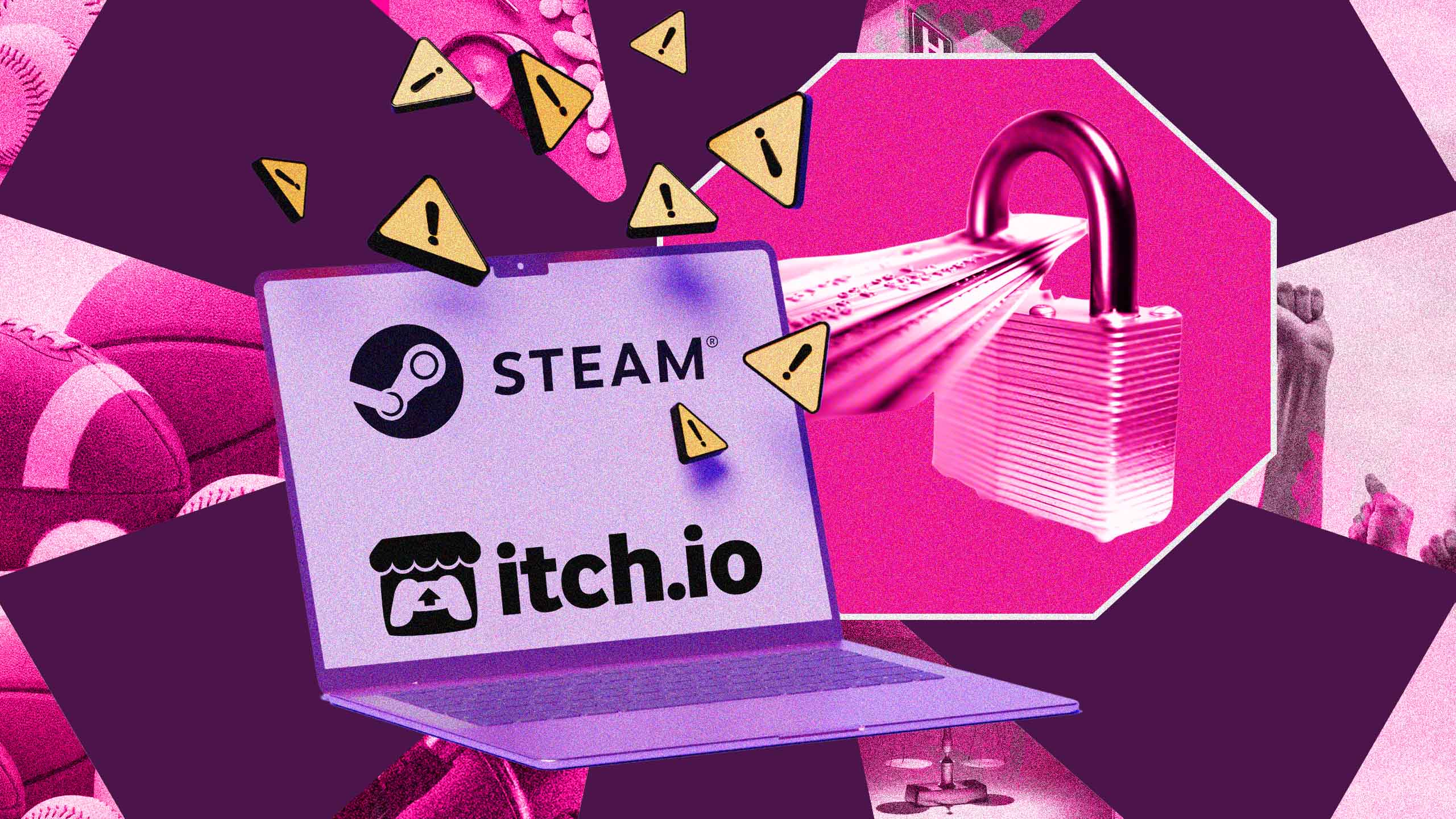
Earlier this week, online game store Steam and multimedia store itch.io both announced that they would delist all Not-Safe-for-Work (or NSFW, a common term for content with sexual themes) content from their sites, citing pressure from payment processors Visa and Mastercard. The card processing companies have been working in tandem with Australian social censorship group Collective Shout to exert influence on the game platforms.
itch.io is also reportedly refusing to pay out money that NSFW creators have already made through recent sales on the site. In some cases, even non-sexualized games that just had LGBTQ2S+ themes were marked for removal. Anti-porn advocates frequently mislabel queer and trans-related content as inherently sexual and Collective Shout is no different in this case. All over social media, queer creators reacted to the news, and are scrambling for possible replacement hosts for their games, stories and art. Bluesky user and developer @jazzpomegranate.com complained, saying, “bro you delisted my game and it has no adult content in it, just the word trans.”
I just wanted somewhere to post my weird gay video games. Why can’t they leave us alone
— Robert Yang (@radiatoryang.bsky.social) July 24, 2025 at 4:28 AM
Collective Shout, according to its website, is “concerned about the increasing pornification of culture and the way its messages have become entrenched in mainstream society, presenting distorted and dishonest ideas about women and girls, sexuality and relationships.” Theoretically, it’s an arguably noble stance, but in practice, the words present a thin feminist veneer fronting a religious crusade against pornography.
The controversy got early attention when journalist Ana Valens published a story last Friday about Collective Shout’s censorship campaign against Steam in Waypoint, Vice’s gaming vertical. The story was later wiped off of Vice’s games vertical completely and Valens quit her role with the vertical. Vice higher-ups later announced that Valens would be permanently barred from contributing to Waypoint going forward. Along with Valens, the site’s managing editor, Dwayne Jenkins, and two other contributing writers chose to leave the vertical in solidarity.
Religious conservatives are growing in power across the English-speaking world, and they have been quick to bring the rest of the world under their prudish and censorious boot. Now I’m personally not one for NSFW content, but I understand threats to free speech and that eliminating queer content is the true aim of the anti-speech right—and is next in their sights.
Additionally, the Trump administration has recently extracted speech-controlling wins in numerous legal settlements with universities and media companies alike. The same day Paramount Pictures reached a settlement with the Trump administration about an editing decision during an interview with Trump on 60 Minutes, the company announced that they were cancelling The Late Show with Stephen Colbert, whose host was a frequent critic who reportedly got under the president’s skin. The company said the decision was financial, despite the show getting the best ratings among late-night programs.
Conservatives have long portrayed themselves as defenders of free speech, often while falsely conflating legitimate criticism of conservative arguments across a variety of issues with censorship. This is all, of course, a misdirection, meant to prime the media and voting base to see the political left as attacking free speech and conservatives as brave, classically liberal free speech defenders.
Yet here we are six months into the second Trump term and we’re facing an all-out attack on free speech at the hands of conservatives—and America’s biggest companies are just going along with it. Without Visa’s and Mastercard’s active participation, it’s unlikely that Steam or itch.io would be suppressing the free speech of NSFW creatives.
It is fundamentally unfair that Visa and Mastercard can exert so much force upon the marketplace. Steam and itch.io have no choice but to comply because those two companies process 90 percent of all online transactions. If the stores lose their payment processors, they go out of business.
To me this smells of an unfair monopoly. If any set of companies can do this to another company—control the nuts and bolts of what it’s allowed to sell at risk of the company going out of business, and leaving it without a viable competitor to go to—that is a monopoly. Unfortunately for the online game platforms, and us consumers, there’s no political will at the moment in either major U.S. political party to do anything about this. Democrats just eagerly participated in passing the controversial Kids Online Safety Act, which gives the federal government the power to restrict online speech that may be directed at kids and under which critics say will endanger LGBTQ2S+ speech online. And Republicans are hellbent on remaking society into their evangelical wet dream, by eliminating queer and trans people from society and further subjugating women.
Neither party feels compelled to take on corporate America—and why would they? Corporations basically control who does and doesn’t get elected, thanks to our lack of campaign finance laws. Attacking corporations in the American oligarchy is essentially political suicide.
Without robust free speech protections, those with power will continue stepping on whoever gets in their way. Solidarity and direct action are the only response we can muster now. Online petitions in both the U.S. and Europe, along with a phone and email campaign, have been organized to target the two card-processing sites and to seek a reversal of these policies. Call the credit card companies, sign the petitions. Demand they live up to the liberal free speech values Americans are supposed to have.

 Why you can trust Xtra