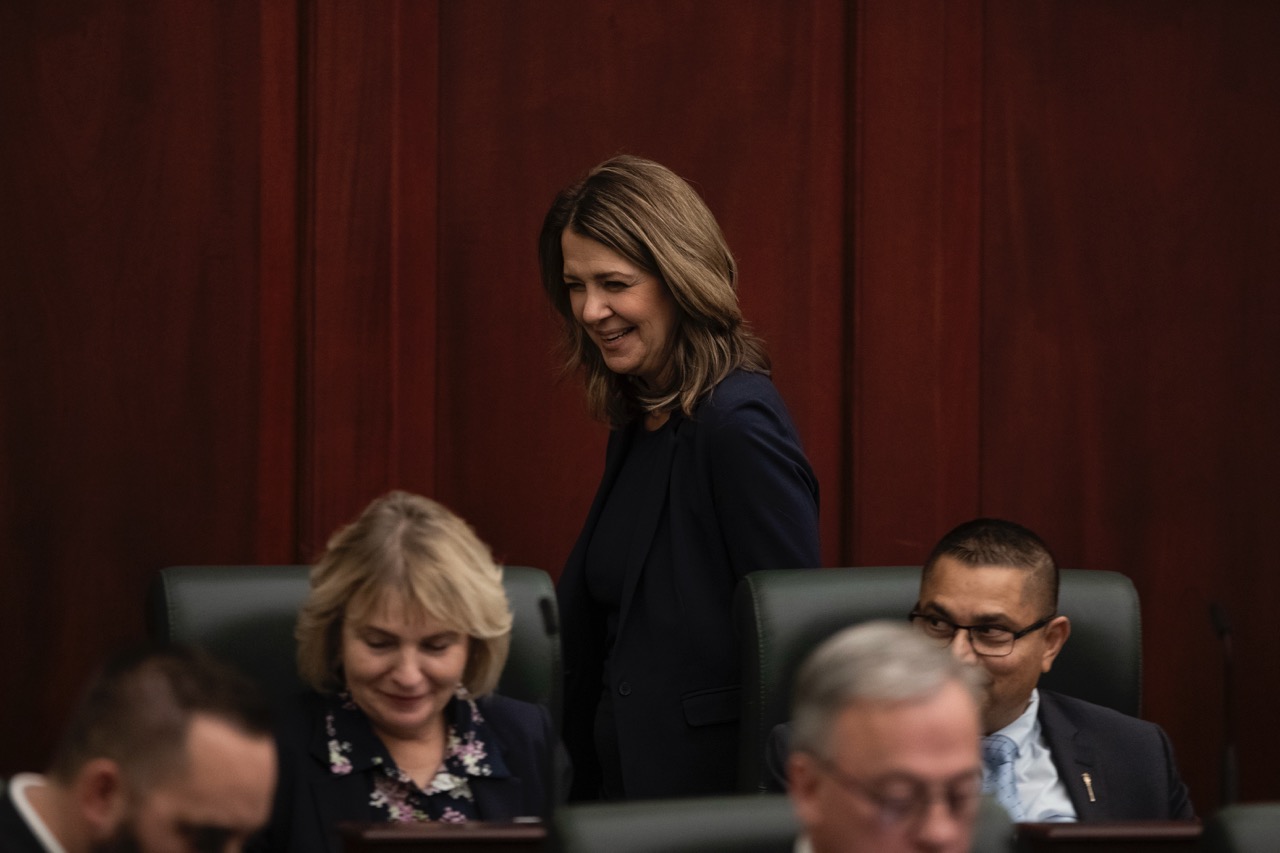
Alberta premier Danielle Smith has chosen the nuclear option to make sure her suite of anti-trans laws remain in effect.
And trans kids in the province will suffer for it.
On Wednesday, Smith’s government will table Bill 9, the Protecting Alberta’s Children Statutes Amendment Act, which invokes the Notwithstanding Clause to shield three pieces of legislation introduced last year from court challenges.
Under the Canadian Charter of Rights and Freedoms, the notwithstanding clause allows a government to effectively override a certain number of Charter rights. Once the use of clause is passed into law—in this case via Bill 9—a court cannot rule that the legislation which the clause applies to be struck down based on human rights.
We must not overcomplicate what’s going on here: this is the Alberta government saying that the rights of trans kids to receive lifesaving healthcare, go by their own pronouns at school or play on sport teams, don’t matter as much as Smith’s government’s right to dictate their lives.
Smith and her government are weaponizing a little-used piece of the Charter and a pile of debunked science and outright lies about trans people to make the case that their laws that make up Canada’s harshest anti-trans legislation are actually about protecting kids.
Whether it’s lies about the safety of puberty blockers or the competitive impact of allowing trans women to compete in women’s sports, the stances and statements Smith is repeatedly trotting out to defend this legislation are at their best misleading and at their worst outright lies.
During a press briefing Monday, Smith repeatedly stressed how protecting her government’s law targeting gender-affirming healthcare will help preserve teenagers’ ability to procreate by stopping them from taking puberty blockers or undergoing “sterilizing” procedures.
When pressed by a reporter who noted that there is not a single reported instance of a youth under the age of 18 receiving gender-affirming lower surgery in Canada, Smith countered that there have been reports of teenagers under 18 receiving mastectomies.
To be clear, a masectomy—aka top surgery—is in no way a “sterilizing” procedure, as Smith and her government seem to want everyone to believe. Not only have legions of trans men and mascs who’ve undergone top surgery gone on to have biological children, so too have thousands of cis breast cancer survivors and women who got breast reductions.
To suggest that such a benign procedure is sterilizing kids is a lie—and it’s exemplary of the level of misinformation that not only guided the creation of this legislation a year ago but is now guiding the defence of suspending people’s rights in order to make sure it stays in effect.
Take this comment from Smith, also from Monday’s presser: “We are also looking at the international evidence that’s emerging that we believe that children should go through puberty before halting it so that they can make sure that they have kids of their own one day. If you don’t become sexually mature, you can’t have kids. And that’s what we’re trying to preserve.”
First of all, the idea of a government being this focused on “preserving” the sexuality maturity of kids is … gross. Second, the concept of having to “go through puberty before halting it” is actually just nonsense. Not only does it have nothing to do with how puberty blockers actually work—they don’t do anything irreversible—but it also just doesn’t make logical sense.
Listen to any media appearance by Smith or her cabinet about these issues and you’ll hear similar claims. And it’s important to highlight these lies for what they are because they show how truly misinformed—or simply willing to ignore actual logic and science—Smith and her government are on these issues. The fact that the Alberta government has to use the notwithstanding clause—again, a section of the Charter that has been used less than five times in its 43-year history—to force these laws through in part shows how little scientific or legal basis they actually stand on.
Talk about the notwithstanding clause can get muddied by legalese. The average person likely doesn’t know what section of the Charter it falls under or even what notwithstanding really means. Xtra columnist Dale Smith—no relation to Danielle—has extensively covered the clause and its threat to LGBTQ2S+ rights over the past few years. As recently as last week, he warned against premiers’ cavalier use of it.
“This is the place we find ourselves—a place where parties or governments are willing to simply invoke the clause to override rights and to keep the courts from even weighing in on whether their laws would be constitutional or not,” he writes. “If it becomes easy to override Charter rights at the first instance, then the Charter will soon no longer be worth the paper that it’s written on.”
That’s why we must care when governments whip the clause out at the drop of a hat. Smith doesn’t want to see these policies challenged in the courts because she knows they will lose because they are not policies that actually care about the rights of trans kids. All three pieces of legislation have been subject to various court challenges and injunctions over the past year on the basis of their violating the rights of impacted Albertans.
This isn’t the first time it’s been used to force through anti-LGBTQ2S+ policy in Canada. Scott Moe’s Saskatchewan government invoked the clause in 2023 to protect its bill to force schools to get parental consent for students who want to change their pronouns or chosen names at school. And while that policy is shielded from being overturned by the courts, Saskatchewan’s court of appeal recently ruled that an injunction brought to the Supreme Court could lead to “a declaratory judgment” on whether the law violates constitutional rights.
So, functionally, the courts can say a law is bad but can’t do anything about it.
This actually marks the second time that Smith’s government has invoked the clause this fall, previously using it to force striking teachers back to work under a new contract.
In the briefing Monday, Smith claimed that “an overwhelming majority of Albertans” supported the three policies targeting trans people, and that her government was taking action so urgently because “the stakes could not be higher.”
But that claim is dubious as well. Considering these policies were nowhere on Smith’s United Conservative Party platform when they were elected back in 2022, it’s hard to make the case that the electorate actually wants this. Particularly when other controversial policies Smith’s government attributed to overwhelming public desire turned out to come from far-right interest groups with ties to Christian nationalism.
One of the reasons the notwithstanding clause hasn’t often been invoked throughout its history is the potential political repercussions— a government willing to suspend the rights of a certain group would likely worry about upsetting their electorate.
Alberta’s next scheduled provincial election isn’t until 2027. So we won’t actually get to know what actual Albertans want until they head to the polls to decide whether Smith’s government stays or goes.
But armed with a majority in the legislature and a clear willingness to bend the law to her will, in the meantime Smith has indicated she has no qualms about doing whatever it takes to get her way—even if trans kids’ rights and medical best interests are standing in the way.

 Why you can trust Xtra