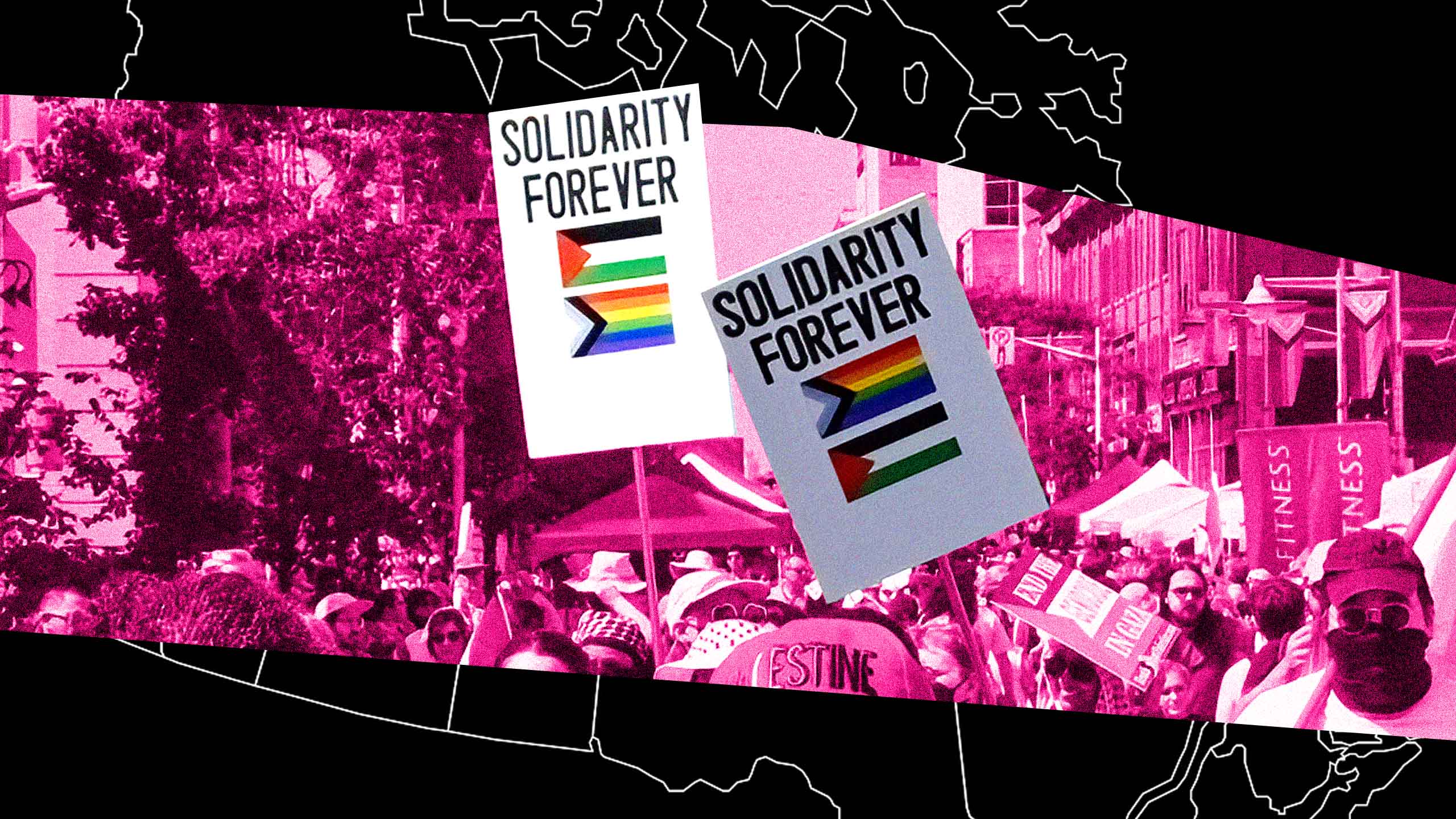
It was October 2023, and I was at a vigil for Gaza in London, Ontario, and the air was thick with silence. Names were read, candles were lit and people stood shoulder to shoulder in quiet mourning. In these spaces, grief spilling into the streets, love for a homeland transcending oceans, something else began to stir beneath the surface. You could see it in the quiet defiance of eyeliner behind keffiyehs, in the way some held hands, in the queer flags folded carefully into shoulders alongside Palestinian ones. Small gestures, soft signals—but unmistakable to those who know. A presence, often silent, but unmistakably there: the strength and sorrow of queer Arabs navigating this moment in history.
Across Canada and the diaspora, queer and trans Arabs are grieving what Amnesty International and a UN Special Committee have determined is a genocide in Gaza. An Israeli blockade has resulted in over 100 starvation deaths in Gaza since October 2023, and the United Nations estimates that Israel has killed 1,000 Gazan aid-seekers in the same time frame. Israel has killed over 62,000 people in Gaza, including over 17,000 children, according to Al-Jazeera. Elsewhere in the world, queer Arabs are showing up to organizing meetings, on university campuses, in intimate gatherings and at public protests with a clarity of purpose shaped by a lifetime of being pushed into the margins. But even in these movements for justice, some are finding themselves once again erased, or asked to compromise parts of who they are. At vigils, marches and campus events, some queer Arabs are discouraged from carrying Pride flags alongside Palestinian ones. They are told that it could alienate other members of the community or dilute the focus on Palestine.
Queerness and Arabness, which have long been framed as mutually exclusive by forces ranging from conservative cultural norms to Islamophobic Western narratives, should no longer be treated as a contradiction to navigate but should be embraced as intertwined forms of survival, memory and power. In the midst of genocide, surveillance and pinkwashing, queer Arabs are not only holding space for each other: they’re building new ones. And their vision for liberation may be the most expansive we have.
To exist as a queer Arab has often meant being spoken for, or spoken over. In both mainstream Arab communities and Western queer spaces, queer and trans Arabs have historically been made to feel peripheral. Too Arab to be comfortably queer, too queer to be recognizably Arab. Their experiences are frequently flattened into narratives of repression or victimhood, and they are rarely afforded the nuance, complexity or agency they deserve.
But over the past year, particularly in the wake of the ongoing genocide in Gaza, something has shifted. Queer Arab identity has emerged as a powerful site of political consciousness and cultural resilience. In vigils, marches, teach-ins and online spaces, queer and trans Arabs are refusing to be reduced to symbols. Instead, they are articulating forms of resistance deeply rooted in love, memory, spirituality and solidarity.
Queers in Palestine is an anonymous group based in Palestine with an online blog dedicated to spreading messages from the hearts of Palestinian queers. Messages that call for liberation, that call for an acknowledgement of queer Palestinian bodies as more than props used by Israel and its supporters to dehumanize Palestinians. “We refuse the instrumentalization of our queerness, our bodies and the violence we face as queer people to demonize and dehumanize our communities, especially in service of imperial and genocidal acts,” reads their statement, “A Liberatory Demand from Queers in Palestine,” which was last updated in November 2023. The statement was co-signed by over 500 LGBTQ2S+ and feminist organizations worldwide, around 50 of which are Canadian.
Some supporters of Israel have used queerness as a weapon against Palestine. In a July 2024 article for Jewish News Syndicate, writer Steve Rosenberg said, “Those who claim to be in the ‘Queers for Palestine’ camp would last less than 10 minutes in Gaza.”
The claim that queer and trans people “wouldn’t last 10 minutes in Gaza,” often used by Zionist commentators to discredit queer people who support Palestine, is both factually dishonest and politically manipulative. It doesn’t use queer identity to protect queer Palestinians, but to justify the bombing, surveillance and displacement of all Palestinians, regardless of their sexual orientation or gender identity.
This rhetoric, known as pinkwashing, falsely positions Israel as a “safe haven” for LGBTQ+ people while erasing its ongoing human rights violations against Palestinians. It weaponizes LGBTQ+ rights to obscure apartheid. In an article for the Times of Israel, American-Israeli businessman Ethan Kushner portrays this difference in viewpoints as the following dichotomy: Israelis who believe in a liberal democratic approach to LGBTQ+ rights, and Queers for Palestine, which believes in the interconnectedness of all oppressions. He writes, “They [Queers for Palestine] see their queerness not just as a sexual identity but as a marker of resistance to systems of power and marginalization.
“This is a point that many Israelis—especially those who approach queer identity through the lens of liberal rights and Western frameworks of equality—often miss.”
The latter’s framing is not incorrect, but when juxtaposed against the former it portrays Zionists as sober-minded civilians who prefer using democratic frameworks. Kushner conveniently fails to clarify that same-sex marriage is illegal in Israel.
In reality, queer Palestinians do not benefit from Israeli “tolerance.” They are subject to the same checkpoints, bombings, military raids and dispossession as anyone else in occupied Palestine.
Kushner and Rosenberg’s narrative dehumanizes queer Palestinians by suggesting that their existence is impossible in Arab or Muslim societies. It denies their agency, flattens their identities and assumes they must be spoken for instead of listened to. It erases the long history of queer and trans Palestinian resistance, and ignores the real work being done on the ground by organizations like alQaws, which supports queer life within Palestinian society. A grassroots organization, alQaws defines their politics as “Palestinian community-centred,” they mould a safe space for queer Palestinians through services including a support hotline and community centres. Portraying queerness and Palestinian liberation as incompatible silences queer Palestinians and isolates queer Arabs in the diaspora. It pressures them to choose between their queerness and their homeland. It attempts to drive a wedge between their identities, when in truth, many experience them as deeply intertwined.
But there have always been queer Palestinians and Arabs who refuse that binary—insisting on the acceptance of a unified identity no matter how much it peeves others who attempt to process it. A thought-provoking article published in LGBTI News and written by N.D. Plume argues, “Queer and Arab are complementary … Our sexuality makes of us Arabs to each (other), and constitutes a site of overdeterminacy that allows us to imagine ourselves as Arab identified individuals. I become Arab to you at that site of coming together.” Plume is making a non-sensationalist, provocative-but-true assertion of an undeniable fact: the identities of “queer” and “Arab” are not contradictory but a harmonious set of qualities that comprise the essence of millions of people.
Jad Salfiti, a queer British‑Palestinian writer, warns against Zionist pinkwashing in a June article for The Guardian. “You can’t in good conscience celebrate Pride in the West while knowing … the arms and funds that are killing queer Palestinians.” He condemns the cynical use of LGBTQ+ symbols—like raising a Pride flag in Gaza—as tools “to distract from other human rights abuses.”
This framework shatters the myth that liberation for queers and liberation for Palestinians are separate causes. There are queer Palestinians, and the greatest threat to the development or existence of any movement supporting LGBTQ+ rights in Palestine is genocide. How do we expect their rights to exist as equal members of society to flourish if their homes, families, hospitals, schools and society at large are being destroyed?
Sa’ed Atshan, in his book Queer Palestine and the Empire of Critique, reminds us: “The systems of Zionism and heteronormativity intersect … they need to be challenged simultaneously.”
On the ground, this theory shapes reality. Journalist Afeef Nessouli, who has reported from Gaza, writes about the interconnectedness of queer identity and resistance, and that true solidarity must involve listening to and amplifying queer Palestinian voices, not subsuming them under a broader narrative.
Izat El Amoor, a queer Palestinian writer, remembers dancing to Palestinian music and finding joy that intertwined cultural heritage and queerness in a 2024 piece for the literary platform Apogee. “The shared experience of navigating this struggle makes Palestine a queer issue, as both queer individuals and Palestine itself wrestle with the meaning and preservation of home.”
But this is not merely theory, this is lived experience. And as Palestinians and the broader Arab community continue to challenge narratives used to erase them, they are also creating support networks around the world, allowing the community, routinely ignored, to flourish.
The mutual aid network run by the Muslim Alliance for Sexual & Gender Diversity (MASGD) provides direct financial and emotional support to queer and trans people impacted by genocide, with a strong focus on Palestinians in Gaza. Since Oct. 7, it has distributed over $200,000, including $70,000 specifically for queer and trans Palestinians, helping cover essentials and supporting evacuation efforts. They offer free peer support sessions led by a trans Palestinian facilitator. They are rooted in community care. They prioritize rapid response, cultural understanding and solidarity. They support a community ignored by mainstream relief systems.
These voices, from Palestine and across the diaspora, dismantle the argument that queerness and Arabness—or pro-Palestinian politics—can’t coexist. Instead, they illuminate a vision of liberation that refuses to separate identity from struggle. They show how queerness, Arabness and solidarity bind together in radical acts of survival: through care, mutual aid, poetry and protest.
In doing so, queer Palestinians and Arabs at large carve new spaces, spaces in which love and grief inform liberation. They demand that movements make room not just for our bodies, but for our fullness, for candles lit in grief, joy, resistance and memory, together.
 Why you can trust Xtra