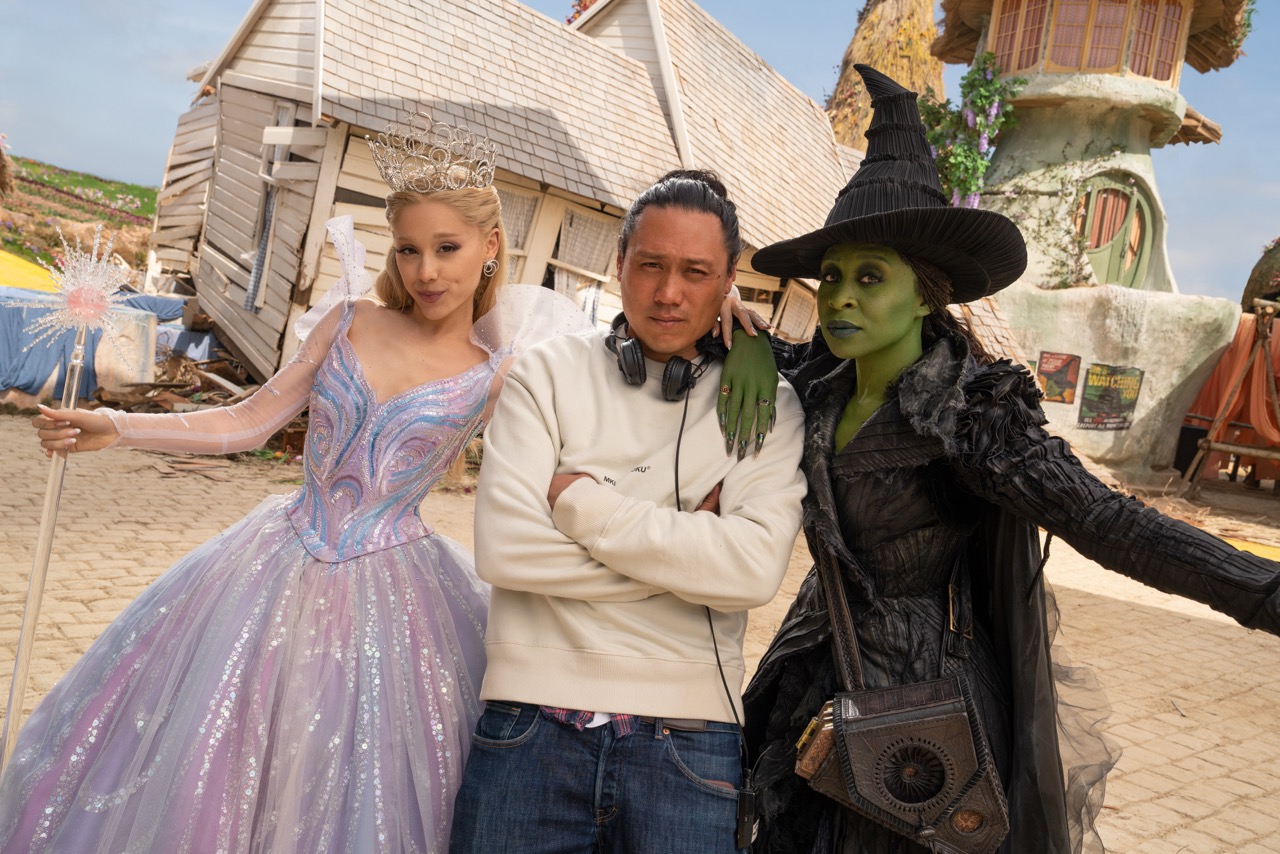
This week’s release of Wicked: For Good marks the final chapter in the two-part cinematic adaptation of the beloved Broadway musical and book that have been a beacon of joy for many LGBTQ2S+ people. Wicked: For Good delivers on the promise of the first film and the high expectations set by Cynthia Erivo’s Elphaba as she brought Part One to a triumphant close by belting the shiz out of “Defying Gravity.”
However, there’s an edge to Part Two that feels appropriate in the context of the overall darkening of the picture for LGBTQ2S+ people in the year since everyone began holding space for “Defying Gravity.” For Good picks up a few years after the first Wicked ends. Elphaba now lives as an outcast, while Glinda (née Galinda) pluckily enjoys being a mouthpiece for the tyrannical Wizard (Jeff Goldblum). It’s a familiar story for many queer people: a BFF grows distant from a friend who comes out against the status quo.
As Elphaba seeks an ally in her quest to pull back the curtain on the Wizard’s lies, she encourages Glinda (Ariana Grande) to see her through the same eyes that others do. It’s a touching moment where the respectful chemistry between Erivo and Grande hits one of the franchise’s highest notes, as one friend acknowledges the “otherness” within their relationship and the ways she’s benefited from her social privilege. Their ensuing duet of “For Good” does for Part Two what “Defying Gravity” did for Part One as the star-crossed besties acknowledge their collective growth through their shared experiences.
“I think a lot of it is about how to be an ally, but maybe not in the sense of the word ‘ally,’” the film’s director, Jon M. Chu, tells Xtra. “In the sense of being a friend, of looking at each other as human beings, of saying, ‘This is not some sort of agenda.’
“This is the purpose of our existence: to look at other human beings and understand them and feel for them and help each other,” Chu continues. “It’s not an agenda. There’s no list.”
Chu’s deflection from the queer subtext (or gay “agenda”) to a broader humanist perspective is, on one hand, perfectly fair within Wicked’s message about loving and accepting people of all stripes. But it inadequately takes ownership of an aspect of the movie that deserves a lot of credit. Letting people feel seen and recognizing their reflections in these characters is definitely part of Wicked’s agenda. Just look at all the mirror shots and exchanges in which Elphaba, Glinda and Prince Fiyero (Jonathan Bailey) trade remarks about beauty both physical and inner. Chu presumably grasps this angle after making that motif so powerful in the film, even if he didn’t say so directly in our interview.
On the other hand, there’s something striking about listening to the straight director pivot as he brings the answer around to the queer actors, such as Bailey and Erivo, who make the Wicked films so vibrantly alive. “These are the best [performers] in these roles,” says Chu. “They understand these roles, they understand the wounds of these characters, and they’re going to be able to communicate this in the most beautiful way. I love that we don’t have to debate it. It just is a fact. Now you can have Johnny Bailey as the [first openly gay] Sexiest Man Alive [in People magazine]. You can have Cynthia Erivo as Man of the Year [as GQ recently named her], and it just is. Why debate it any longer?”
The films embrace the power of positive presentation. There are a number of queer actors in the cast, like Erivo, Bailey, Marissa Bode as Elphaba’s sister Nessarose, and Bowen Yang and Bronwyn James as Glinda’s Tweedledee- and Tweedledum-type sidekicks, plus Colman Domingo’s much-hyped voice performance as the Cowardly Lion—only a few lines, but a welcome addition nonetheless. Moreover, Grande’s huge gay fan base and her support for the LGBTQ2S+ community adds a paratextual layer to Glinda that both invites and supports the queer/ally reading of Wicked for anyone who’s looking.
“There’s this thing that says ‘there’s cathedrals everywhere if you’re willing to see them,’ and I feel so blessed in my life,” says Chu. “I think that everyone I bring into the circle—Cynthia, Ariana—they see the world in this beautiful light too. Even though their lives have been complicated, even though they’ve been looked at as ‘othered,’ even though they’ve been hated upon in certain aspects by people out there, they are survivors through it. They also see the beauty of surviving it.”
This philosophy, again, is perfectly fair, as Wicked benefits from performances that feel lived-in. But Chu’s cathedrals adage isn’t a Wicked quote. It’s a line from conservative writer and podcaster Jordan Peterson, who said that gay people being allies with trans people was among the worst forms of oppression that queer folks have faced. Chu presumably (hopefully?) doesn’t know the source he’s quoting, so the train of thought becomes muddled, if borderline cringe. But the sincerity with which he interprets it speaks to Wicked’s earnest effort to be inclusive.
That sense of community is well earned, but being the spokesperson for the biggest film of 2025 (sorry, Avatar) means owning and understanding the conversation in which the film finds itself, not shaping it to fit an easily digestible framework. But perhaps there’s a cathedral here amid chaotic sound bites from the campaign trail. If the first Wicked offered an exercise in holding space, then Wicked: For Good serves a lesson in claiming space.
This notion echoes throughout the film. The performance of “For Good” illustrates how and why Wicked continually invites many queer readings through the pairing of two women. They make peace by singing about how their lives have been shared for the better. The film adds to Wicked’s sense of claiming space with a finale that sees Elphaba, Glinda and Fiyero confidently enjoy the next steps of their journeys as equals. As the two queer actors serve as the model union in Wicked’s finale, the film plays against the heteronormative couplings that traditionally close Broadway musicals and Hollywood movies.
Meanwhile, Glinda has a transformative moment after Fiyero leaves her for Elphaba. As Grande performs the new song “The Girl in the Bubble” with heartfelt gravitas, Glinda sings about stepping outside of her comfort zone. The song recognizes how her bubble, both literal and metaphorical, keeps others at a distance. As Grande pops Glinda’s bubble, and the darker edge of For Good serves as a reality check to the first film’s candy-coloured escapism, the new Wicked says more about being an ally than any iteration of the musical ever has.
Chu seems to implicitly grasp this sentiment. He references “The Girl in the Bubble” when asked about bringing Wicked to life with a kind of depth and scope that simply can’t be achieved on the stage. Put another way, he finally gets it when asked a question about using space.
“Immersing someone inside and outside a point of view will compel you more than ever to say, ‘Hey, I am trapped in my own bubble and there’s things happening outside and I don’t have to listen to it,’” he says.
“But if I hear closely to these edges,” he notes, mimicking the action of putting an ear to a bubbly wall, “maybe I’m willing to pop my bubble. My life’s not affected, but I can effect that change because they deserve it, because we’re all in this together. I think that that’s the power of this movie and the power of everybody who worked on this movie. That was always our intention for the very beginning.”
Call it being an ally or being a friend, but Chu’s journey down the Yellow Brick Road ultimately leads him to answer our first question. Allyship, after all, is about amplifying and uplifting voices that are traditionally marginalized. By virtue of Chu’s own answer, many key ingredients that make Wicked sing are prime examples of what the queer community needs from its supporters right now.

 Why you can trust Xtra