Journalistic disclosure: Middle-aged critic with prostate problems is sent by sadistic young arts editor to review a musical comedy about a monopolistic corporation that controls access to everyone’s toilets. Running water is a major element of the sound design. Now read on.
Successful musicals in the last couple of decades have fallen into three main camps. One is the grand melodramatic style, complete with special effects like the Andrew Lloyd Webber shows or Les Miz. The second involves a basic plot line that allows the recycling of favourite pop songs or pop groups: This would account for the popularity of Mamma Mia or for the upcoming We Will Rock You.
The third camp (and here one uses the term advisedly) is aimed primarily at audience members who demand an ironic detachment from the very thing that is entertaining them.
Hence The Producers; enjoyed mainly as a parody of what the audience thinks Broadway musicals used to be about. Hence also Hairspray; an affectionate recreation of a film that was itself steeped in camp and irony.
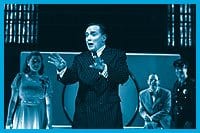
Ironic detachment is at the very heart of Urinetown, the New York production of which is now playing at the Bluma Appel Theatre, using Canadian cast members. And if The Producers and Hairspray owe their genesis to movies and parodies of 1960s styles, Urinetown is The Simpsons as musical theatre.
There are lots of plot and character similarities between the long-running cartoon series and the musical comedy, including even a sycophantically sissy assistant to the capitalist villain. But what they mostly share is the sense that the really smart people in the audience are those who can laugh knowingly at the parody while simultaneously recognizing the skill with which the parody is accomplished.
Certainly the skill is undeniable. Composer Mark Hollman and lyricist Greg Kotis have produced a wonderful pastiche of various musical song styles. Director John Rando, choreographer John Carrafa and set designer Scott Pask are the leaders of a group of very talented US professionals who have been connected to various productions of Urinetown for at least four years.
Their skills are matched by the quality of singing, dancing and comedy produced by the Canadian actors on display. David Keeley plays a disarmingly charming police thug. Frank Moore grabs the role of the villain with gusto and steals almost every scene. Stephen Patterson and Cara Leslie shine as the younger leads.
It is certainly not the fault of the individual members of the cast that this reviewer felt uncomfortable at times. Affectionate tributes to the songs and dances of old style Broadway musicals that celebrated ethnic life like Fiddler On The Roof, along with parodies of black gospel choirs and song styles from the black civil rights era, are performed by a cast with only one visible minority member. That’s the trouble with irony – you have to be careful that it remains just a sophisticated way of seeing, and doesn’t veer off into insensitivity.
* Urinetown continues at the Bluma Appel (27 Front St E) until Sun, Jul 11; call (416) 368-3110.
 Why you can trust Xtra