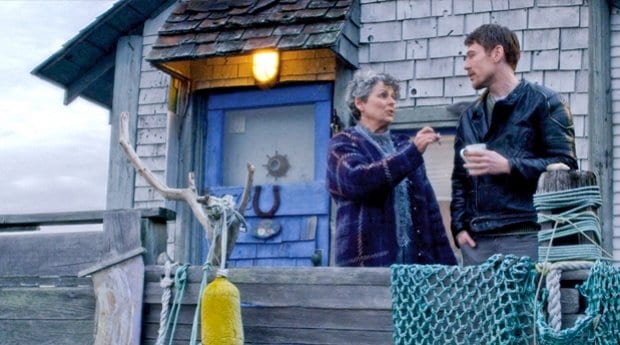
In Two 4 One, filmmaker Maureen Bradley’s debut feature, ex-lovers Adam and Miriam have a tequila-fuelled one-night stand. The last time they had sex, Adam identified as Melanie, a gender-conflicted lesbian trying to contend with Miriam’s polyamory. This time, with a slip of some donated sperm, they both end up pregnant.
My first question for Bradley is “Is the science accurate?” It’s clear from her chuckle that I’m not the first person to ask.
“Yep, it’s very accurate, it’s very well researched. Thomas Beatie is the most famous.”
Beatie is the author and activist who has given birth to three children since his 2002 sex-reassignment surgery. As intriguing as his story may be, it’s not the story that Bradley wanted to tell.
“Good drama is conflict. And facing the things we don’t want. Thomas Beatie’s story is fascinating, but he wanted to get pregnant — there’s no drama in that. There’s a lot of Oprah-value, but it’s not a movie; it’s a biopic,” says Bradley, who directed more than 40 short films before shooting Two 4 One. “We love to see people suffer and come through in the end. It’s that whole Aristotelian, cathartic thing. People can relate to that thing happening that you don’t want to have happen.”
That “thing” for Adam couldn’t be happening at a worse time. He’s embracing his masculinity. He’s considering phalloplasty. He tells his doctor he wants “to be complete.” He is, as Bradley puts it, “just on his way to get a penis.”
Adam’s spoken desire “to be complete” presents the film’s core conundrum. What defines a woman? What makes a man? And what — or whom — do you have to sacrifice to find out?
“We all have a story, and sometimes we screw ourselves up by believing that story is true,” Bradley says. This Buddhist perspective is delicately woven throughout the script as characters wrestle with what they think their story has been and what it will be.
Actor Gavin Crawford’s unaffected take on Adam is sweetly understated. In the opening scenes, we see a guileless, underachieving mattress-repair technician. But as histories are revealed, we discover the profound determination it’s taken to get Adam to this point. Crawford’s quiet portrayal is fully realized but never forced.
“I edited the film and I’ve seen those scenes hundreds of times, and they still get me,” Bradley says. “I never tire of watching Gavin.”
And then there’s Miriam. Miriam is not an extrovert — she’s an explosion. She seems to be in a constant state of self-contradiction, swinging dramatically between nurturer and narcissist.
“So many people who read the script disliked her. We really love bad men — Breaking Bad, Mad Men. But why are we so hard on female characters? I really like flawed characters. But philosophy aside, she’s real! And there’s probably more of me in Miriam than anyone else.”
A lesser script — and perhaps more importantly, a lesser actor — could’ve presented Miriam as simply inconsistent and implausible. But Naomi Snieckus embraces every opposing nuance of Miriam’s character so fully, we believe her. In fact, due to the actor’s commitment and charm, we couldn’t imagine her any other way.
When asked how much credit she would give Snieckus for creating a fully realized, if not always likable, Miriam, Bradley doesn’t hesitate. “Ninety-seven percent. I feel so fortunate to have worked with these actors.”
Canadian film and theatre royalty Gabrielle Rose plays Adam’s mother, Franny. A delightful amalgam of earth mother and elf, she sparkles in her harbourside cabin, her serenity a hint to her son’s inner strength.
Budget limitations and a mere 15-day shooting schedule ultimately led to Bradley’s decision to film in her home town of Victoria. “I knew people here would get behind me, and they’ve opened their doors,” she says. And the city’s position on the western edge of the country delivers the perfect backdrop. As Adam rides his vintage Ducati along coastal roads, the vast sea and sky are always just over his shoulder, suggesting an oceanic expanse of prospects.
“Probably the biggest lesson of my 40s was realizing you can liberate yourself if you just stop believing in the inevitability of your own story,” Bradley says. For Adam and Miriam, the unexpected discovery of the next chapter in their story is, well, pregnant with possibilities.
Two 4 One screens at the Vancouver International Film Festival
Wed, Oct 1, 9pm, Rio Theatre, 1660 Broadway
Fri, Oct 3, 11am, International Village, 88 W Pender St
viff.org
Watch the trailer here.
 Why you can trust Xtra