When Vancouver’s Frank Theatre put out a call in March with an emphasis on inviting queer people of colour to come together for a two-day workshop on racism in the city’s queer community, Anoushka Ratnarajah didn’t expect to see so many white people attend.
“That was an intense day,” she says. “I was surprised that any white people were there and it immediately shifted the dynamic in the room.”
The discussion that followed openly addressed issues of race and racism in Vancouver’s queer community, and paved the way towards The Pink Line, which will see its first presentation on June 26, 2016, at the Queer Arts Festival.
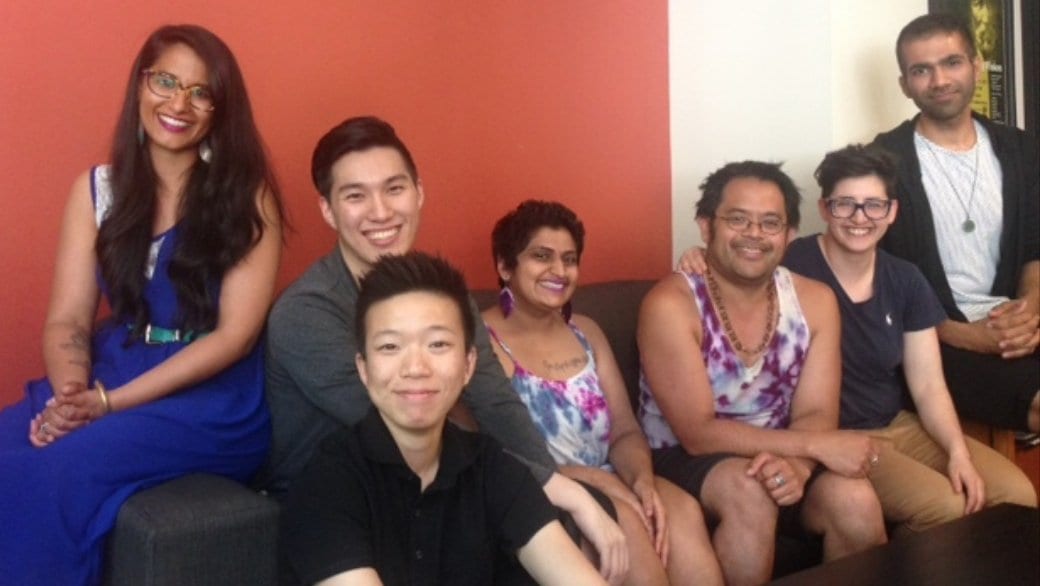
From that weekend-long workshop, five actors, including Ratnarajah, and a director/facilitator, Fay Nass, emerged. Together, they are creating a piece of theatre that shares scenes from the actors’ experiences to weave a narrative of overt racism, internalized racism, beauty standards, and feelings of desire in a community that favours white skin over others.
“We talk about how the western queer aesthetic is being imposed on us, and this idea of coming out,” Ratnarajah says, “needing to come out and having to tell your family and that being an integral moment in a queer story.”
One of Ratnarajah’s stories in The Pink Line takes a speed-dating approach, where she goes on a series of short, fictional dates with a number of white folks, only to field their clueless questions.
“It revolves around all of the questions that white folks have asked me on our first interactions with one another, like either just meeting or on a date. ‘Oh my god! You’re the first gay Muslim I’ve ever met!’” says Ratnarajah, who is half Sri Lankan and not Muslim.
“They just assume that I am, because I’m a brown woman,” she says.
“Or, like being, ‘How do you say gay in Hindu?’ — when Hindu is a religion and not a language,” she continues.
The idea is to create an environment of exchange that Vancouver seriously needs, according to Nass.
Multiculturalism isn’t enough, she says, when the culture is still dominated by white stories and everyone else is expected to fit into these norms.
She would much rather live in a trans-cultural environment, where everyone learns about everyone else, she says.
The play aims to open a dialogue about these cultural conventions, and ask why the mainstream doesn’t include other perspectives.
“It would be wonderful if people could realize how little they see people of colour on stage and that there’s something wrong with that, or how little they hear us,” Ratnarajah says. “Or maybe even reflect on how many people of colour you would have in your life.”
The Pink Line is for everyone in the community, Nass and Ratnarajah agree.
In part, the play aims to help white people feel racism on a new, less intellectual level. “The piece is very much coming from this embodied theatre practice,” Ratnarajah says, “and for us to be able to get into our bodies and share our stories from our bodies and move comfortably in the room and be full on stage.”
People of colour will likely recognize many of the storylines, especially since they reflect similar experiences shared while workshopping the script.
“Devising this piece together has been a healing experience for myself,” Ratnarajah says. “I hope it will be a healing experience for the queer folks of colour in the audience, and I hope it will be a door that white queer allies will walk through and join the conversation.”
The Pink Line
Sunday, June 26, 2016, 7pm
Roundhouse Community Centre, 181 Roundhouse Mews, Vancouver
Tickets $15–25
Editor’s note, June 24, 2016: This article was fixed to correctly spell Anoushka Ratnarajah’s name.
 Why you can trust Xtra