To celebrate Xtra’s 30 years of publishing in Toronto, we’re running a series of memories and musings from community members, current staff, writers and former staff members.
In the fall of 1989, I broached the idea of a literary review at Xtra. My intention was to broaden the paper’s readership by injecting culture into the politics and news items that were then its staples.
I was pleasantly surprised when the idea was approved — with curiosity by some, but with gusto by others, particularly advertising rep Colin Brownlee and then-designer David Walberg, later the paper’s editor (who won a design award for the 1992 edition of the Church-Wellesley Review).
Wanting to launch the review with pizzazz, I invited author Timothy Findley to write an introduction. When I contacted him, he seemed wary. He and his partner, Bill Whitehead, were volunteering at Casey House, not far from the Xtra office. I decided to pop over with co-editor Peter Hawkins for a chat.
Findley was courteous but non-committal, which brought out my persistent side. I told him of my passion for literature and how difficult it was to find publishers for LGBT-themed writing. Somehow, I convinced him.
On reading his introduction, I understood his hesitation: he’d been involved in a similar project where the editor’s choices were based on sexual rather than literary merit; neither a prude nor anti-erotic, he was simply disappointed in the writing. Our selections did not disappoint.
The issue proved a hit with readers when it appeared on April 27, 1990. Coincidentally, we had founded Canada’s first LGBT-themed literary review. The CWR ran annually to 1999 as a print publication and, in the last few years, branched into an online quarterly (now in Archives Canada).
For a decade, we published poetry, fiction, drama and memoirs. Many of the writers, unknown then, have since become favourites. They include Elizabeth Ruth, Brian Francis, Daniel David Moses, Debra Anderson, Jim Nason and RM Vaughan. Others, like Peter McGehee and Gordon Stewart Anderson, would be far better known now had they outlived the AIDS decade.
We were also among the first to publish Michael V Smith, Dale Peck, Derek McCormack and Billeh Nickerson. Novelists Paul Russell, Patrick Roscoe, Sky Gilbert and David Watmough, as well as poets Chocolate Waters and Achy Obejas, had already made their marks and we were happy to include them.
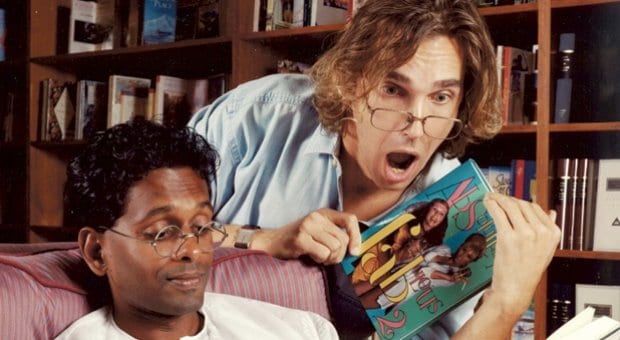
Subsequent introductions were provided by newcomers Shyam Selvadurai and Marnie Woodrow, as well as established writers like Jane Rule and Douglas LePan, the latter a two-time Governor General’s Award–winner who came out in his 70s. We had four assistant editors, numerous proofreaders and several designers, each of whom contributed to making the review a continued success right to the end.
Until recently, I thought the Church-Wellesley Review was a page from my past. Then, in 2010, I was approached by the University of Saskatchewan to contribute copies to the Neil Richards Collection of Sexual and Gender Diversity. Further interest came from the Pride Library at the University of Western Ontario.
The requests sent me scurrying to my basement to uncover copies I had diligently stored away, only to find them damaged by mice. I was ultimately able to put together two full collections and the better part of a third, which I completed with a scanner. Happily, these literary footnotes are now available for future-generation fans and historians of LGBT writing.
Lambda Award–winner Jeffrey Round’s latest novel is Pumpkin Eater. He continues to contribue to Xtra and was the editor of the Church-Wellesley Review from 1990-1999.
Read more about Xtra’s 30th anniversary.
 Why you can trust Xtra