My girlfriend and I often joke that our hometowns are polar opposites. I grew up in Richmond, B.C., a suburb of Vancouver where more than half of the population is Chinese. My girlfriend is white and from a rural community in southern Ontario, with fewer residents than the student count of my high school. The region, Kawartha Lakes, is mostly known as cottage country.
Every few months, my girlfriend and I go to the Kawarthas to see her family. It always feels like entering a different world. There, by her parents’ lakefront home, time seems to warp and slow: the languid summer days feel endless, and I could sink into that Muskoka chair facing the water and lounge in the sun all day.
But when we go into town, I’m reminded of where and who I am. As we entered a restaurant one evening, I watched heads turn and felt all eyes in the room fall on me. It’s hard to say whether it was my being Chinese in a pub full of white cottagers, or my being visibly queer and trans—or, most likely, both. But beyond those blank stares, I saw the parsing happening in people’s minds as they considered what someone like me could be doing there. My stomach dropped. I instantly felt like I was somewhere I shouldn’t be.
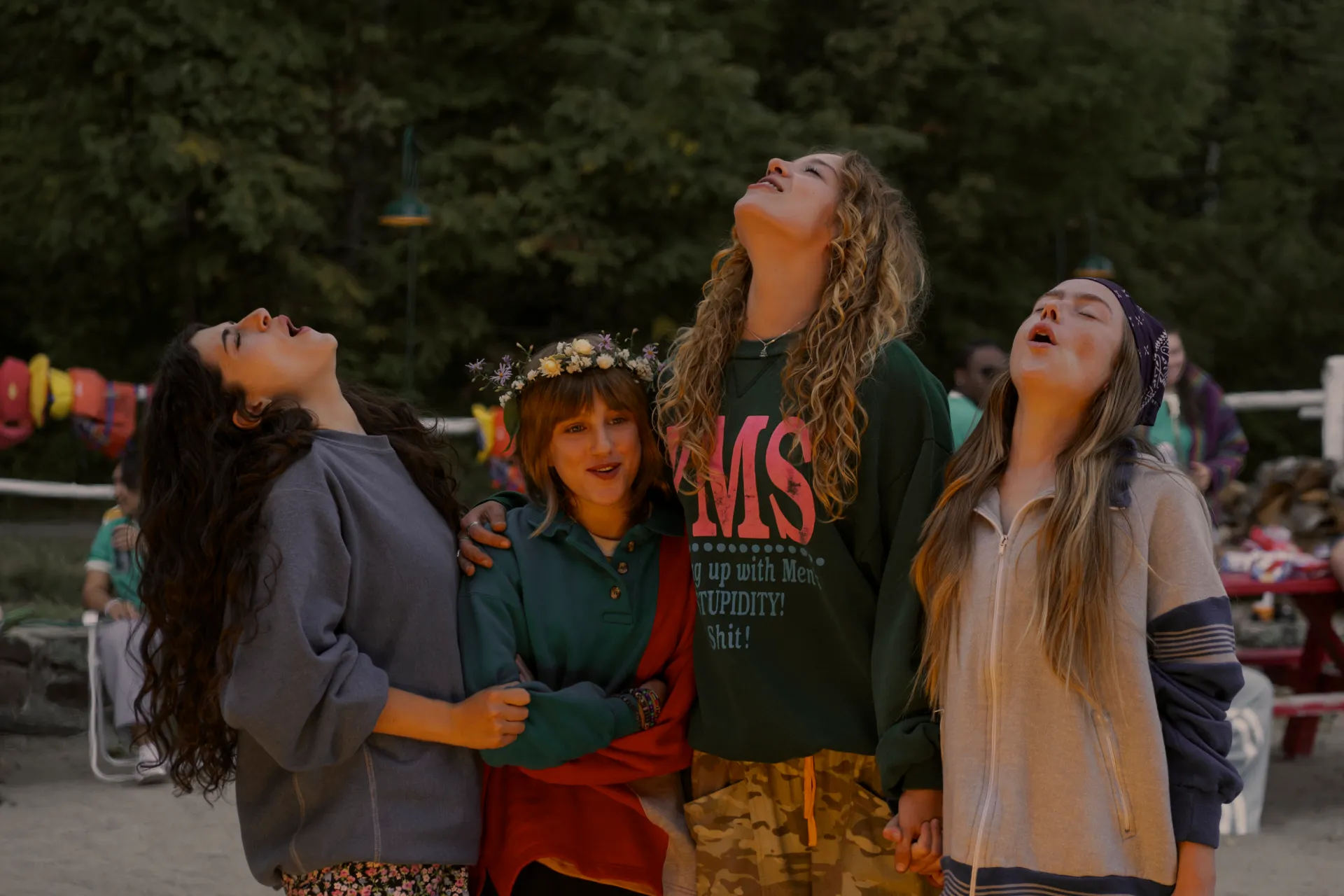
I was struck by that same feeling when I watched Sterling Point this weekend. The new surprise-hit Prime Video series, directed by Ontario-born actor-turned-filmmaker Megan Park, centres around Annie Jacobson (Ella Rubin), a 17-year-old living in Brooklyn Heights, New York. After the death of their estranged grandfather, Annie and her brother learn that they have inherited a fictional remote island called Sterling Point in the real-life Muskoka region of Ontario. Annie ventures to the area alone to unravel secrets about her family, but soon finds herself in a straight love triangle, exploring her sexuality and letting go of her newly out, gay, long-term boyfriend. She also joins a very queer friend group that includes lesbian marina workers Ramona and Oona, and queer chef Sully. (While Annie is shown dating men, she isn’t labelled in the show and definitely gives bi vibes.) By summer’s end, the city girl has fallen deeply for the island’s big-hearted cast of characters and quaint charm.
Set in peak-season cottage country, Sterling Point makes no secret of its desire to invoke an all-Canadian summer. Annie picks up a carton of Kawartha Dairy milk at the general store; boxes of Kraft Dinner make cameos on the teens’ kitchen counters. The friends taste-test BeaverTails, crash a Canada Day cottage party, float lazily on tubes and go cliff jumping. And of course, there are plenty of shots of boats racing across shimmering lakes, weaving past lush green islands under vast clear skies.
I couldn’t help but feel a twinge of excitement in recognizing some of that Canadiana portrayed onscreen. But greater than that, I felt a kind of sadness, and that same swirling feeling in my stomach as when I go into town in the Kawarthas with my girlfriend. These experiences that are nostalgic to many, which are so rooted in Canadian identity and in belonging to this country, are not ones I grew up with. They’ve never been mine, and never will be. Maybe I don’t want them to.
I wonder if these same thoughts run through the mind of Sully, who is played by Filipino-Canadian actor Nikko Angelo Hinayo. Alongside Annie’s love interest Ellis (played by Jacob Whiteduck-Lavoie, a member of Kitigan Zibi Anishinabeg), Sully is one of few people of colour in the main cast, and in the show overall—the only others who come to mind are Ellis’s mother, a rude friend of Annie’s other love interest, and the subject of one of Oona’s soon-forgotten flings.
Sully is effervescent and unabashedly queer, and a proud kid of gay moms. Would he feel the freedom to be himself in real-life Muskoka? Would he still wear cute halter tops and denim skirts, crack jokes about Oona hooking up with his mom? Even in the idealized universe of the show, Sully isn’t afforded much space of his own. He is a steadfast and loyal friend who brings the party, cooks comfort food and offers advice that reflects a remarkable perceptiveness about the people he loves. And yet, he doesn’t seem to exist in a world beyond that of his friends’; in fact, in an early episode, he is literally left behind, treading water in the lake and calling out to his friends who have sped away on a boat.
Advertisement
I wonder, too, what Sully makes of growing up in a predominantly white town. For a long time, I was deeply embarrassed about being from Richmond. I was well acquainted with many white Vancouverites’ disdain for our Chinese-language store signs and their claims about a “Chinese invasion” of the area. As a kid, that insidious notion that a refusal to assimilate meant that we didn’t deserve a place here wormed itself into my brain and calcified.
When I first learned about “the cottage” a few years ago, it was easy to dismiss it as white culture. It was something that I could cosplay and try to shapeshift into, but to which I had no real attachment. To me, those luxury waterfront homes pointed to an obsession with ownership, obscene displays of wealth and reckless expansion. And that’s not to mention how the romantic narratives of cottage culture conveniently discard the millennia-long history of Indigenous people’s use of these lands and waters, and disregard the grave impacts of development and recreation on local ecosystems.
It’s much harder, however, to deny the cottage’s place in the popular imagination. For many, cottage country holds a promise of what Canada is and should be. Muskoka—deemed “the Hamptons of the North”—is a vacation destination for the David and Victoria Beckhams and Steven Spielbergs (and Kaia Gerbers, as name-dropped in Sterling Point) of the world. It’s a getaway that’s largely only accessible to a very specific and privileged demographic: rich, white, cis straight people.
For the people of colour who make it there, it is often at a cost. Sometimes it comes in the form of the look you get from white cottagers in town; other times it’s more explicit, like last fall, when Ontario MPP Hardeep Grewal and his family were verbally harassed while eating ice cream in a town in Muskoka. Who gets to go to the cottage says as much about Canada, if not more, than the vision of the cottage itself. That’s true even of the fictional characters we place there, whether they’re New York City teens with generational wealth or millionaire Canadian hockey players.
@xtramagazine There were no trans characters in films released by major studios in 2025. That’s according to GLAAD’s Where We Are in Film study, which examined LGBTQ2S+ representation across 225 films released by 10 major studios in 2025. Not only did none of the tracked films include a single trans character but LGBTQ2S+ representation declined overall. Of the 225 films tracked, only 20.4 percent contained LGBTQ2S+ characters, a decrease from the 23.6 percent inclusive films counted in 2024. Representation has been trending down across the board. LGBTQ2S+ characters are not only in fewer films but they’re also getting less screen time and have less narrative significance. GLAAD president and CEO Sarah Kate Ellis warned that the overall decline in LGBTQ2S+ characters on screen will have long-term impacts. “If the industry doesn’t prioritize investing in films with LGBTQ2S+ characters, it risks losing a generation that will go elsewhere to find entertainment that does include our community.” We break down what you need to know from the annual report. #lgbtqnews #film #glaad #filmnews #lgbtq ♬ original sound – Xtra Magazine
All of this makes it difficult to watch Sterling Point and not consider how racialized people fit into the town at its core. Yes, it is undeniably refreshing to see a YA story where queerness is not treated as an anomaly, where there are no plot lines about homophobia or coming out or the difficulties of accepting your sexuality. It is a joy to see a slow-burn lesbian romance back on our screens, to witness playful Sapphic flirting à la Reneé Rapp and to watch a scene that captures the experience of dysphoria in simple terms. Sterling Point even nails a lot of points that are rare to see on TV in general: there are beautiful portrayals of sisterhood, thoughtful musings on grief and non-cringey rich stretches of teen dialogue (even if they’re at times unrealistically emotionally mature). But it is painful to see a show that prides itself on the accuracy of its representation—of queer people, of Muskoka—invisiblize the kinds of conflicts that emerge in the real-life spaces it re-creates. Even in this dream of a world, whiteness is front and centre.
Arguably, Sterling Point’s cast and story merely reflect its setting in an overwhelmingly white place. But the show follows in a line of recent media that sells Canada as cottage country: most memorably in Heated Rivalry, but also in Park’s 2024 movie My Old Ass, in the new Prime Video romance series Every Year After (adapted from Torontonian Carley Fortune’s bestselling novel) and in an upcoming Canadian adaptation of the reality show Summer House. Sterling Point can’t be detached from the legacy of Schitt’s Creek, a show that portrays an unexpected small-town haven for queer people that is predominantly white. Those images of this country, while true to the experiences of a select few, can’t be all that we have.
Over the years that my girlfriend and I have been visiting her parents, I’ve come to find a bit of familiarity in cottage life. I’ve memorized the waters that my girlfriend and I have paddled in, the brook where I searched for frogs with her young nephews, the route to the sandbar where her family and I tossed around a football. In town, I’ve started looking for traces of the queer and trans folks and people of colour who call this place home: the Pride flag stickers in a new record store, a shop owner’s passing remark about his husband, a Chinese Canadian restaurant tucked between a gift store and a pilates studio. Those signs of life remind me that we deserve to be here, too.

 Why you can trust Xtra