Artist and sculptor Jordan Maclachlan’s favourite local “bottle-man,” a true gentleman named Ernie, used to frequent her neighbourhood a couple of times a week, searching for empty wine bottles to cash in at the Beer Store. “One day he showed up looking ashen. I could tell that he was quite ill,” she says. “He told me that he had scattered mothballs around his pillow at night to keep the mice away from his face while he slept at his shelter. He had inadvertently poisoned himself with these mothballs and died a couple of months later.”
This tragedy is part of the inspiration for Maclachlan’s ongoing exploration of urban “living,” homes and homelessness, most recently her exhibition Condo Living.
Maclachlan, who grew up in a very liberal family, spent her formative years at a Quaker school in Boston – an open-concept classroom mixing outdoor time, music, science and art, which she loved. “When we eventually returned to Toronto, the difference was stupefying,” she says.
A career creating with her hands began here. “We used to dig up our own clay and collect pieces of bark, et cetera, and bring them back to the classroom, where we were encouraged to make whatever we wanted. If I try to describe in adult terms what doing that feels like for me . . . it gives me the feeling one gets when falling in love. Very powerful.”
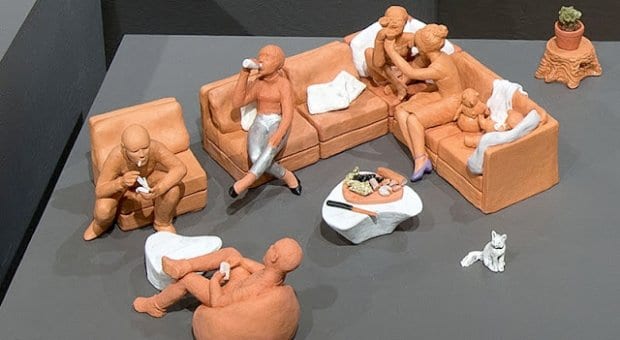
Condo Living grew from her work on Unexpected Subway Living, a large installation first shown at the Museum of Contemporary Canadian Art and later at Orange in St Hyacinthe, Quebec. The exhibition focuses on delightfully bizarre tableaus of small clay figures, intricately detailed, living out what happens behind closed condo doors. The creatures in her world love, party, screw and vomit, each piece isolated in the artful gallery setup.
Maclachlan doesn’t shy away from sex and queerness in her work; even the promo picture of the exhibit shows a sculpture of two men cuddling in a bathtub. “I am the parent of a gay teenager and have witnessed what it is like for a gay individual growing up,” she says. “This has been the single most devastating, heart-wrenching experience I have ever encountered. Young people are just that — young. They are children, just becoming. If there is anything that I believe is horrific or wrong or perverse about humans, it is this: their hatred of those who are simply different.”
Condo Living
Runs until Sat, May 11
ArtBarrage
80 Spadina Ave, ste 208
artbarrage.com

 Why you can trust Xtra