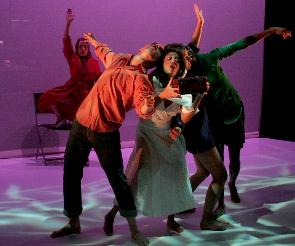
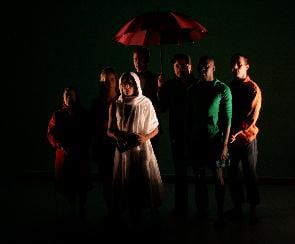
Nada Humsi, Jessalyn Broadfoot, Pam Patel, Brad Cook, Badih AbouChakra, Tawiah Ben M'carthy and Trevor Copp perform in Body 13. Credit: Nicholas Cumming
MT Space had a hit in 2011 when it presented The Last 15 Seconds at Theatre Passe Muraille. The collectively devised show incorporating dance and video received rave reviews and toured internationally. Now, MT Space returns to Passe Muraille with Body 13, a similarly created show that tackles sexuality and intercultural dialogue.
Also returning is performer Trevor Copp. “I began working with MT Space on The Last 15 Seconds,” Copp says. “It was named one of the top 10 shows of the year. The day Majdi — the director, who I knew from doing our masters’ together at Guelph — called me to offer me the part, I had no reason to believe I’d ever work as an actor again. I now have had to quit everything except acting. I owe MT Space a great deal.”
As well as working with MT Space, Copp now runs his own company, Tottering Biped Theatre, which will bring the show First Dance, a theatre-dance hybrid about gay marriage, to Hamilton’s Theatre Aquarius this February.
In Body 13, several storylines with recurring themes intersect. “It’s about love across differences,” Copp says. “Age, race, orientation and religion all shed radically different lights on love — especially impossible loves. Body 13 declares the death of the unevolved: the white straight man unwilling to acknowledge that his place atop the ladder is gone.”
Copp’s storyline involves a queer romance affected by cultural beliefs and mental-health issues. “I play a gay man with severe social anxiety encountering a Ghanaian man whose gay identity is a problem in his culture,” Copp explains. “He’s the one with the cultural taboo, yet I’m the one with the trauma — it makes no sense, as in life.” Tawiah M’carthy, creator of, and performer in, Obaaberima, which opened Buddies’ current season, plays the Ghanaian man.
Copp and M’carthy’s storyline is very specific and complicated, but when MT Space began work on the show, they didn’t actually know which stories they were going to tell. Some plays begin with a script; for Body 13, it was a single word — “‘sexuality.’ That one word was the entire pre-process concept that we walked into the room with,” Copp says. “That was it — no text, no characters, nothing.”
The process of creation was longer and more collaborative than anything Copp had experienced outside of theatre school and began with the cast walking around the rehearsal hall, finding sounds and rhythms. “When the first characters appeared, it was like a miracle; as were the scenes that followed soon after. Eight weeks — a radically long time in theatre terms — led up to the first workshop, then we returned a year later and wiser to put four more weeks into a finished show, and then we premiered. It’s long and intense enough that you are concretely a different person than when you began.”
The “MT” in MT Space stands for Multicultural Theatre, and the company has a mandate to represent diversity onstage, which is reflected in Body 13, where characters from a variety of ethnicities, sexual orientations and levels of privilege rub shoulders. As the title suggests, the show finds a connection between these disparate characters through the physical body.
“The body itself is the inexhaustible metaphor,” Copp says. “Onstage we accept the body becoming anything — shapes and lines in movement, the containers of our culture and history.” For Copp, the heightened theatrical world of Body 13 is able to explore these themes in a way only live performance can. “I don’t think you can talk about sex and difference in the same way without the bodies in the room with you, naked in front of you, unable to lie.”
 Why you can trust Xtra