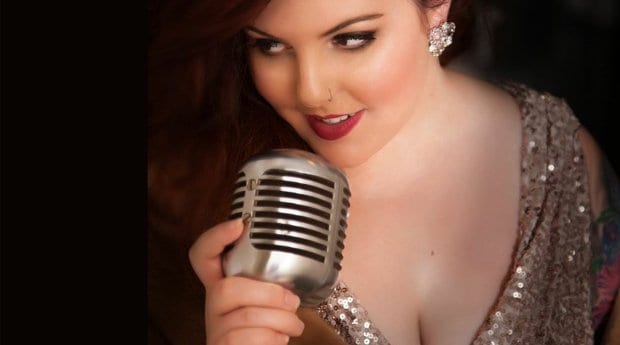
With 122 million YouTube views and counting, Macklemore & Ryan Lewis’s year-old ode to “Same Love” has touched people around the world, but few lives have changed as dramatically as Mary Lambert’s.
Lambert, who wrote and performed the “I can’t change, even if I tried” chorus on Macklemore’s hit, has, in less than 20 months, gone from crooning in coffee shops to singing a duet with Madonna at the Grammys and jamming with Jennifer Hudson at the MTV Video Music Awards.
The songwriter/slam poet lives in Seattle and this month is coming north to headline the Vancouver Folk Festival.
Lambert’s road to stardom started with a late-night phone call from her friend Hollis Wong-Wear, who had just contributed a chorus for Macklemore & Lewis’s song “White Walls.”
“We were in the poetry world together,” Lambert says. “She was such a big supporter of my work and suggested me for the song. I think the boys had tried everybody. I was a last resort because they had run out of options!”
Lambert laughs, humbly. “I wrote the hook in about two hours, they loved it, and I loved it too! It was a match made in heaven.”
That it was: while Macklemore’s supportive, anti-homophobia lyrics are deeply compelling, Lambert’s gorgeous soprano singing “she keeps me warm” is an integral part of the track’s appeal.
Less than a month after the CD’s release, Lambert and the band were fast-tracked to fame. When the group performed on The Ellen DeGeneres Show, Ellen introduced them as “my new heroes.”
Lambert’s life hasn’t been the same since.
As the Spider-Man saying goes, “With great power comes great responsibility.” Lambert continues to push emotional envelopes in her own solo career, living as an out, proud lesbian, writing a size-empowerment spoken-word piece entitled “Body Love,” and speaking publicly in interviews as a survivor of sexual abuse and other traumas.
“As soon as you can put that first card down and say, ‘This happened to me’ and be open about it, it really becomes healing, both for you and for the other persons,” she says. “We are harbouring a lot of guilt as survivors, and that is complete bullshit. I want to eradicate that as much as I can in my career.”
Though she’s hard at work on her first full-length solo record, dubbed Heart on My Sleeve and intended for release in October, Lambert says she’s thrilled to play the folk festival for the very first time.
“I’m so excited. I believe I’ll have my band up there with me. I love Vancouver so much!” she says.
Other LGBT performers slated to play this year’s festival include longtime folkie Ferron, who will not only perform as she’s done many times since the festival began in the late 1970s, but will also join a group of First Nations women as they honour their ancestors’ spirits with song and drumming on opening night.
Bluegrass fans can also warm to the roots-infused sounds of Ashleigh Flynn & the Back Porch Majority. Flynn’s most recent CD, A Million Stars, features a collection of stories involving noteworthy — but under-noticed — groundbreakers and genderbenders from the Wild West.
Guitar legend Nina Gerber (who has played with Jackson Browne, Bruce Cockburn and Nanci Griffith) will also be performing alongside legendary singer/songwriter Eliza Gilkyson.
Vancouver Folk Festival
Fri, July 18–Sun, July 20
Jericho Beach Park
thefestival.bc.ca
 Why you can trust Xtra