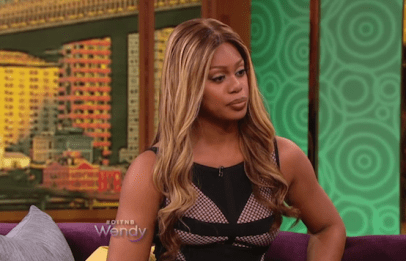

Laverne Cox was on The Wendy Williams Show, where she asked the host “How you doin’?” in both English and Hebrew, a language she picked up from all the New York Jewish men she’s dated.
Along with opening up about her love life, Cox revealed that she kept working at New York drag cabaret Lucky Cheng’s until filming of the first season of Orange Is the New Black had been completed. But Cox was quick to point out that she is not a drag queen. When Wendy then asked her to define what it means to be transgender, Cox explained:
“Transgender very basically means that the gender you identify as is different than what you were assigned at birth — very simple,” she said. “Transgender people’s experiences are really different. It’s an individual experience; there’s no one blanket transgender experience. It’s really about listening to individuals in terms of who they are and accepting people on their own terms.”
Watch the full interview to see why Cox won’t talk about her surgeries on camera, her thoughts on being the first trans Time magazine cover girl, and having her twin brother play her character (pre-transition) on Orange Is the New Black:
 Why you can trust Xtra