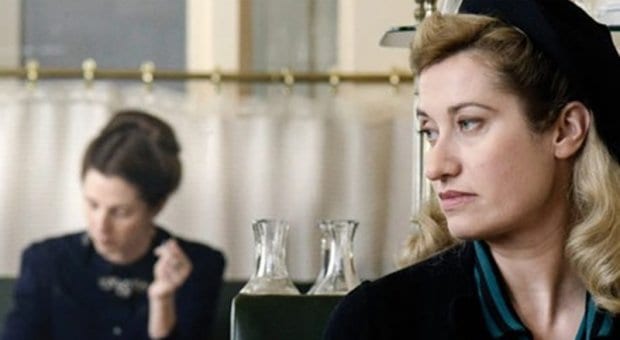
“Oh God, am I free then? Don’t say yes, don’t say no,” Violette Leduc pleads in her memoir La Folie en tête (Mad in Pursuit). This being the first signs of what will be her long-lasting intellectual and sexual obsession with Simone de Beauvoir, whose protégée she was to become immediately after the war. Director Martin Provost’s film Violette, which played at this year’s TIFF, captures the tone of Leduc’s writing perfectly — the madcap energy, the edge, the desire, the no-holds-barred, the loneliness, the melodrama, the anger. It’s all faithfully there, even though the film moves in sedate sequences and maintains autumnal colours.
All but forgotten now by English-speaking readers, Violette Leduc was likely the first literary memoirist to talk about growing up an illicit child of an unwed working-class mother, about lesbian desire and sex, the rejection of motherhood and abortion. She inhabited the memoir form the way it would be occupied 20 years later by the many writers of the second feminist wave: as consciousness raising and empowerment, as appropriation of the master’s tools, but also as a unique experimental form. Her fiction is interesting — The Taxi is written as a nonstop dialogue between two anonymous lovers, The Lady and the Little Fox Fur is an old woman’s flânerie, as much through Paris as through her own abject poverty — but it is in her multiple volumes about her own life that we see Leduc in all her glory.
Provost was interested in the time in her life before Leduc became a best-selling author. He divides the story into chapters, each named after a key person Leduc (played by Emmanuelle Devos) meets in that period. After some stalking of Beauvoir in Café de Flore, Leduc dares hand her first manuscript to the older writer, who reads it and, give or take a few edits, immediately finds a publisher for it — and none other than Albert Camus at the Gallimard. Sartre is also an early supporter, and Leduc almost overnight becomes part of French intellectual circles. She stays on the margins, low-selling and destitute, however, well into her third book.
Beauvoir is a key person on many a turn: she encourages Leduc to write, then to keep writing reception notwithstanding, connects her with influencers, meets for drinks, calms her down when necessary, picks up the many different kinds of tabs, and puts her on the right track. She is beautifully played by Sandrine Kiberlain, her costumes accentuating her tall, willowy build, reserved in gestures and facial expressions, always reasonable, never losing control. Provost, smartly, eliminates Sartre from the screen — he is not in the cafés nor in the editorial meetings where he in actuality must have been — because Sartre’s presence would hijack every frame and every conversation. Equally impressive, Provost goes for evoking the spirit of Beauvoir rather than the literal Beauvoir physique: the surviving recordings of her suggest a strident talker (“You could hear a cane in her voice,” said Philippe Sollers), but Provost avoided this kind of reduction and gave us the gentle, patient Beauvoir as she might have appeared to her contemporaries in the second half of the 1940s, and to the smitten Violette in particular.
At the same time, Beauvoir is also the securely established one, her career moving from good to better to the Prix Goncourt, and even her private quarters have an air of well-off elegance in contrast to Violette’s rental. To Violette’s excessive entreaties she often responds with “I am terribly busy,” and she mocks Leduc’s obsession with her as childish. She travels, she has plans, she is wanted. She can afford many things, including generosity.
And while Leduc wrote about her sexual relationships with women in a brave and inventive language — and was censored and rejected for it — Beauvoir denied hers until the last day of her life. Only after her Letters to Sartre and her early journals saw light of day in 1990 did her liaisons with women become documented — sometimes with her underage students, sometimes passed on to Sartre, more often than not with a great deal of drama involved.
Woman-to-woman love never had any prominent place in Beauvoir’s public writing and activism: we can argue whether her first novel, She Came to Stay, about a young woman who almost tears apart a Sartre-Beauvoir-like couple, is a disservice to the cause or not. Leduc, meanwhile, did her own thing. Thérèse and Isabelle, La Bâtarde, Mad in Pursuit, and L’Affamée — all refuse subterfuge. Provost’s film does justice to this impulse, and to the unique literary voice that was Violette Leduc.
 Why you can trust Xtra