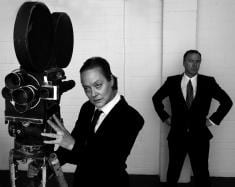
In the ’30s and ’40s, Hollywood’s first female film director, Dorothy Arzner, was an out lesbian and prodigious talent. Later generations of female journalists and academics claimed that Arzner was oppressed and suffered through her work, despite a living Arzner protesting the rewrite of her own life. This is the subject of Camera Woman: A Play in Two Parts, opening Dec 10 in Calgary.
Camera Woman is being produced by Urban Curvz, a theatre company whose mandate is to celebrate women’s stories and provide artistic opportunities for female artists. Urban Curvz’ new artistic director, Kathryn Waters, is directing the production.
“This play spoke to me when I was looking at shows for this season,” says Waters. “The messages in Camera Woman are the same themes that Urban Curvz as a company needs to be thinking about. When we pick plays and we explore the lives of women, are we doing them justice? Are we exploring them for all of their complexity or are we simply trying to prove some prefabricated thesis?”
Camera Woman was written by queer Toronto author RM Vaughan and has the zippy dialogue and cleverness that he is known for. He deftly deals with Arzner as covert feminist and queer activist versus Arzner as dedicated craftsperson and technological innovator (Arzner’s real life claim to fame was the invention of the boom mic). Waters underscores the point that Vaughan’s subtitle, “A play in two parts” is significant.
“The first part of Camera Woman plays out the scenario of ‘What if Arzner was the grasping, unhappy, tortured creature that the feminists of the ’70s and ’80s made her out to be?’ Part two is where Arzner, at the end of her life, confronts one of these feminists, taking her to task for interpreting her life falsely,” Waters explains.
Consequently, the audience is taken on a journey in which assumptions are made about a character and then broken. Carrying the audience on the journey is internationally respected actor Denise Clarke, who portrays Arzner.
“The cast is so good in this production. Audiences are going to laugh: there is a lot of wit and one-liners that the cast really delivers. Plus there is going to be a healthy dose of theatre magic,” says Waters.
“Glory for me, would be if the play causes audiences to run to their computers afterwards — to Google &mdash to do the ultimate justice to Dorothy Arzner’s life, and find out more about who she really was.”
Camera Woman: A Play in Two Parts.
Dec 10-19, 2009.
Pumphouse Theatre.
2140 Pumphouse Ave SW, Calgary.
403-263-0079.
Tickets and info at:
Urbancurvz.com.
 Why you can trust Xtra