Métis filmmaker Gail Maurice waited 20 years to make her new film, Blood Lines. Originally, she intended to play the film’s protagonist, Beatrice; instead, enough time elapsed for her to take on the role of Beatrice’s mother instead. The reason for the delay, Maurice explained in a Q&A following the film’s screening at the Vancouver International Film Festival (VIFF), was the queer romance at the film’s centre; when Maurice tried to get funding for the film, she was asked why it had to be a lesbian story, instead of focusing solely on the mother-daughter relationship. In addition to being plainly homophobic, these responses reveal a fundamental misunderstanding of what makes Blood Lines compelling—its exploration of knotty and complicated relationships through a queer and Indigenous lens.
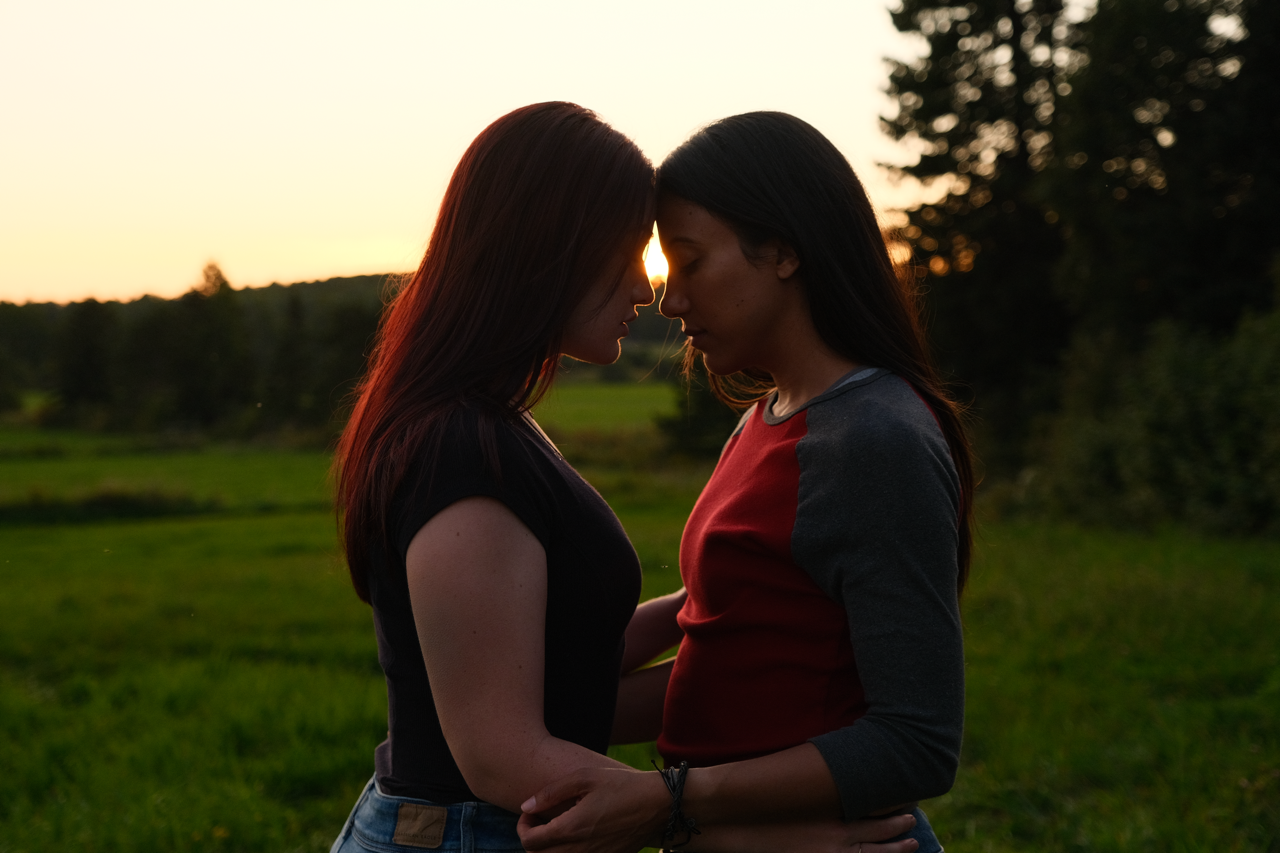
Blood Lines, which is Maurice’s second feature film after 2022’s Rosie, follows Beatrice (Dana Solomon), a young Métis woman navigating a complex relationship with her estranged mother (Maurice), and Chani (Derica Lyn Lafrance), who was adopted and raised in the city, and is now trying to track down her birth family in Beatrice’s small Métis community. The film explores the nature of family, community and Indigenous belonging, alongside the pain and loss perpetuated by colonial structures.
Over the course of the movie, Beatrice develops a romantic relationship with Chani, having first approached her with an offer to write a story in the local paper to solicit information about her origins. Late in the movie, though, there arrives a twist of such magnitude that it is impossible to discuss the movie without spoiling it: Beatrice and Chani are actually sisters, with Chani having been taken away by child welfare services shortly after birth, while Beatrice was raised in the community by her grandparents. This incestuous twist seems initially to be played for shock value, and may be predicted by certain viewers, particularly Indigenous ones. In the VIFF Q&A, Maurice revealed that the plot was inspired by her own concern that she might inadvertently bring home a relative while frequenting a lesbian bar.
However, following the initial shock of the reveal, Blood Lines does not shy away from delving into the emotional impact of the revelation, and situates it within the ongoing, decades-long context of Indigenous children being separated from their families. Chani, previously disappointed upon receiving a letter stating that her birth mother has declined communication, has now achieved her goal of discovering her birth family. But it is not a joyful reunion, and it does not resolve the loss she feels over having been taken from her family and community.
Early in the film, the pair attend a community meeting for adult adoptees; one attendee describes working up the courage to call one of his birth parents, only to hear a dial tone immediately after introducing himself. Throughout the film, Maurice conveys the resounding pain prompted by ongoing processes of family separation, wounds that cannot simply be healed when Chani does discover her family. A pair of foster parents whom Beatrice interviews are depicted as caring and well-intentioned, but Maurice demonstrates that the best of intentions amongst non-Indigenous foster parents do little to quell the inherent damage of family separation.
It is no surprise, then, that Chani’s newfound family ties provoke more emotion than they resolve, even beyond the added confusion of Beatrice and Chani’s prior romantic relationship. Though Chani initially flees back to the city, she eventually returns and has a frank conversation with Beatrice. Chani confesses that, even though she now knows the truth, she does not feel like she and Beatrice are family, and she still does not feel connected to their community. Earlier in the film, Chani witnessed first-hand Beatrice’s comfort and belonging in the community, even winning a prize for her jigging at the local Métis day. Learning that she is Beatrice’s sister, then, only amplifies her feelings of isolation and grief, as the knowledge that they are related by blood does not immediately impart a similar sense of belonging upon her. Here, Blood Lines challenges the logic of blood quantum, as knowing the details of her family connection does not make Chani instantly at ease within the community.
The film does not, however, suggest that Chani’s feeling of being an outsider is fixed, nor that she cannot become a part of the community she was born into and taken from. Throughout the movie, a group of older women in the community, whom Maurice referred to in the Q&A as the “granny gang,” repeatedly interrupt Beatrice during her work at a gas station, taking her on drives soundtracked by Dolly Parton and encouraging her to reconnect first with her mother and then with Chani. Later in the film, the granny gang similarly push Chani to reconcile with Beatrice, showing that they wish to nurture and guide Chani even if she may not feel the immediate connection she might have expected or desired.
Beatrice also tells Chani that, while Chani may not hold the same cultural knowledge or sense of belonging as Beatrice, being a part of their community is about a way of being in the world, of seeing and belonging to the land, which transcends how they were raised and to whom they were born. Beatrice was raised by her grandparents in the community and is knowledgeable about her Métis culture, projecting a sense of ease and belonging that Chani desires. Despite these seeming advantages, though, Beatrice also struggles to reconnect with their mother, still living with her anger, loss and sadness at having been left with her grandparents. Again, here, the film is cognizant of how colonial structures and systems still inflict damage on Indigenous individuals and communities.
However, despite its exploration of pain, loss and intergenerational trauma, Blood Lines is not a bleak film, nor one devoid of hope. While Chani and Beatrice’s romantic relationship ends due to the revelation of their familial connection, it is initially a tender portrait of queer love and connection. After Chani and Beatrice learn they are sisters, one of the granny gang’s members tells them firmly that they did not do anything wrong, emphasizing that it was their initial, forcible separation, rather than their queer love, which has caused their pain.
In the Q&A, Maurice stated that her own queerness was never a big deal amongst her family and community, and said that she wanted the film’s love story to reflect that feeling of acceptance. While Beatrice and Chani cannot continue as lovers, and do not yet feel like sisters, they have a genuine connection that can persevere. Through Maurice’s direction, a provocative twist that may derail another film instead provides hope for comfort and connection, as a salve to settler-colonialism’s malevolent effects.

 Why you can trust Xtra