By now, you’ve probably seen at least one piece of art from Tom of Finland. The aesthetic has become iconic: Tom’s hyper-masculine, black-and-white illustrations have become a standard for homoerotic art.
And now, Tom’s homeland is honouring the legendary artist with a series of stamps. According to FinnBay, The Finnish Postal Service, or Itella for short, apparently, has released a sheet of three stamps depicting a sub sitting between the legs of a well-muscled cop. Also some man-butt, because hey, Tom of Finland. Why not, right?
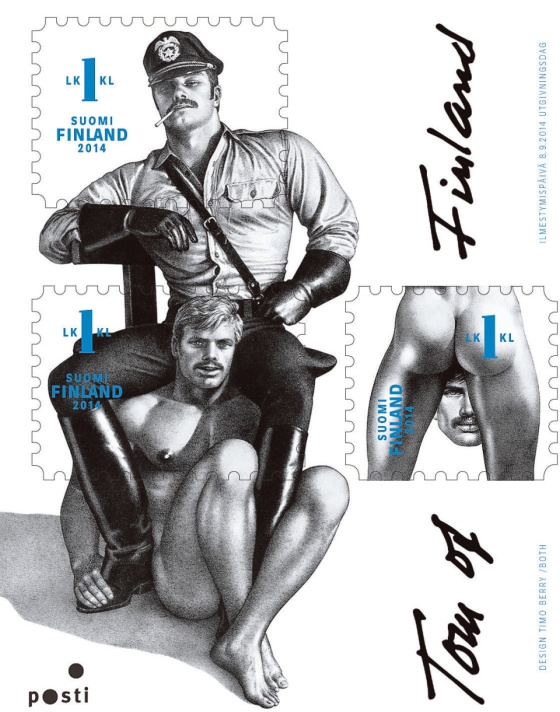
[Itella/via Helsingin Sanomat]
Itella praised ToF’s work, saying that his works have “attained iconic status in their genre and had an influence on, for instance, pop culture and fashion. In his works, Tom of Finland utilized the self-irony and humour typical of subcultures.”
Well, if you wanted to get someone to go back to snail-mail, naked men is certainly one reliable way to get them on board. Although you may want to be careful who you send this to. Nothing ruins a loving, handwritten letter to your mother like sticking a naked male ass on it. (Unless you have that kind of a relationship, in which case . . . Good for you! No jokes; that’s a very deep relationship you share.)
Watch Xtra’s video on Art and Queer Culture, including Tom of Finland, here.
 Why you can trust Xtra