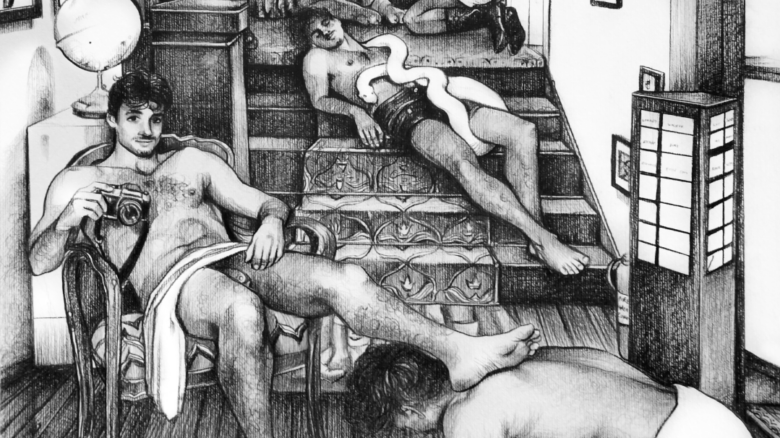
Heated Rivalry has fundamentally changed the conversation about LGBTQ2S+ inclusion in professional hockey.
That’s a lot of impact to assign to a small-budget Canadian TV show full of relatively unknown actors and a lot of explicit gay sex. But as a result of the smash hit show—which follows two rival players in a fictional NHL who fall in love—there have been massive spikes in ticket sales for NHL games, the Ottawa Senators have started selling themed jerseys and arenas are playing t.A.T.u. for the hockey-watching masses. Stars Hudson Williams and Connor Storrie have become A-listers overnight and bookstores can’t keep the series it’s based on in stock.
Suddenly, it seems like hockey is the gayest sport around.
But along with this conversation has come a wave of rightful criticism over professional hockey’s actual real-life inclusion efforts. There still has never been an openly gay player in the NHL itself (minor leaguer Luke Prokop came out in 2021). The league faced massive criticism for restricting Pride nights and visual Pride flags on jerseys and stick tape in 2023. And the sport itself is still rife with misogyny and homophobia—just look at the Hockey Canada sexual assault scandal that unfolded over the past few years. One hockey podcaster also faced blowback for supporting the popularity of Heated Rivalry on the surface while knocking it behind the scenes.
It’s a fascinating dichotomy to witness—a popular culture zeitgeist obsessed with fictional gay hockey players, while the ongoing fight to make space for actual gay hockey players to exist continues. It’s particularly notable in 2026 as one of the most visible signifiers of hockey’s progress on LGBTQ2S+ inclusion, Pride Tape, marks its 10th anniversary.
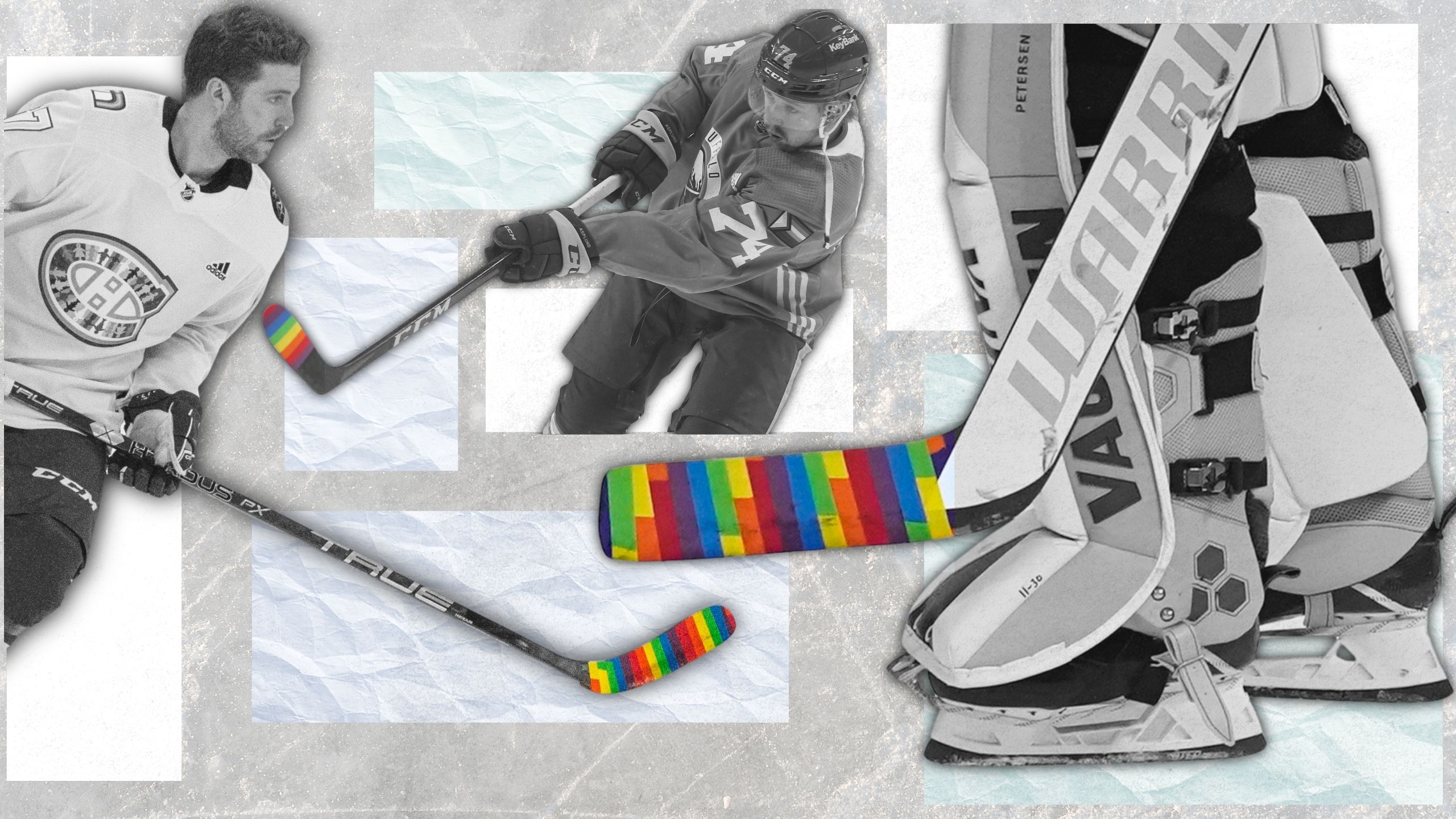
Ten years feels like both an eternity and just yesterday when thinking about something as seemingly basic as rainbow hockey stick tape. But from its origins in 2016, Pride Tape is anything but simple.
The rainbow hockey stick tape started as an inclusion effort in Edmonton from Dr. Kristopher Wells and marketer Jeff McLean. Wells, now a Canadian senator, was a professor at the University of Alberta at the time and one of the directors of the Institute for Sexual Minority Studies and Services where his research focused on sport inclusion. He says that his research would often come back to the idea that queer and trans boys avoid team sports.
“I had this research question: Why are young gay and bisexual boys dropping out of team sports at younger ages than their cisgender heterosexual peers?” Wells says. He says the research is well documented “that often young gay boys and men go into individual sports and avoid team sports. And a lot of it’s because of the culture of the locker room.”
He says that he and McLean—who worked with an Edmonton-based ad agency at the time—wanted to develop some sort of public campaign to address the issue and landed on Pride Tape after seeing the impact of Pride flag visibility during the 2014 Sochi Winter Olympics in Russia. Wells says that the idea of a universally visible symbol like the Pride rainbow colours felt like a concise and simple way to encourage athletes to show their support for their LGBTQ2S+ peers.
The pair worked with professional hockey tape manufacturers to develop the product as something players could actually use in games to signal their allyship both on and off the ice. The initial production run was funded in 2016 via Kickstarter, with then Edmonton Oilers captain Andrew Ference—who a few years earlier became the first NHL players to march in a Pride Parade—as an early supporter.
Wells says Ference gave them good advice around prioritizing the quality of the tape itself, so players would actually use it.
“He said don’t count on all the guys using it […] not because they don’t want to. It’s just because they’re so superstitious right [about] tape and their routines, and you know [about] hockey culture and things like that,” Wells says. “So our goal was never to have everybody use it.”
Since 2016, organizers have sold the stick tape through their website and distribute free cases of it to sports teams and organizations around the world. Wells says that the goal is for sales to offset the costs of the tape they give away. Since starting with the Oilers in 2016, Pride Tape has become synonymous with Pride Night initiatives across the NHL as various players and teams feature the tape and associated initiatives to raise awareness around LGBTQ2S+ inclusion in hockey.
Pride Tape has also partnered with the league for the past three years to present an annual Pride Cup event fundraising to support LGBTQ2S+ hockey associations. This year’s event in Surrey, B.C., benefited Vancouver’s the Cutting Edges and the Seattle Pride Hockey Association.
“Kristopher and Jeff launched the Pride Tape initiative 10 years ago and each season we see more players highlighting their ongoing support for the LGBTQ+ community by using it. Pride Tape and the addition of the annual Pride Cup have been important initiatives supporting our work to make the sport of hockey inclusive,” NHL Players’ Association executive director Marty Walsh told Xtra in a statement over email.
But it was the league’s attempt to ban the tape in 2023 that truly thrust Pride Tape into the spotlight. In October 2023, the NHL instituted a new rule barring team “theme nights,” which included Pride Games and their associated signifiers. The bans came after a small handful of players objected to participating in Pride nights and wearing the associated themed jerseys amidst a wider cultural backlash to public displays of diversity, equity and inclusion efforts.
“Our goal was never to have everybody use it. It was just to have the people who understood what it meant to use it, to be real allies with that,” Wells says. “The beauty of Pride Tape is not the tape itself, but the magic and the power is in the conversation that that tape enables in those spaces, like the locker room, to say, ‘You’re not alone. There’s an ally here. There’s somebody who supports you here, even if you’re not out.’”
Following the ban, many NHL stars, including Oilers captain Connor McDavid, spoke out in support of Pride initiatives. Arizona Coyotes player Travis Dermott actively defied the ban, adding Pride Tape to his stick during a game. After a few weeks of public backlash, the league ultimately rolled back the blanket ban on Pride Tape.
“After consultation with the NHL Players’ Association and the NHL Player Inclusion Coalition, players will now have the option to voluntarily represent social causes with their stick tape throughout the season,” the league posted on X at the time.
With Pride Tape now entrenched as an icon of the league’s inclusion initiatives, it has expanded around the world to other sports including lacrosse, baseball and softball.
That something like Pride Tape started in Alberta, of all places, might come as a surprise to many people, seeing as Alberta has made international headlines in recent years for its restrictive anti-LGBTQ2S+ policies, including banning trans women and girls from women’s sports, suspending gender-affirming medical care access for young people in the province and restricting certain books from school libraries in the province. But Wells argues that Pride Tape could’ve only happened somewhere like Alberta.
“I think things [like Pride Tape] come from Alberta because that’s where they’re needed the most. Resistance breeds a certain creativity,” he says. “I don’t know that Pride Tape could have happened anywhere else. It happened here because it needed to happen.”
Wells says that 10 years into Pride Tape, there’s still plenty of work to be done with hockey and the NHL when it comes to inclusion—and yes, Heated Rivalry will play a part.
“Everywhere we’ve seen Heated Rivalry debut, when it premiered in Britain or Australia, sales of Pride Tape go up,” he says. “People are wanting to do more than just watch the show. They’re wanting to go out into the community and show that they’re an ally, particularly in the sporting space.”
Canadian author Rachel Reid, who wrote the Game Changers book series Heated Rivalry is based on, features Pride Tape in later books in the series. Wells is optimistic it will make an appearance in future seasons of the show and bring more attention to real-life inclusion initiatives in professional hockey.
“I did my due diligence and I sent a case of Pride Tape to the folks at Crave and said to share it with the production team and with the actors as well,” Wells says.

 Why you can trust Xtra