
"There are a lot of bodies buried in that city," says Luscombe of his hometown, Hamilton.
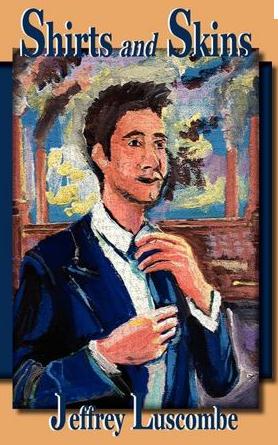
The horrifying legend of Evelyn Dick, the Hamilton mother who was convicted of the gruesome murder and mutilation of her husband and child in 1947, seems an unlikely start for a coming-out story. Yet that’s exactly where local author Jeffrey Luscombe’s first novel, Shirts and Skins, begins.
The book tells the story of troubled Josh Moore, beginning with his childhood, haunted by the story of Dick and the other discomforts of his life in a particularly grimy corner of Hamilton, Ontario. And although the tensions of Josh’s confused, if understated, sexuality do make this book a gay coming-of-age tale in one sense, the episodic life story is in many ways a vehicle for Luscombe to explore urban decay and class divisions in the once booming industry town.
As Josh figures out how to fit in at school and later the steel mill, his chances of a life outside of Hamilton become increasingly dim. He has a decrepit house, an overworked mother and a distant father failing to cope with a brutal combination of agoraphobia and alcoholism. These challenges mean, however, that the possibility of escape orbits constantly around his reluctant acceptance of the cards he’s been dealt.
With limited mobility and a boatload of shame, Josh carries forth with an outwardly straight existence until late in his life, and very late into the book. Indeed, for as many changes as he experiences, Josh never actually goes to Toronto.
“I don’t think enough is written about Hamilton; I’m intrigued by Hamilton,” Luscombe says about his hometown (though he now lives in Toronto). “And I actually like Hamilton.”
It’s fair to say Luscombe might not fit, stylistically, into the local genre Timothy Findley half-jokingly coined “Southern Ontario Gothic.” It includes the likes of Alice Munro and Robertson Davies. But there is certainly something sinister and quietly political about the Hamilton Luscombe creates, buzzing quietly under the shadow of a gruesome crime and a deteriorating infrastructure.
Stern realism coupled with something of an alternate universe creates a clever and unlikely backdrop for the quintessential gay coming-of-age genre, and it’s not unintentional. Luscombe intentionally disrupts that tradition.
“A lot of [coming-out stories] seem to be about people at boarding schools, you know?” he explains. “There doesn’t seem to be a lot for people on the blue-collar end of the spectrum.”
As a result of this relocation, typical coming-out story tropes, such as early (or even late) moments of homoeroticism, or the culture shock of the big city, are stifled, even kept from the reader. This reiteration of Josh’s conditioning toward privacy, or shame, adds a clever layer to the social commentary that is the driving force of the book. And although the prose is somewhat unremarkable and a bit unstable in its imagery, Luscombe gives a solid voice to an undersung narrative and an underappreciated town. Shirts and Skins invites its readers to dig a bit deeper.
As Luscome says, “There are a lot of bodies buried in that city.”
Shirts and Skins
Jeffrey Luscombe
Chelsea Station Editions
$18
 Why you can trust Xtra