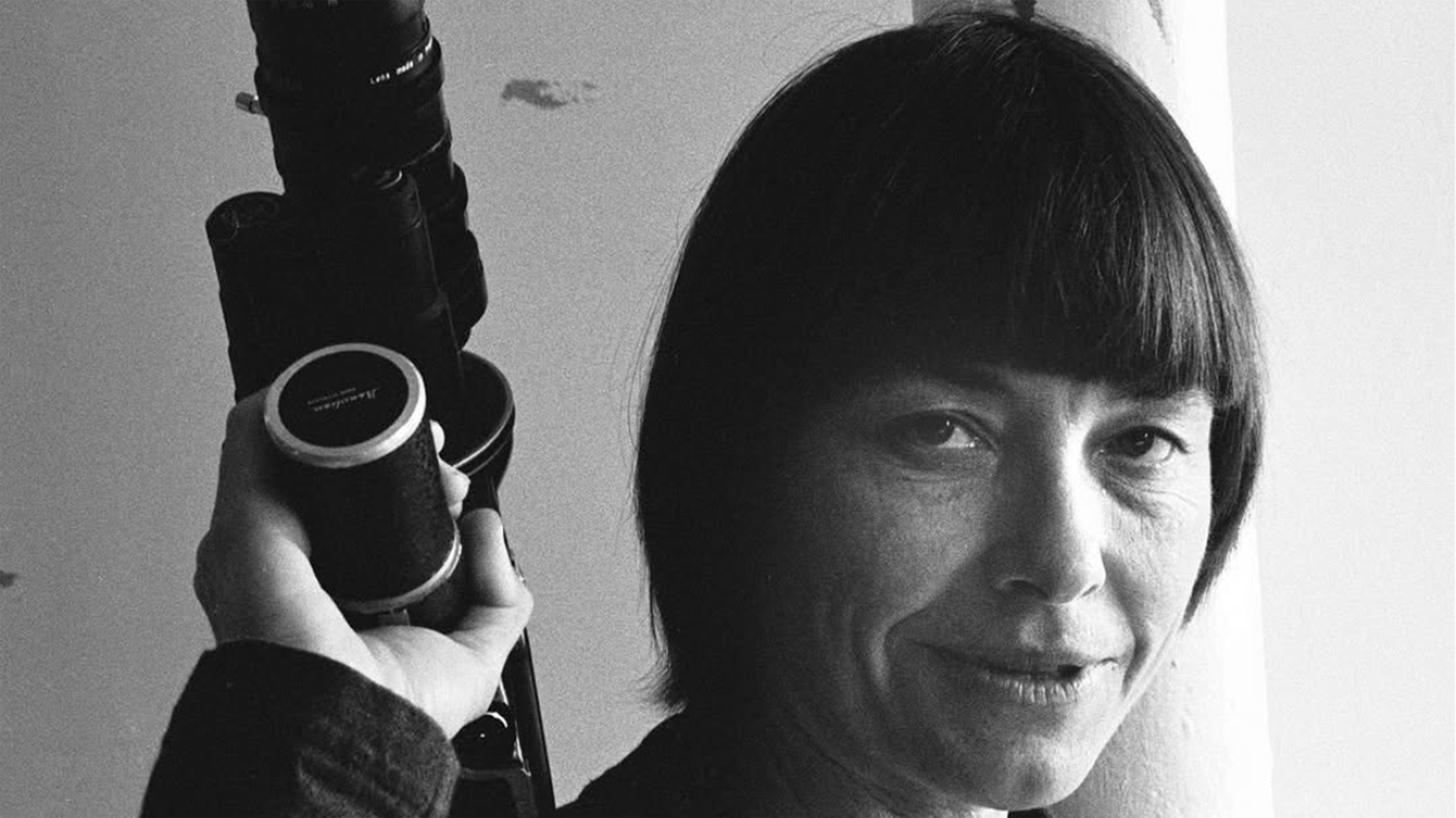
Barbara Forever opens with a black screen and Barbara Hammer’s voice. Hammer, an experimental filmmaker who passed away in 2019, is the documentary’s subject, and she’s testing out a microphone. It’s as if she’s speaking to the microphone, having a conversation with it to see if it is succeeding in capturing her voice to digital file and by extension to the archive. A few minutes into the film, Barbara in voiceover quips: “I want to have something to give, and I want to exist, forever.”
Barbara Forever, which is currently on a limited theatrical run, is essential viewing. Hammer challenged artistic and cinematic norms and depicted what she had never seen before: lesbians in love, lesbians in strife, lesbians living. Performance, biography and archival footage played key parts in her work to create her story and the histories of other women. O’Connor’s documentary was made following the success of her 2022 short Love, Barbara, also on Hammer, and follows Hammer’s artistic approach. Hammer becomes known to O’Connor, then to us, through an exploration of her work (over 80 films!) and her archive, a “life lived through film.”
Previous documentaries such as 2018’s Dykes, Camera, Action! and 2019’s Queer Genius situate Hammer in the lineage of queer cinema, but Barbara, Forever is Hammer’s alone. It is a multivalent, generous and love-laden perspective on a central figure in queer cinema, and if you are anywhere on the LGBTQ2S+ spectrum or in any way creative, this film will be very important for you.
Hammer started making films in earnest shortly after coming out as a lesbian at 27, when she describes herself as “being born.” The revelations came hand in hand: in touching a woman’s body erotically and looking through the camera lens, Barbara discovered a new world and way to live. The result was a beautiful weaving of the two, with a presence and feel of touch in the cinematic image. She also created something entirely unique at the time: lesbian erotica by lesbians, which she called “a lesbian history in a world where we’re invisible.”
Her body and her intimate relationships were central to her practice. In a feverish year and a half at the beginning of her career, she cranked out 13 films, many of them inspired by the people in her life.
Hammer’s depiction of the queer body as a site of experience is an essential element to my own practice as a queer video artist and filmmaker. Though I only (finally) started watching her work earlier this year, I am wholly indebted to it. Her use of her personal life to broach more universal topics is a technique that is integral to my project, and getting to see how this played out in her life in Barbara, Forever was an artistic revelation for me.
Specificity is an advantage and not a weakness when it comes to artistic creation. After moving to New York in the 1980s, Hammer talks in the documentary about how she was encouraged to choose between being a lesbian filmmaker or an experimental filmmaker. She was told a lesbian audience was interested in seeing realistic depictions of their community, while an experimental audience was not very interested in seeing lesbian sensuality. Her work is an important and unique amalgamation of both. Forsaking one for the other would have diminished her artistic importance while shrinking possibilities for queer cinema to mere essentialism.
History is at the forefront of Hammer’s works. “Who makes history and who is left out?” is a question repeated throughout her corpus. During a conference at the 1992 Sundance Film Festival for Nitrate Kisses, Hammer’s first feature-length film, director Todd Haynes discussed Hammer’s project as “rewriting history as something that is … provisional.” By “provisional,” he meant mutable, non-fixed and non-linear.
Hammer’s films embraced non-linearity because they were, by her description, lesbian films, and therefore required a new shape and language. Hammer’s 2000 film History Lessons does just this. The film manipulates archival footage into a history of lesbians, aided by re-enactments and shots of Hammer rifling through film canisters. To be able to generate a history in the face of its erasure or inexistence is a powerful creative tool for queer artists. It also calls into question the validity of existing histories, as well as a desire to revise, rethink and retell the past for a brighter future.
Hammer worked with younger artists later in life to produce multi-generational collaborations, and gave away her B-roll footage so that her work could live on through the works of others. Gaining an understanding of one’s artistic lineage is a sublime perspective shift. No work is created in a vacuum, and all ideas are generated from the ideas of others. To better carry that role out, I believe that knowing who comes before you is essential. Barbara, Forever is a great depiction of an artist creating her own path and language in reaction to limitations. It’s essential viewing for any queer person doing basically anything in the world right now.
The end sequence of the documentary moved me to tears. It is a series of clips of Barbara getting up after filming herself in a scene to reach around the camera to hit the record button. There is a specificity to this action that is immediately understood by anyone making videos or films and using themselves as performers or subjects and creates an instant connection. It is in this series of movements that the importance of this documentary and Hammer’s work became clear to me: Hammer always stayed true to who and what her artistic vision was, regardless of any dissuasion around her.

 Why you can trust Xtra