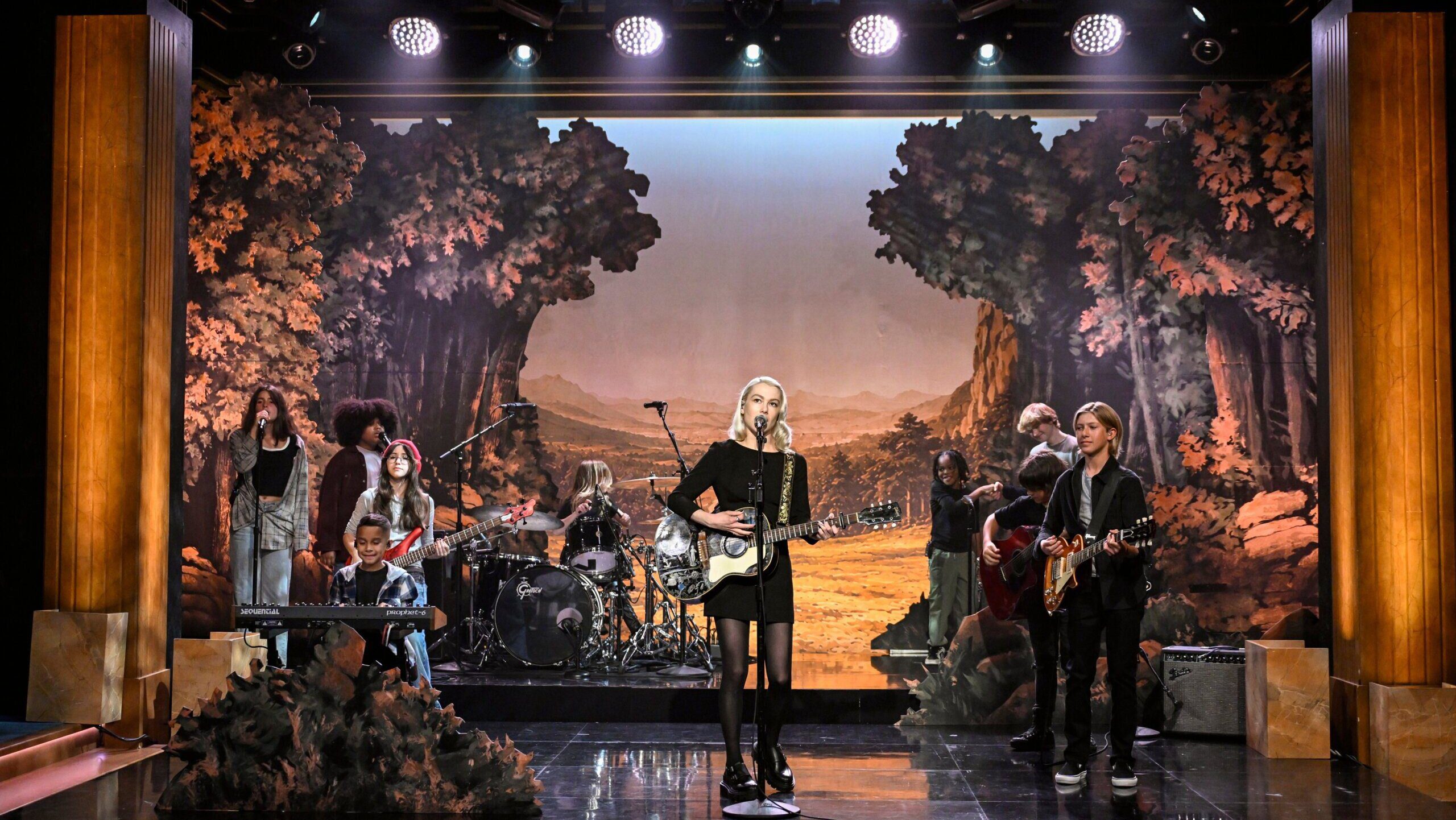
The first time we hear Phoebe Bridgers on Lost Weekend, her first solo record in six years, she is hiding from the audience. Her voice, so often hushed and haunting, is filtered first through the cold tenor of a vocoder on “The Outside,” the opening track. “Crying in a suit and tie,” she intones, “but you should see the other guy.” Her voice here is robotic and distant, the vocoder a shell for her own exhausted body, as if the machine functions as a manifestation of dissociation.
Over these opening seconds and minutes, she draws the outline of a funeral, rumoured, but not stated, to be her father’s. The preternatural grief of it pushes her to hide behind this digital mask, allowing her voice to be removed from the body, save for the chorus, where her softest self returns with honest appraisal. “When I am on the outside, watching,” she sings, “I am on the outside, watching.”
No matter how stark or profoundly beautiful they might be, I believe that nothing is ever fully real in most sombre stories. There’s often, but not always, a detail that’s not entirely true, as if we might protect delicate hearts with nothing more than artifice as a shield. A name might get changed, or a detail skewed and distorted. There are stages of grief, each of them softening blows to the heart, but it’s not often that we consider how important lying is to surviving our own anxious memories.
Consider then the subterfuge of grief when we think about the market value of earnestness. This idea of raw honesty serves as a foundational layer of pop fandom. How real and open an artist is, regardless of the stage or the lights in the marquee, has become a commodity. Bridgers knows this better than most; her music has edged on desperately earnest since she broke through in 2017 with “Motion Sickness,” a song that would later be heavily implied to be about an abusive relationship she had been trapped in with long-cancelled alt-country musician Ryan Adams. Bridgers revealed herself with an open book, creased at the spine, allowing all-too-eager fans to read whatever blood managed to spill out on the page.
Just as she has been the Ur-example of the modern-day sad songwriter, it’s easy to sidestep the part of her that revels in devilish trickery. There was a time when Bridgers was a vibrant presence on Twitter, a born poster and a skilled shit-talker, who once called David Crosby a “little bitch,” and told a mousy reply guy to shut the fuck up after they reacted passive-aggressively to a post she made that simply stated “fuck TERFs.” Just as she threaded the bleeding truth of her lifelong Elliott Smith fandom, she sharpened the edge of her deadpan humour. As if one could not survive without the other.
Now in her early 30s, her Twitter profile is gone, just as quickly as the site has lost the lustre of its hedonistic youth. The once omnipresent Bridgers became quieter, holding her secrets tighter than ever. She played new songs for people at select shows in towns throughout North America, and asked fans to put their phones in Yondr pouches to keep the secret of these songs alive. Reportedly, you couldn’t bring in a pen or paper, on the off chance someone tried to bootleg a show in longhand. Rumour has it that at one stop, she made a joke about someone potentially smuggling an Apple Watch into the venue in their ass, but without proof it’s just another detail to make a story better.
When we talk about the desire for all this earnestness, I wonder how it is for anyone who is not a cishet male in any creative industry. The music industry, like any machine, churns and eats and destroys everything and anyone who veers too close to its jaws. Where cishet men are often lauded for being willing to display anything that edges on sincerity, it’s everyone else’s duty to bear the weight of vacillating between complex emotional states, and the turmoil of those dark waters. Sharing too much of yourself becomes dangerous, especially as time leaves ghosts in all our stories.
It’s this grief and loss that haunts the hallways of Lost Weekend. Bridgers lost her father in 2023, and in the years between this and her last solo record, Punisher, on which she seems to have written about the tangled tether between them. “You called me from a pay phone, they still got pay phones, it cost a dollar a minute to tell me you’re getting sober,” she sings on “Kyoto,”” Punisher’s second single. The pay phones and the terrible cost of them aren’t true, but they’re real enough to hurt. Her pained facade is masked by these conjured details. “You wrote me a letter, but I don’t have to read it,” she continues on “Kyoto,” wrapping up the story of him. The songs on Lost Weekend, muddied somewhat by producer Jack Antonoff’s heavy hand, are nonetheless a welcome return for the former queen of the eternally online. On “Kill Me,” Bridgers sings, “This is gonna kill me” before a sharp pause catches her breath and turns the world silent for a moment that feels like a lifetime. “Wait,” she sings, then allows the beat to return, and continues. She hints at wanting to disappear, to become no one at all. Each track is a story, easily connected by red string between each other to create a wall of contradictory stories.
She has split with Paul Mescal, she has started dating Bo Burnham. There are headlines in magazines that don’t care about her music at all, pondering the shade allegedly drawn on Gracie Abrams, Mescal’s new partner. Redditors sift through the finer details of tracks like “The Governor’s Waltz,” seeking resolution to theories. It’s hard to not see this as the opposite desire of all her artifice and trickery. Bridgers doesn’t want us to know all her names and fine details, and in fact, she never did. She wants to tell us these stories, crafted expertly around soft-plucked guitars and threaded between her sardonic wit and carefully drawn observations of the world around her.
Lost Weekend finds Bridgers a little older than she has ever seemed before: a little more weary of the weight of the past, but no less excited at the possibilities of the road ahead of her. It’s easy to be lost in the mire of so much sadness, but the point of this is never to feel devastated by her work. It’s to feel seen, and reflected in her intricately constructed memories, so that we might all feel less alone in our carefully masked grief.
The Bridgers on Lost Weekend is an earnest journeyman, shaping each painful memory into beautiful songs that trade equally between mourning and wry contentment—like Barbie’s crumbling platinum facade, dancing and smiling, asking if anyone ever thinks about death. I don’t think Bridgers is ever telling us the full truth, though I believe she has felt every hurtful second of the stories she tells around it. Maybe then, the point of all her open pages was never to arrive at the truth of their gospel.

 Why you can trust Xtra