Last summer, I saw a ghost.
I was walking to my friend’s place just before midnight, the city’s hum seeming quieter in the comedown from a concert. Out of the corner of my eye, I saw her. The first girl I loved, walking alongside me, just a few feet away.
I broke into a cold sweat. I hadn’t seen her in seven years, since the summer she moved abroad and I across the country. I quickened my pace and tried to pass her, but at the next intersection, she caught up. We were shoulder to shoulder, the air between us thick with tension. I risked another glance. Under the glow of the street lamps, it was unmistakably her.
I rushed forward as soon as the light changed, speeding down the block until I was through the glass doors of the apartment building’s entrance. I turned around and waited to see her pass. But she never did. It was as if she’d vanished into thin air.
My stomach churned. I texted one of our mutual friends, who confirmed my ex wasn’t in town. But I couldn’t shake the certainty that I’d seen her, nor the disorientation of being reminded of a past I thought I’d long left behind.
Lesbian relationships are known to be intense and fast-moving, but your first often holds particular weight. Perhaps it’s because it is such a tangible affirmation of your queerness, to yourself and to the world. It confirms that what you’ve known about yourself is true, and that a future you’d only dreamed of—of living life on your own terms, of falling in love and having it requited—is possible, and finally here.
Lesbians joke about the emotional devastation of that first breakup. It feels like the world is ending, and you never quite get back to who you were before it. Director David Lowery’s A24 thriller Mother Mary, which arrives in Canadian theatres this weekend, examines that cosmic rupture and its aftermath by portraying it as a sort of haunting. The film explores the immense grief that comes with losing someone who was deeply embedded in your life, and how, inexplicably, your connection to them can persist across time and space.
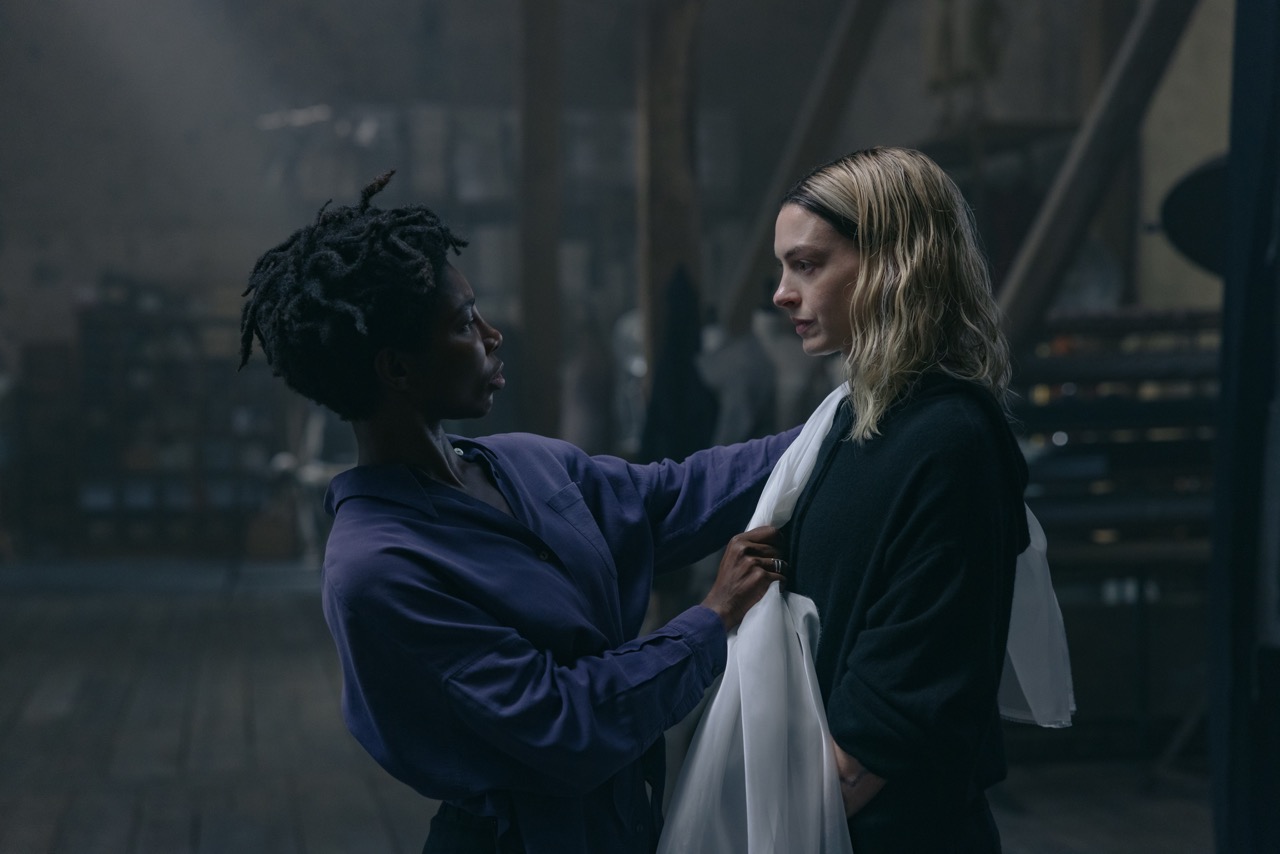
Anne Hathaway plays Mother Mary, a mega pop star on the verge of a comeback after a career-threatening accident. She ventures into the atelier of her long-estranged best friend and former costume designer Sam Anselm (Michaela Coel), begging to be outfitted for her grand return to the stage the following evening. The film unfolds over the course of the next 24 hours, as Sam’s dressmaking allows the two to plumb the depths of their fractured relationship and work through unfinished business.
Mother Mary’s desperation for Sam’s approval is visually palpable even in the dialogue-heavy first act. She drags herself up the banister of the steep staircase to Sam’s bedroom, crawls across the floor to Sam’s audience of one during an agonizing routine for her new song and contorts her face in anguish in response to Sam’s slights. Hathaway nails the portrait of a celebrity on the brink and captures the physicality of a tormented ex-lover aching for answers and, ultimately, deliverance.
Just as Mother Mary had long been the muse for Sam’s creative genius, her raw expressions of emotion are given structure and voice by Sam. The synergy between the two is pure magic; they can’t seem to escape each other’s gravitational pull. The few moments when they touch—Sam trailing a finger down Mother Mary’s back, or grazing her skin as she takes measurements—are electric. While their relationship is never explicitly labelled as romantic, the themes of Sapphic longing are undeniable. You can feel the decade of history that the two share.
Sam admits that Mother Mary’s role in her life has to be all or nothing. She hasn’t listened to Mother Mary’s music in years. She turns off the TV when Mother Mary appears. Remnants of their work together are carefully stowed away in Sam’s barn: an old photograph of them smiling is obscured by other pages on a bulletin board and an issue of Vogue featuring Mother Mary sits at the bottom of a drawer. The steely determination with which Sam has extracted Mother Mary from her sight fits within the lesbian logic of how unbearable it is keeping your first love at arm’s length. You’d rather fling them to the furthest corner of the universe than face the weight of remaining in their orbit.
In one of the film’s vivid flashbacks, Sam recounts the last Mother Mary show she saw. She describes seeing the pop star perform from the front row and being so overwhelmed by her magnificence, and the lack of recognition of Sam’s part in building it, that she clenches her jaw with such force her wisdom tooth cracks. Awash in pain, Sam goes home, grabs a set of pliers and, without hesitation, wrenches the tooth out.
Upon hearing this retelling, Mother Mary’s face twists in horror. Except that story is not what really happened, Sam clarifies. She was exaggerating, she says; she in fact went to the dentist, was put under anesthesia and woke up with the pain gone.
The flash of comic relief disguises a keenly observed metaphor for grief. The heartache of your first lesbian breakup summons both a desperate, frenzied urge to rid yourself of all the emotions eating away at you—and the blinding, blood-red blur of pain when you finally cut yourself loose—and the sudden emptiness of one day no longer feeling the anger and love, having been granted an absolution not of your invoking. Only a cavity remains.
Throughout the film, grief manifests as a crimson spectre that takes various forms: a flowing cloth that ripples through the air, a grotesque, embryonic mass pulsing on the floor. It is a ghost that only Mother Mary and Sam can see and feel. Mother Mary tells Sam of how this feminine apparition has been consuming her in an almost demonic possession. “Every minute of every day, I feel her inside me,” Mother Mary says. “Maybe I’m supposed to keep her there—like that’s what I have to do, that’s my job now. I don’t know how much longer I can do it.”
But the film also offers a kind of wish fulfillment for those of us who yearn for that elusive concept of closure, or as it’s more discerningly put forth by Sam, clarity. Mother Mary works best as an unflinching dissection of what a retrospective conversation long after a formative breakup—when you revisit all the words left unsaid—can look like. It reflects how grief over the end of your first lesbian relationship can be jarring, nightmarish and profoundly destabilizing to your sense of self; but also how it can be beautiful and redemptive, allowing room for love to endure.
Lowery argues that, try as we may, we can never outrun our history. It will one day come knocking at our door, or chasing us through hallowed halls and seeping into the private spaces where we are at our most vulnerable. It is in taking ownership of and atoning for our actions—facing the chasm our abandonment has created, acknowledging the pain we’ve caused and honouring the bond that persists in spite of a relationship’s ending—that we can free ourselves and each other.
The night of my supernatural encounter, I dreamed of talking things through with my ex. I apologized for how impulsive I’d been when I was young, how quick I was to sever our relationship and to deny the existence of a connection that’d shaped how I love and what I saw myself as worthy of. In real life, I’ve never mustered the courage to do the same.
The hauntings continue. Sometimes I wonder if she sees the ghosts too.

 Why you can trust Xtra