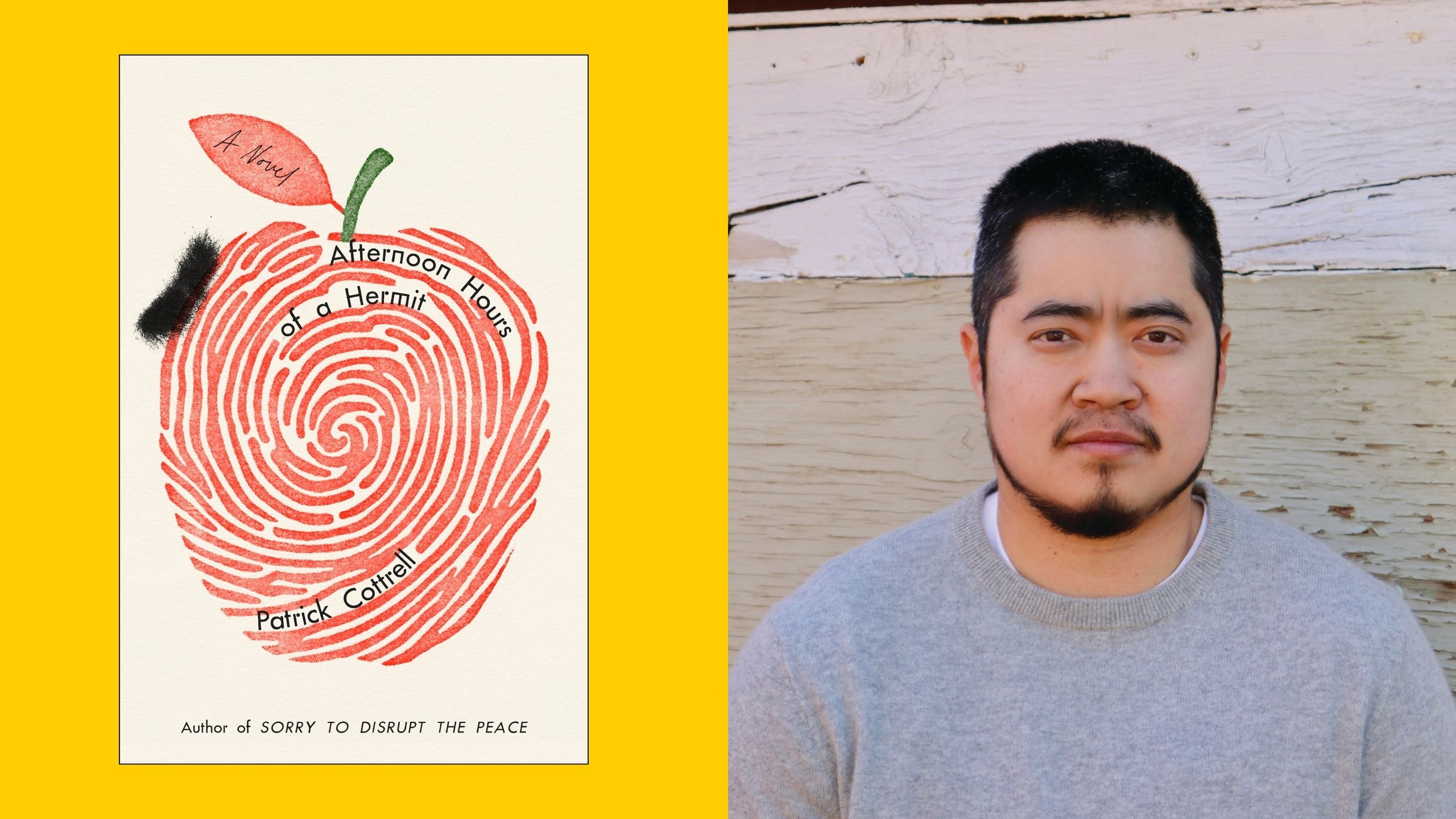
In the introduction to their 2022 anthology, Pathetic Literature, Eileen Myles describes the writers within as those who are “doing everything at the absolutely wrong scale.” These contributors, who range from Samuel R. Delany to Qiu Miaojin to Renee Gladman to Robert Walser, are unafraid of repetition, of taking up extra space through writing, of opening up new vistas of feeling and suffering, and of looking directly at death. To Myles, the label of “pathetic,” rather than being a term of belittlement, is a “badge of distinction.” Patrick Cottrell’s second novel, Afternoon Hours of a Hermit, could easily wear this badge. A follow-up of sorts to his first novel, Sorry to Disrupt the Peace, it defies the rules of a traditional sequel, behaving more as a re-examination of the previous book and its events than a sequel in the strictly narrative sense.
Sorry to Disrupt the Peace was published to acclaim in 2017; its protagonist, a Korean adoptee in her early thirties, returns to the home of her adoptive parents in suburban Milwaukee after her younger brother, also a Korean adoptee, though not biologically related, dies by suicide. She becomes obsessed with investigating his death, searching for clues in the stifling family home, whose atmosphere is laden with various deceits and platitudes about transnational adoption, death and familial responsibility.
In Afternoon Hours of a Hermit, Cottrell’s protagonist, once _____ Moran (Cottrell uses a blank whenever the narrator’s deadname is uttered) is now Dan Moran: “single, approaching forty, once plain in appearance as a woman, now ugly as a man.” In the five years since his younger brother’s death, Dan, in addition to transitioning, has become a published writer, having written a novel, also titled Sorry to Disrupt the Peace.
Neither of these developments have made Dan any less awkward than the version of him in Cottrell’s previous book. He is still prone to either hiding away when called upon or inserting himself forcefully into social situations that he was not invited to. He eavesdrops on conversations, crashes the readings of other writers and spies on people through their apartment windows. These pathetic tendencies—doing everything at the wrong scale—prove useful, however, as he reopens an existential investigation into his brother Kevin’s suicide, his family’s reactions to it and the fuzzy contours of his own life.
The animating event of Afternoon Hours is an anonymously sent photograph that Dan discovers in his mailbox in New York. The photograph is of his brother as a child, dressed as a detective, looking at the viewer through a magnifying glass. “A suicide is never over,” Dan realizes, shaken by the image. This “eye of inquiry” prompts Dan to return once again to the family home, where it turns out his parents have arranged a memorial dinner for his brother, an annual event that no one has told him about. There, resuming the role of writer-detective, he searches for clues: Who sent the photograph? What is the photograph trying to tell him? Who was his brother in the year leading up to his suicide, and did Dan previously misunderstand the circumstances of his death? These questions lead Dan back into the past, a trajectory that he feels is “at odds with the forward momentum of [his] transition.”
Much of the territory of Afternoon Hours will be familiar to those who have read Sorry to Disrupt the Peace: investigating a sibling’s suicide, returning to a repressive family environment, obsessing over specific details to the possible detriment of the bigger picture. Cottrell has described Sorry to Disrupt the Peace as an anti-memoir, in that it contains recognizable elements of his own life, structured and reshaped in an entirely fictional manner.
Like his literary idol, the late Austrian writer Thomas Bernhard, Dan is attracted to repetition, revisitation and revision in his writing and his life. However, important new rooms have been added to the structure that was presented in Sorry to Disrupt the Peace: Dan’s transition, his new vocation as a writer and his estranged middle brother, Matthias, who did not exist in the previous book. Dan also contends more deeply with his family’s decades-long unwillingness to acknowledge the alienating power dynamics inherent in transracial adoption. Driving around the affluent suburb in his dead brother’s old Honda, avoiding the passive aggression of his family, Dan scratches at unexamined memories and tracks down people from Kevin’s life. In his bid to understand his brother better, Dan uncovers truths that the rest of the family would rather gloss over.
Cottrell is adept at the kind of claustrophobic first-person narration that brings the reader so close to his protagonists that we feel we are perceiving the world from directly behind their eyes. Their observations become our observations, their paranoias our paranoias, their blind spots our blind spots. In Afternoon Hours of a Hermit, he displays a remarkable ability to compress an overwhelming deluge of revelations into a deceptively short text, which takes place over only two days—an even shorter time frame than the week covered in Sorry to Disrupt the Peace. Though the plot itself is fairly minimal, Dan’s investigations, though often misguided and confused, result in an expansive and destabilizing reckoning with the past five years, which he thinks of as “the post-suicide phase.”
Cottrell’s books are less concerned with character development than they are with the question of how to carry on living despite having many reasons not to. Looking back on his life thus far, Dan considers the effect of his obsessive writing and investigating on his continued existence: “My constant curiosity got in the way of my suicide.”
In a 2021 interview with Lit Hub, Cottrell credits the influence of Bernhard on his approach to novel writing. The characters in Bernhard’s novels do not change from beginning to end, Cottrell points out: “It’s really about … the thought processes, and how the character feels about their circumstances.” Bernhard appears as a sort of ghostly mentor to Dan in Afternoon Hours of a Hermit, providing him with a form of staunch, realist guidance that he is unable to receive from his family, or even from other living writers in New York.
It turns out that the most realistic way for Dan to deal with his family is to lean into his own storms of feeling, often at inappropriate times. A pathetic excess of caring and emotion is in fact an important and effective weapon against the fragility of the white Midwestern family unit and its refusal to confront difference, violence and pain. When someone keeps calling the house asking for “the sister, _____ Moran,” Dan shouts down the phone, “There’s no one like that here and there never was!” Just as Dan’s adoptive family neglects to use his correct pronouns or call him by his name, his mother admits that she allowed her best friend to refer to Kevin as “that little Chinese boy” for years, well into his adulthood. She never bothers to correct her friend’s racist, infantilizing language, because, as she tells Dan, it would be too uncomfortable to do so.
Dan’s anti-social and confrontational ways of being are acts of refusal in this smothering context. His excesses are impossible for his family to ignore, even though they try their hardest to dismiss and patronize him. According to his father, Dan’s perspective has always been “somewhat foggy,” but this description proves to be better suited to his family members. Bleak as Afternoon Hours of a Hermit often is (though there are moments of hilarity), it serves as a rousing reminder to all queer and trans people, to all the freaks: Be inappropriately emotional, be overwhelming, be abrasive, be weird, be pathetic. Point to the uncomfortable and the unjust. Disrupt the peace at every chance you get. It could be the only way for us to go on living.

 Why you can trust Xtra