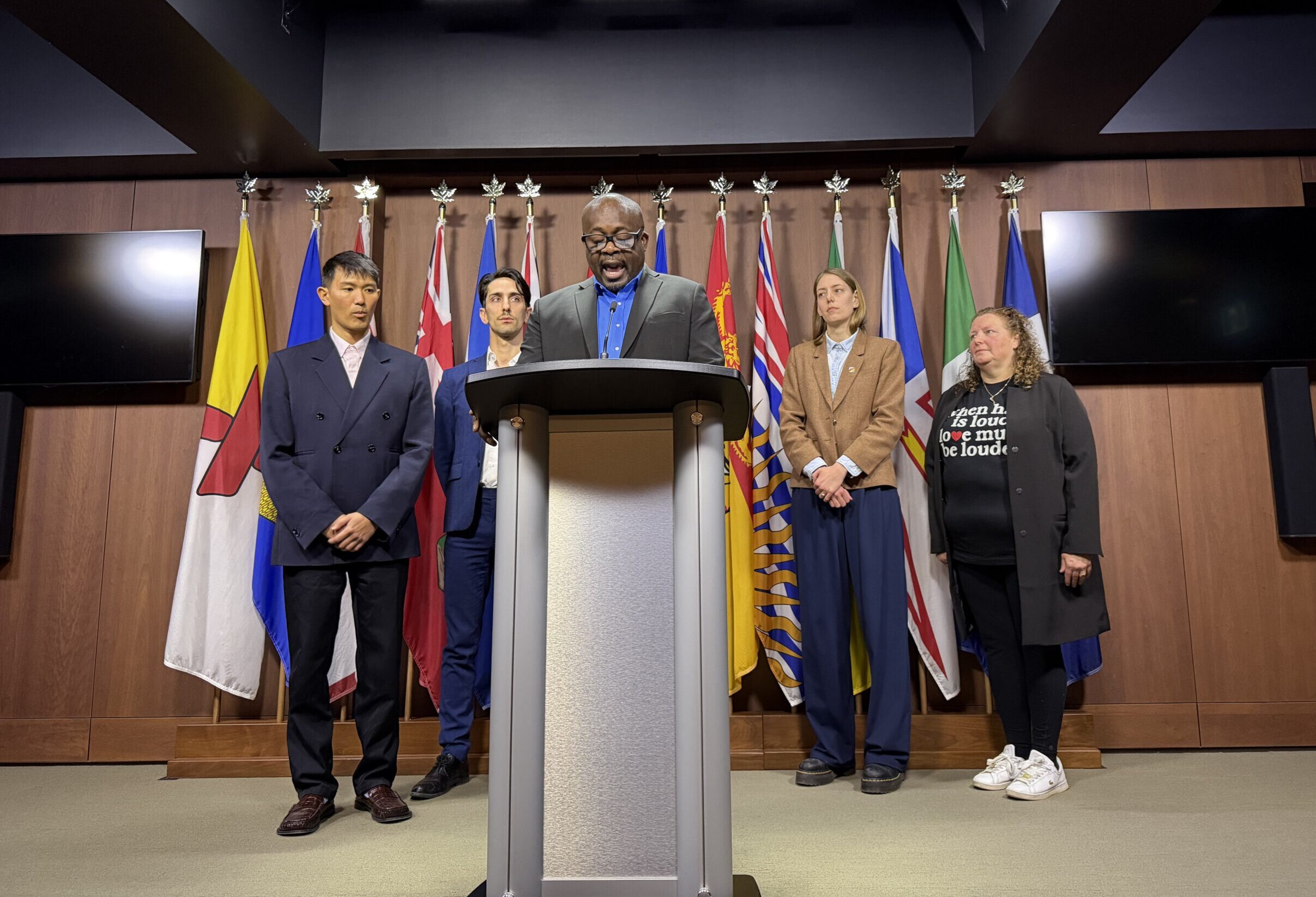
The organizers of the country’s three largest Pride festivals, along with Capital Pride and Timmins Pride, were all on Parliament Hill Monday and Tuesday to make the case to MPs and ministers that, given the challenges they face, they are in need of more stable funding. The leaders of the Toronto, Vancouver and Montreal Pride festivals all cited rising costs for their events, and corporate sponsors that have pulled back.
The groups are asking for $3 million per year for three years, to be distributed through Fierté Canada Pride to the 200 Pride organizations across the country, as already happens with the existing $1.5 million security funding envelope that these festivals currently are able to access. Many of the organizers came armed with the data around the economic impact of their festivals to show how these modest investments turn into big returns for the county’s GDP.
For Callie Metler, executive director of Capital Pride, this kind of funding is needed because the festival continues to grow in attendance, but sponsorships and budgets have not.
“It’s important for our events to be free and accessible, and that’s why we’re calling on the federal government to support that kind of work we do,” Metler says, adding that she doesn’t want to have to choose between paying for more fencing for the festival site or paying artists to perform.
Since the pandemic, costs have skyrocketed, says Kojo Modeste, executive director of Pride Toronto. “I looked at what was spent on infrastructure, insurance and security, and those prices increased in some cases by up to 300 percent,” says Modeste. For example, Pride Toronto’s insurance costs went from $59,000 in 2019-2020 to nearly $300,000 this year, according to Modeste, who has been unable to get an answer as to why the costs have increased so much even though there haven’t been any particular added risks. “We’re constantly playing catch-up.”
Joseph Hoang, executive director of Vancouver Pride, notes that there has been a rise in homophobia and transphobia across the country, which means that festival organizers need to ensure that their attendees remain safe, and that public safety is paramount.
In the wake of the tragedy at the Lapu Lapu Day festival in Vancouver, large-vehicle mitigation is now something that all festivals are being required to engage in, especially since most major Pride festivals have a street-based component. That requires increased fencing and private security, which increases costs.
Modeste notes that this year will be the 10th anniversary of the Pulse nightclub shooting, which is a constant reality check for Pride organizers.
“Is it going to be us next?” Modeste asks. “You’re always on guard. This is not just about protecting folks that are on the floats, but also our allies that come to support us.”
Metler notes that there is no actual guidance on how to secure an event against heavy vehicles, so a lot of their work involves discovering best practices, and they work closely with the city and police to ensure that precautions are increased year over year. This is not just an increase in infrastructure but also in terms of time and effort on the part of organizers.
Julie DeMarchi, founder and treasurer of Fierté Timmins Pride, says that in a small-town context, there are always threats, which means that organizers inevitably can’t let their guard down and try to prepare for the unexpected while also hoping that it goes well.
“As a small Pride, we have the protesters and the folks that come out to try and cause harm, and we try to provide the safest space possible,” DeMarchi says. “A few years ago, when the security grant came out, we saw an unprecedented amount of online hate.”
DeMarchi says that while there were some protesters, it has forced them to be prepared.
DeMarchi says that for small Prides, there is a need to create the safest spaces possible because people often move away to bigger cities after they come out so that they can feel a greater sense of community.
“We need to create that back in our own homes, so that folks don’t have to leave,” DeMarchi says.
@xtramagazine The full lists of the books targeted for removal from two Alberta school districts have been published, and both feature a slew of familiar LGBTQ2S+ titles. Last week, journalist Jeremy Appel of the independent newsletter The Orchard published the results of a freedom of information request filed to the Calgary Board of Education and Edmonton Public School Board asking for full lists of which books were removed from school libraries. The call for book removal came after Premier Danielle Smith’s Alberta government introduced new policies last year, mandating what kinds of books can be on the shelves of Alberta schools. Under the policy, school districts are required to ban “any explicit visual depiction of a sexual act” from their school libraries. The policy came about following advocacy from several far-right social conservative groups. We break down what you need to know about the titles spotlighted for removal by Alberta’s two largest school districts. #lgbtqnews #alberta #albertanews #canada #bannedbooks ♬ original sound – Xtra Magazine Advertisement
In addition, small-town Pride organizations often become de facto service providers for queer and trans people in their communities, which is an added burden for volunteer-run Prides who rarely have the time or capacity to apply for the grants that the federal government provides. Small Prides often don’t meet grant requirements as they are not registered as not-for-profits.
DeMarchi says that if they get this funding from the federal government, and it is distributed through Fierté Canada Pride as the security grants are, it will mean that small- and medium-size Prides are able to access funding easier than they can through the usual grant process.
Higino Monteiro, the interim executive director of Fierté Montréal, says that while Montreal is in a particularly special position of not requiring federal funding because of support from Tourisme Montréal and the province, the support from all levels of government does send a necessary message to Canadians.
“That’s what we’re trying to translate in our funding request to the federal government,” Monteiro says.
The organizers are making the economic case to the government, and not only to Minister for Women and Gender Equality Rechie Valdez, but also to regional economic development ministers like Gregor Robertson and Mélanie Joly.
When asked by Xtra on Tuesday if she is open to the request, Valdez did not say whether she is considering granting these funds, and instead provided a statement about the ongoing funding, including the $54.6 million over five years, with $10.9 million ongoing in funds supporting LGBTQ2S+ communities across Canada.
“This includes funding for the 2SLGBTQI+ Community Capacity Fund, which helps organizations build networks, strengthen operations, and better serve their communities across Canada,” Valdez’s spokesperson says. “It also includes $7.5 million over five years, with $1.5 million ongoing, dedicated to Pride festival security—responding directly to rising safety and insurance costs faced by organizers.”
The loss of sponsors who pulled their funding when they ended DEI programs are less concerning to organizers like Modeste than their long-term sponsors who aren’t able to contribute to the levels that they used to.
“Last year, we saw a $500,000 loss in sponsorships, and this year we think that will increase,” Modeste says. “We’re not going to have less sponsors—we may even have more.”
Modeste notes that many sponsors have said that they aren’t able to contribute the amounts that they used to because a lot of companies have been hit hard by the U.S-imposed tariffs, and they hope that this will be an opportunity for the federal government to step up, given the economic benefits of up to $1.2 billion in taxable revenue generated from Pride festivals.
Figures provided by Modeste show that Toronto Pride contributed $587.3 million to Ontario’s GDP in 2025, as well as $251.3 million in combined tax revenue to all levels of government. It also directly supported 4,570 jobs.
“This is a return on investment you will not see anywhere else,” Modeste says.

 Why you can trust Xtra