In the second episode of the hit TV series Heated Rivalry, the two lead characters compete in the 2014 Winter Olympics in Sochi, Russia. And while at this point in the show, closeted pro hockey players Shane (Hudson Williams) and Ilya (Connor Storrie) are still in the early stages of their heated affair, the topic of LGBTQ2S+ inclusion naturally comes up when Shane and some American hockey players discuss going to watch a friend compete in the men’s figure-skating program.
“Brave for a dude to show up to a place like this and be like, ‘Hey, here’s me.’ Russia is not safe for folks like that,” one of the Americans says, assuming the friend in question is gay and hinting at the dangers faced by queer and trans athletes who competed in Sochi.
The real-life 2014 Sochi Olympics saw calls for boycotts in response to Russia’s restrictive anti-LGBTQ+ policies, including its 2013 ban on the distribution of “propaganda of non-traditional sexual relationships” among minors. And while athletes—including many who are openly queer—competed in Sochi, conversations around boycotting or withdrawing from major sporting events persist. Most recently, activists have called for the upcoming FIFA World Cup and 2028 Olympics to pull out of the United States in response to President Donald Trump’s immigration crackdown and other policies, including restrictions on trans rights.
But at the provincial level, one sporting organization has already chosen to walk the walk when it comes to being inclusive, and it could present a model for others to do the same. In late 2025, Skate Canada—the governing body responsible for competitive figure skating in the country—announced it would no longer host events in Alberta due to the province’s restrictions on trans athletes.
“Skate Canada has determined that we are unable to host events in the province while maintaining our national standards for safe and inclusive sport,” the organization said in a mid-December statement.
In late 2024, Alberta premier Danielle Smith’s government introduced and passed a slate of anti-trans policies, including the Fairness and Safety in Sport Act, which bans trans women and girls from competing in women’s sports in the province. The bill was further entrenched into law when Smith invoked the Notwithstanding Clause this past fall to shield it—alongside other laws targeting gender-affirming care for young people and pronoun disclosure in schools—from legal challenge.
Under Skate Canada policy, athletes are permitted to compete in the gender category that aligns with their identity, and are not required to meet any specific transition-related medical benchmarks.
In a series of social media posts, Smith called the 2025 Skate Canada decision “disgraceful.” But her strong reaction hints at the tangible impact a move like this can have on a region. By pulling its events from the province, Skate Canada is denying Alberta the associated tourism boost and prestige national and international events can bring to a region—along with the associated dollars. According to its 2025 annual report, Skate Canada generated more than $2.2 million in event revenue last year.
Figure skating has long been an avenue for LGBTQ2S+ representation and progress in sport. While skating faced criticism throughout the ’90s for its pressure to present women as overly feminine, several high-profile Olympic level skaters have been openly gay. Three-time U.S. champion Johnny Weir came out in 2011 and Adam Rippon became the first openly gay American man to win a Winter Olympics medal in 2018. In 2022, U.S. pairs skater Timothy LeDuc became the first openly non-binary Winter Olympian. And this year in Milan at the 2026 Winter Olympics, openly queer U.S. skater Amber Glenn is competing, and has proudly spoken out about her identity and the importance of queer and trans representation in sport.
While on its surface Skate Canada’s move is one of policy adherence—the organization’s statement indicates a simple misalignment of its rules with Alberta’s—experts say the action itself speaks a lot louder than any symbolic grandstanding.
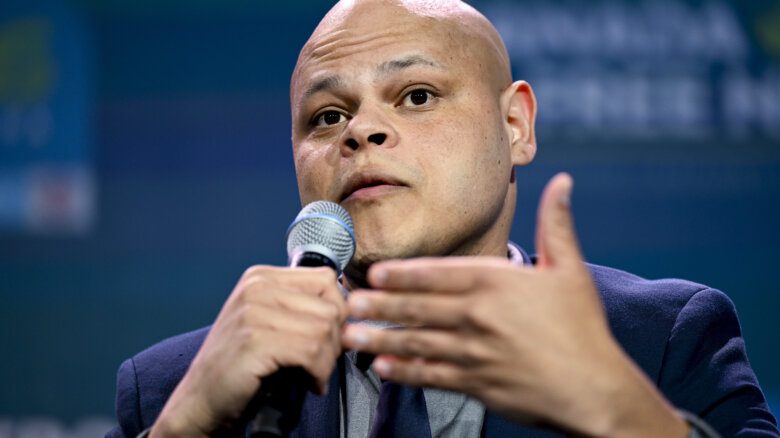
University of Calgary associate professor William Bridel, whose research focuses on inclusive sport policy, worked directly with Skate Canada when the organization first started developing its trans-inclusive approach. He says that while he wasn’t involved in the call to pull out of Alberta, he welcomes it.
“I think it was a good decision. I think it’s a decision that follows from the values that Skate Canada has been trying to pursue and uphold over the last several years through their focus on [equity and inclusion] more broadly within the sport,” he says. “It was an actionable item, moving beyond sort of performative.”
After receiving grant funding from the Social Sciences and Humanities Research Council of Canada (SSHRC), starting the summer of 2018, Bridel worked with a team of student researchers who read through every line of Skate Canada policy to identify where the language used was exclusionary or not as inclusive as possible. Researchers also investigated coaching education materials and interviewed members of the organization at the time who identified “as queer or under that umbrella,” Bridel says.
Bridel provided a final report that recommended changes to some rules, including suggestions around costume requirements, how skaters are referred to—for example, as a pair rather than a couple—and gendered language.
That year, an official trans-inclusion policy was brought to and approved by the Skate Canada board. It was updated again in 2023.
Could that set a precedent for other organizations? Bridel says he hopes more sports organizations will follow.
But, Bridel says, when it comes to Alberta, it’s all about context. He pointed to certain infrastructure requirements of sports like long-track speed skating, where Calgary has only one of three functioning Olympic ovals in the country, as limiting a governing body’s ability to take a stand.
“I think it’s contextual,” he says. “But other sports where you’re not, maybe as reliant on a specific sport infrastructure … like curling, for example, you can do it in lots of places.”
Bridel is less optimistic about how the Skate Canada approach could be a model in the U.S. and internationally. In recent years, American collegiate level sports organizations and leagues have shown a strong willingness to bend the knee to anti-trans government policy at the state and federal level.
The National College Athletic Association (NCAA) updated its policies to limit trans athlete participation directly after Trump’s executive order on gender identity last year, and the University of Pennsylvania specifically bowed to threats from the administration around funding cuts and removed recognition of trans swimmer Lia Thomas from its record books.
“The idealist in me is, like, yes, let’s use Skate Canada as a positive example and promote it as like, ‘Look, this can be done realistically,’” Bridel says.
However, he says “if we’re looking at the States in particular, I’m less hopeful.”
This story was produced in collaboration with The Walrus.

 Why you can trust Xtra