In all likelihood, Pierre Poilievre will be the one who leads the Conservative Party of Canada into the next federal election. But the party he just earned the right to continue to lead is still divided, particularly when it comes to their approach to LGBTQ2S+ and DEI issues.
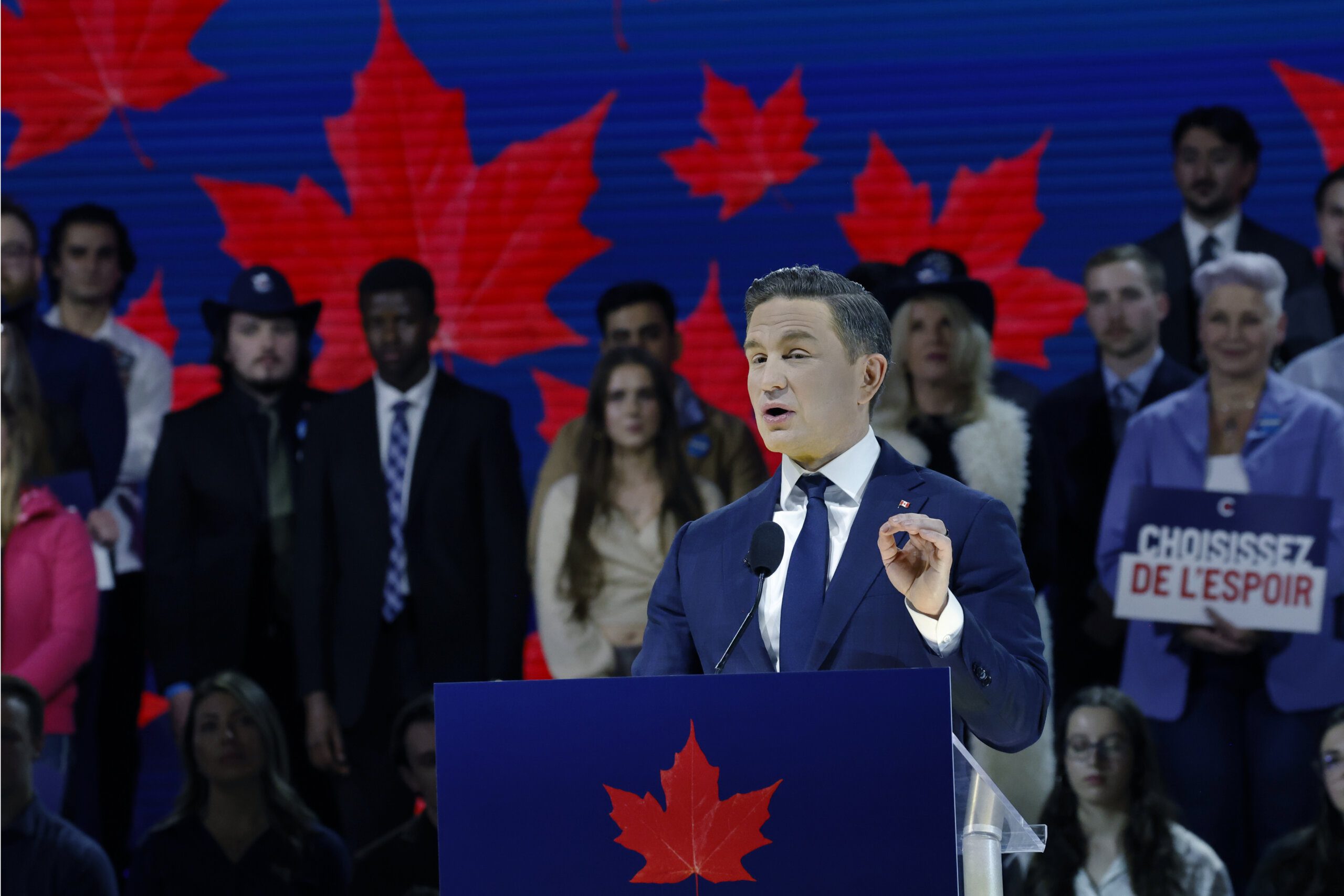
At the annual Conservative Party convention in Calgary this past weekend, Poileivre earned just over 87 percent of the delegate vote, well clear of the roughly 80 percent benchmark seen as needed for him to stay on. It’s a strong showing, even better than the 84 percent support former prime minister Stephen Harper got from the Conservatives following his own 2004 election loss to the Liberals.
The triumph marks a key victory in Poilievre and the party’s long road to recovery after bumbling last year’s federal election to a historic degree. Exactly one year ago, Poilievre seemed poised to sweep a scheduled federal election and emerge as prime minister with a strong lead in the polls and a weakened Liberal party.
But not only did the Conservatives lose to Mark Carney’s Liberals in the federal election last April—with Carney winning a majority government—Poilievre even lost his own Ottawa-area longtime seat for the first time in two decades. Questions abounded about the future of the party and Poilievre himself. Had they gone too far right in their “anti-woke” messaging? Did people actually trust Poilievre as a leader? Did the Conservatives get too cozy with Trumpism—or not cozy enough, if you ask certain corners of the base?
A year later, it’s clear that Poilievre’s party at least thinks he’s the one to start answering these questions. After parachuting into and winning arguably the easiest Conservative riding in Canada for a byelection this summer and getting back on the campaign trail to win his party’s support, Poileivre is back basically where he started a year ago.
But he and the Conservatives still have plenty to sort out.
Vocal and most visible at the convention itself is the question of Alberta separatism, a movement largely filled with the same sort of fringe right-wingers who otherwise would be staunch Poilievre supporters. How will he play to their needs while still preaching the unified Canada? While the prospect of Alberta actually leaving Canada is—for a host of reasons—vastly unrealistic, there are very real people on the ground taking it very seriously, and those are people Poilievre wants in his fold.
And then there are the high-level questions around what the Conservative Party wants to be. Do they want to be “Trump North” and all that entails? Under Poileivre’s leadership, the party has slid socially to the right. We saw it in Poilievre’s messaging during last year’s election campaign, and we saw it at the last convention before this, where party membership endorsed policy resolutions banning trans women from women’s prisons and raging against DEI.
This year’s convention saw a similar resolution about DEI, where more than 90 percent of delegates called for ending DEI programs and a restoration of “meritocracy”—also echoing an online petition boosted by the party in the House of Commons late last year.
But a vote around codifying opposition to Bill C-4, the federal conversion therapy ban as Conservative Party policy, narrowly failed on the convention floor. And the debate around it points to the warring factions of the party.
Jack Fonseca, director of political operations at Campaign Life Coalition spoke as a delegate in favour of the resolution on the convention floor. Campaign Life Coalition is a far-right advocacy and lobbying group that has previously pushed anti-LGBTQ2S+ school board candidates and arranged “Pride flag walkout days,” and the group has typically had a large presence at the Conservative convention over the past few years.
“Thousands of kids get transed by woke schoolteachers and social media influencers who prey upon young minds,” Fonseca said during debate. Another delegate from Edmonton argued that kids eventually “grow out of their feelings of gender incongruence.”
Nanaimo—Ladysmith Conservative MP Tamara Kronis argued against the resolution and division it presented within the party.
“We should not be adopting policies that divide us. This policy divides us, and I urge you to vote no,” she said during the debate. Kronis has since been subject to social media backlash from influential figures in Canadian anti-trans advocacy like “Billboard Chris” Elston and Meghan Murphy for opposing the resolution.
Technically, the vote received 52 percent support—a majority of delegates—but failed to get a double majority in order to pass as an official resolution. Policy resolutions require not only the majority of votes but also a majority from more than half of the provinces represented. Delegates from Manitoba, Quebec, Nova Scotia, Newfoundland and Labrador, Prince Edward Island and the territories—which collectively count as one jurisdiction—did not give majority support to the resolution.
It’s the thinnest of margins on a topic that has long divided the party. In 2021, former leader Erin O’Toole allowed the federal ban to pass largely unopposed in the House of Commons, despite opposition from some of his MPs. Poilievre, an MP at the time, voted in favour of the federal conversion therapy ban.
And while it didn’t pass into official policy, the closeness of the vote at this year’s convention and continued unrest will put pressure on Poilievre to define his and the party’s stance on conversion therapy and LGBTQ2S+ issues in general.
The party seems to be in agreement on broad talking points and slogans—at this weekend’s convention, the Conservatives successfully passed a policy resolution calling for “a restoration of ‘meritocracy’ by doing away with diversity, equity and inclusion (DEI) programs” with 90 percent support. And that broad stance echoes Poilivre’s personal reliance on railing against “wokeism” during the last federal campaign.
But the devil is in the details, and the divide points to the fundamental problem with Poilievre’s Conservatives. Broadly calling out DEI and “wokeism” can work when drumming up support amongst a certain segment of social conservatives, but you start alienating people when you get into the details of what that means and who is impacted. Debate around the conversion therapy resolution showed the spectrum of social conservatism that exists within the party right now.
Deciding where to draw the line when it comes to protecting rights and free expression is a delicate dance. While there are certainly people within Canadian conservatism who want to see “Trump North” and all of the actual restrictions on LGBTQ2S+ rights that would entail, there’s also a more centrist chunk of the party with strong opposition.
While a lot has changed for Poilievre and the Conservatives in the past year, in many ways things are right back where they started.

 Why you can trust Xtra