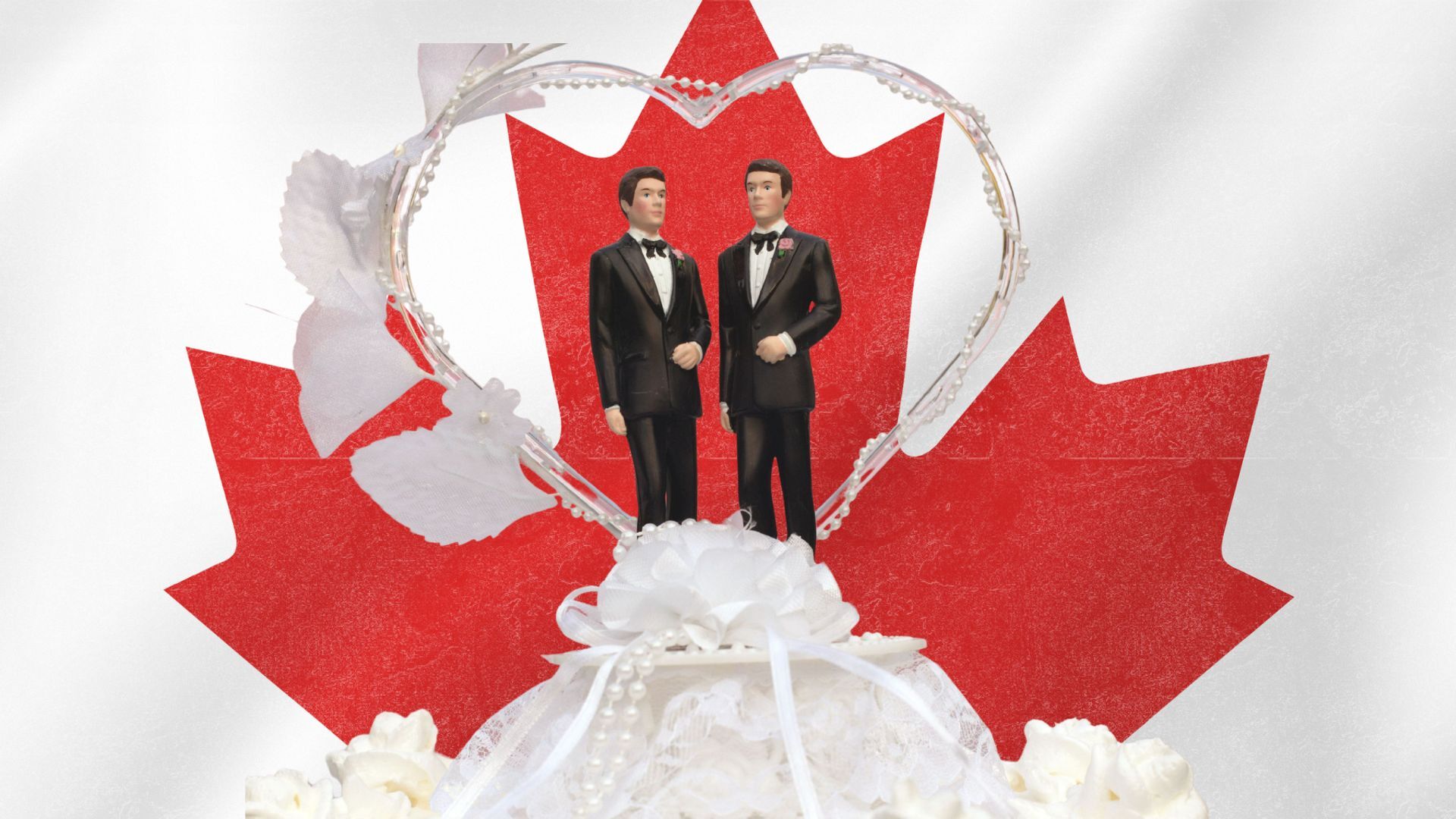
Early in the morning of Nov. 8, 2001, as a freshman reporter at The McGill Daily, I found myself in the back of a modest courtroom in downtown Montreal, alternately scribbling quotes in a notepad and trying to figure out how to get a newfangled digital camera to take a decent picture of the powerhouse attorney at the front of the room who was furiously arguing on behalf of her clients, Michael Hendricks and René Leboeuf. Hendricks and Leboeuf wanted to get married.
I had jumped at the assignment. It’s rare as a student journalist that you get to write about something that could become actual history. And there was a real sense at the time that what was happening in Canada was capital-H History.
It’s hard to remember how revolutionary the idea of pursuing same-sex marriage was in 2001. Same-sex marriage had only become legal in the Netherlands a few months earlier and was largely treated like a strange curiosity here in North America, something only those quirky Dutch would come up with. It would still be four years before Parliament would pass the Civil Marriage Act on July 20, 2005, legalizing same-sex marriage nationwide.
But a string of legal, political and cultural victories across Canada in the 1980s and ’90s led activists to believe it was time to make their biggest push yet. Gradually, sexual orientation discrimination had been banned by the federal and most provincial governments over the 1980s and 1990s, culminating in a Supreme Court decision that required all provinces to ban it. The federal government ended its ban on gays and lesbians in the military in 1992. And in 1999, the Supreme Court ordered Ontario to extend common-law spouse status to same-sex partners, though stopping short of full marriage equality.
Even queer people couldn’t agree on marriage
But pursuing marriage equality wasn’t even something everyone in the queer community agreed on.
Where some viewed marriage equality as a fundamental right that all queer people should be able to access, others saw capitulation to a heteronormative institution that queer people should be dedicated to replacing or eliminating outright.
Some viewed marriage as a bourgeois concern and decried the resources spent in the fight, which they wanted to be focused on causes like the rights of trans people and sex workers, leaving aside the consideration that trans people and sex workers might also benefit from the legalization of same-sex marriage.
Some in the community argued that pushing for same-sex marriage would backfire, as it could negatively polarize society at large against the LGBTQ2S+ community—especially if we lost. There were loud calls—both from activists and politicians—that we should accept the lesser status of civil unions and domestic partnerships that had been passed in some provinces. Even if they didn’t guarantee full equality, some activists believed that civil unions had the benefit of undermining heteronormative marriage more than same-sex marriage would.
As it turned out, the queer community didn’t have to decide on a single path—it’s not like all queer people get together and plan out a strategy and choose a single path for the community to take. Individual couples like Hendricks and Leboeuf pursued legal challenges across the country, mostly funding expensive legal challenges out of pocket with minimal financial support from the community.
“There was a lack of support from the LGBT community in general until we started to win,” Hendricks told Xtra on the 10th anniversary of their victory. “For example, one ‘community’ lawyer pleaded for civil unions in court, which led the chief justice of the Quebec Appeals Court, Michel Robert, to ask him during the hearing for which side he was arguing.”
A flurry of cases was filed in nearly every jurisdiction in Canada challenging the federal definition of marriage. Courts in eight provinces and Yukon would eventually strike down the federal ban on same-sex marriage before Parliament amended the law itself.
And by a quirk in Ontario law, a pair of same-sex weddings officiated by Rev. Brent Hawkes in January 2001 were declared by the court to be legally valid, making them the first same-sex couples in the world to be legally wed.
Hawkes wore a bulletproof vest to the ceremony due to credible threats he’d received over the well-publicized event.
Marriage was revolutionary
Same-sex marriage wasn’t just revolutionary in some theoretical sense for Canadian society, and it wasn’t just a pathway for queers to assimilate into the mainstream.
Same-sex marriage changed the lives of thousands of queer people across Canada in concrete ways. For many queer couples, accessing marriage meant financial and personal security through spousal benefits and recognition of shared assets. It enabled them to raise families and for their children to enjoy legal protections. Untold numbers of immigrants were able to permanently settle in Canada because their relationships were recognized. For the sick and elderly, marriage meant a promise of dignity in medical care, death and grieving lost partners.
And a whole generation of queer people has been given role models from a generation of queer couples and families who are reconfiguring those hetero norms to suit their own needs. Far from quietly assimilating into the straight world, queer parents are among the strongest advocates for LGBTQ2S+-inclusive education for the next generation.
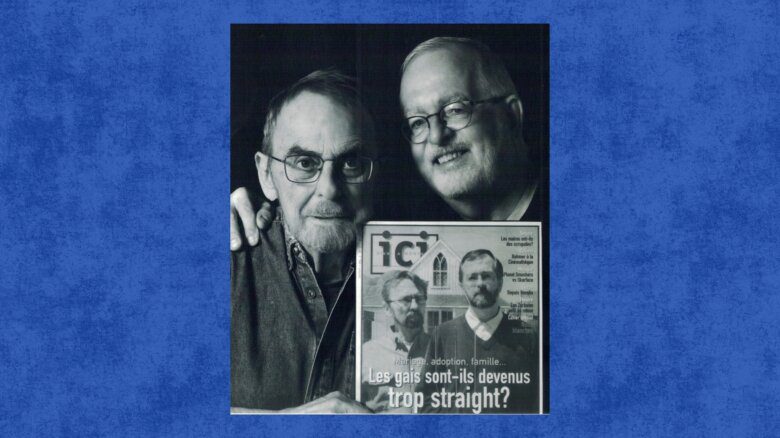
Peter and Murray Corren, one of the eight couples who filed the successful challenge for same-sex marriage in British Columbia in 2001 were also tenacious advocates for LGBTQ2S+ inclusion in schools, and their multi-year human rights challenge led the province to overhaul the curriculum to make it more queer-friendly.
The fight didn’t stop with marriage
Despite the worst fears of some grassroots activists, the queer community in Canada didn’t just rest on its laurels once the marriage fight was over.
That’s partly due to Stephen Harper’s Conservatives sweeping into what would be a decade in office just months after the same-sex marriage law passed. The queer community quickly mobilized to push back against the Conservatives’ anti-LGBTQ2S+ agenda. Early on, an attempt to repeal same-sex marriage was shot down in Parliament. Other fights, like ending the discriminatory age of consent law, weren’t as successful.
But the networks and legal strategies formed during the fight for marriage helped win dozens of rights expansions at the provincial level, including banning anti-trans discrimination, allowing trans people to update their birth certificates, winning coverage for gender-affirming care under provincial health plans and updates to family law to fully recognize same-sex parents.
Under Trudeau’s Liberal government over the last nine years, the momentum continued with protections for trans people under discrimination and hate crime laws, banning conversion therapy, repealing the anal sex law, repealing the bawdy house law, ending the ban on blood and tissue donation from men who have sex with men and an official apology, expungement and compensation scheme for people who’d been persecuted under anti-LGBTQ2S+ laws.
Despite some notable recent backsliding in Alberta and Saskatchewan, which have both recently announced policies restricting gender care for youth and blocking their participation in school sports, Canada now has one of the most enviable records on LGBTQ2S+ rights in the entire world.
What equal marriage did for the world
When Parliament passed the Civil Marriage Act in 2005, Canada was just the fourth country to legalize same-sex marriage nationwide, with Spain having beaten Canada to bronze by a matter of weeks.
But Canada’s action on same-sex marriage was uniquely influential in the global fight for LGBTQ+ rights.
As a huge, English-speaking country right above the United States, Canada provided a credible template for the expansion of marriage rights for our neighbour. Mainstream commentary on same-sex marriage quickly went from it being an odd European punchline to an urgent social issue. Demcrats gradually flipped to being supporters of same-sex marriage while Republicans moved quickly, albeit ultimately unsuccessfully, to block it through amendments to state constitutions.
It also helped that Canada was an easy destination for queer Americans who wanted to get married but weren’t allowed to at home. In the decade before same-sex marriage was legalized nationwide in the United States, hundreds of queer couples trekked over the border to tie the knot, including popular sex advice columnist Dan Savage, who spoke frequently about his marriage and family in his columns, books and talk show appearances.
“Ending marriage discrimination in Canada was a big boost to our work to win the freedom to marry here in the United States,” says Evan Wolfson, founder of Freedom to Marry, one of the key organizations that pushed for equal marriage in the U.S.
“Specifically, couples from the U.S. could—and did—go to Canada, marry and come back home to states like, for example, New York, that would honour those lawful marriages even if couples still couldn’t yet marry here at home,” he says. “And generally, Canada was living proof and reassurance that ending marriage discrimination would not usher in a host of ills, as the opponents and fear-mongers kept saying.”
Canada’s international influence was also felt across other English-speaking nations, as our marriage movement helped inspire successful movements in South Africa, the U.K., Ireland, Australia, New Zealand and Malta.
Quebec also played a role in France’s legalization of same-sex marriage in 2013. Then French prime minister Jean-Marc Ayrault told reporters he’d been pressed on the subject by the president of Quebec’s National Assembly during a state visit. He called on opponents to consider the case of Quebec as proof that equal marriage wouldn’t lead to the “chaos” they predicted.
Canada’s immigrant communities have also played a key role in building support for equal marriage in their countries of origin. Canadian residents and weddings have also been at the centre of marriage-equality cases in places as far-flung as Israel and Bermuda, and in an Italian case that had implications for same-sex couples across Europe.
It’s been 24 years since I sat in that courtroom in Montreal. Hendricks and Leboeuf, joyous in their victory, are still together, and still agitating for the queer community. That fiery lawyer who argued their case became a local celebrity hosting a Quebec knockoff of Judge Judy.
I’m still reporting on the fight for equal marriage.
Today, same-sex marriage is legal in 39 countries, with another dozen recognizing civil unions. More than one billion people live in equal marriage jurisdictions around the world, including more than 85 percent of the Western Hemisphere. The march of progress continues around the world, with Asia and Eastern Europe emerging as new battlegrounds where same-sex marriage has gone from being unspeakable to a mainstream political issue.
The war for LGBTQ2S+ equality might be far from over, but the battle for marriage equality in Canada will go down as one of the key chapters in that history.

 Why you can trust Xtra