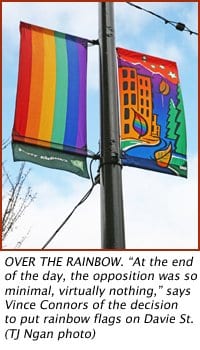
Eight years ago, Vancouver’s gay community already called Davie St home. But other than a small number of businesses, there was no outward identifier of the neighbourhood’s queer character.
“Davie Village is very much a mix of gay and straight. It’s not just one pocket,” says Vince Marino, who owns three bars on Davie St.
Then, a short segment of Davie St — initially just three blocks — began to work together on a marketing plan that eventually included rainbow flags.
“It starts with a great idea,” says Marino. “It appeared to be a hard sell, but it became an easy sell.”
It’s still a diverse neighbourhood, adds Vince Connors, an area lawyer who helped get the project off the ground.
“It wasn’t as politically sensitive as you might think it was,” says Connors. “At the end of the day, the opposition was so minimal, virtually nothing.”
Marino says it took two years to get the project up and running, but both gay-owned and straight-owned businesses got on board. On Davie St, there was no Business Improvement Area (BIA), so they started one. Planners were conscious that it was to be a business decision, not a gay business decision. All told, only three businesses registered strong objections, says Connors.
And now everyone is reaping the rewards, according to James Steck, who runs promotions at Davie St’s biggest nightclub.
“It benefits your business whether you know it or not,” he says.
The flags become part of a new era of goodwill not just between businesses and clients, but business-to-business as well.
“It’s given a lot of a community feel,” says Steck.
The result of the teamwork has been successful projects like the West End BIA winning a bid to hold one a leg of the 2007 Triathlon World Cup, says Marino. That project brought visitors from over 30 countries into the heart of the neighbourhood.
It’s been especially helpful in luring tourists to the area, says Steck. And with thousands of gay tourists a year, the gay and straight merchants of Davie St are able to cash in on their feeling of comfort.
“For the gay community when they’re travelling, if you see the banners flying, with that comes a better level of feeling, a safer feeling,” says Marino.
Steck agrees.
“Coming into the city, they drive over Burrard St bridge and we’re one of the first sightlines they see. And they’re like, ‘Ah, that’s the Davie St Village. We’re home now,'” says Steck.

 Why you can trust Xtra