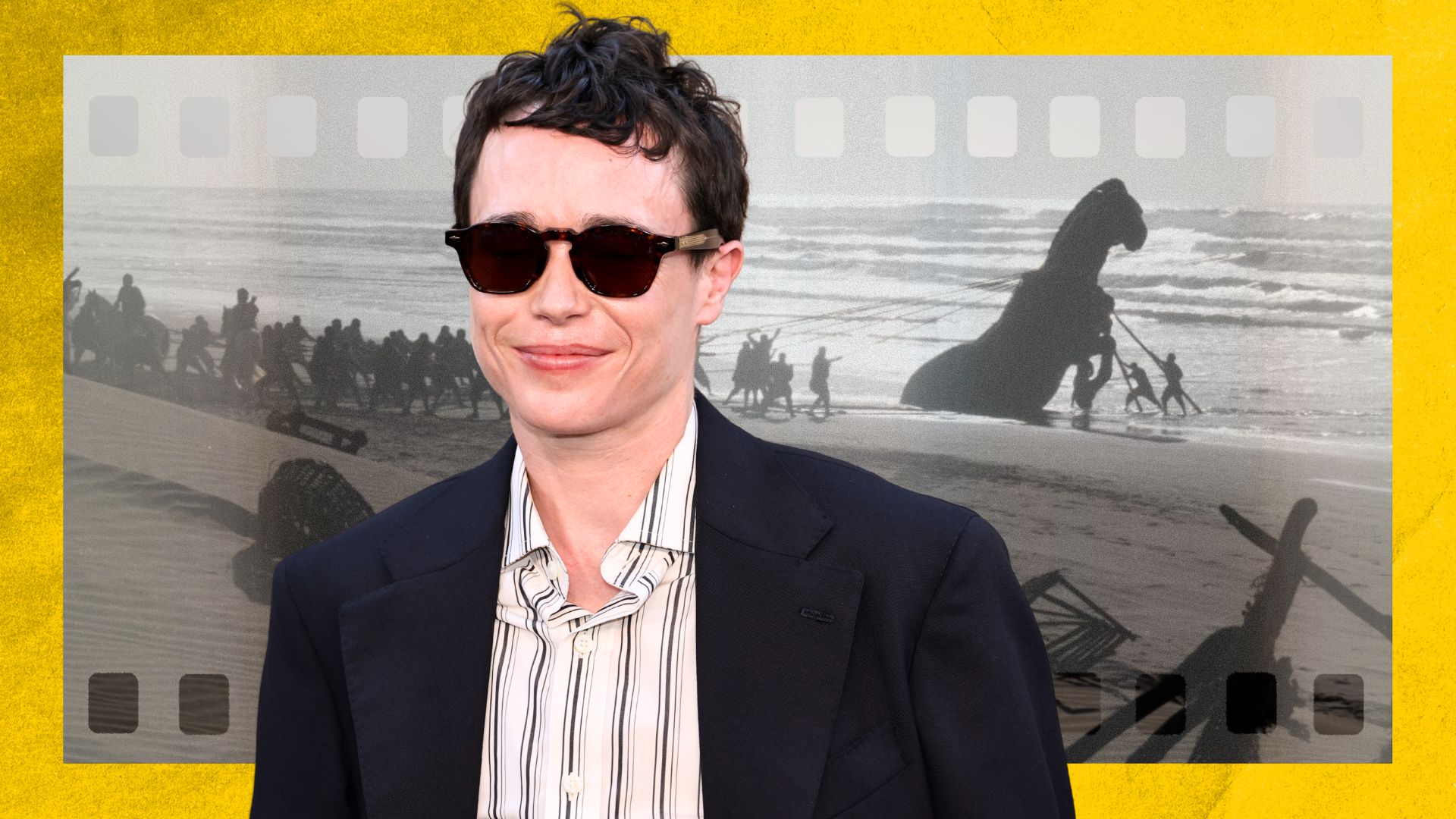
Elliot Page’s is one of the very first faces you see in Christopher Nolan’s sweeping adaptation of Homer’s epic The Odyssey.
The film opens with a storyteller recounting the capture of Troy. We cut to the infamous Trojan Horse buried in the sand of an abandoned beach. A soldier named Sinon (Page)—emaciated, panicked and confused—is the only human in sight, as a war party from Troy approaches. We all know what happens next: Sinon says the horse is a gift for the goddess Athena, it’s brought through the city gates, Odysseus and his men jump out in the night and they start a siege that ends the war and kicks off the decade-long journey home to follow.
But Nolan’s interpretation gives new context to Sinon’s role in this canonical deception. The original Aeneid suggests Sinon is aware of the trick—the soldier has historically been seen as a symbol of treachery. However, Nolan’s Odyssey reveals that Sinon was himself deceived by Odysseus (Matt Damon). This version of Sinon genuinely thinks he was abandoned, and doesn’t even know the men he’d been fighting alongside for 10 years were sheltering in the horse inches behind him as he’s killed by the Trojans. Odysseus’s guilt over this particular deception frames much of the rest of the film and its overarching themes of morality and the fall of civilization.
While Page appears sparingly throughout the nearly three-hour film, his fantastic performance will hopefully—if the world is just—garner buzz for the actor to get a second Oscar nomination (though admittedly he faces stiff competition even just within the film’s cast—Himesh Patel! John Leguizamo! Robert Pattinson! I could go on!).
And yet, the narrative about Page’s role in the film has largely devolved into fodder in the online culture war, as the worst people on the internet continue their breathless obsession with him and his transness. But not unlike the role he is playing in Nolan’s Odyssey, there is a lot more to his casting than surface-level interpretation.
News of Page’s casting (along with Lupita Nyong’o as Helen of Troy and Zendaya as Athena) set right-wing social media alight with claims that Nolan was ruining the epic’s legacy. The fervour was certainly amplified by the fact that the interests of many of the most vocal online racists and transphobes also happen to intersect with classical Greek history. The site formerly known as Twitter came ablaze with accusations of Nolan ceding to the “woke mob” by daring to cast diverse groups in his adaptation of a centuries-old story and suggesting that a trans actor can play a soldier, or that a Black woman can be the canonically most beautiful woman in the world. And yeah, there was a lot of AI slop involved in the social media trolling too.
Never mind that everyone in this movie has an American accent, and last time I checked, lead actor Matt Damon isn’t actually Greek. Then again, the Venn diagram of people mad about The Odyssey being “woke” and people who love to depict Jesus as a white guy is basically a circle.
Elon Musk himself posted repeatedly about the film’s cast ahead of its release, claiming that Nolan “desecrated” Homer to meet the “woke rules required to win an Oscar.” The X mob particularly fixated on a rumour that Page was playing the Greek hero Achilles, with Rob Finnerty, an anchor on the far-right media network Newsmax, going on a transphobic tirade against Page’s casting during an on-air segment in May. News of Page’s actual role did not quell the worst of the transphobic posting on X, with clips of the film continuing to circulate alongside hateful critiques of Page’s appearance and masculinity even now that the film is out.
Despite being the most famous trans man—and arguably, trans person in general—in the public eye, The Odyssey marks Page’s first major studio film role since coming out as trans in 2020. He’s had smaller-scale projects since then, including writing, producing and starring in the excellent 2023 Canadian indie drama Close to You, about a trans man returning home to visit his family in an Ontario town. Viewers watched Page’s character come out and transition on the Netflix series The Umbrella Academy, mirroring his real-life experience. And over the past half decade, he’s dabbled in other projects, from producing the cheerleading film Backspot to writing his memoir, Pageboy.
But despite his relatively lower profile in recent years compared to the height of Juno or Inception, Page has remained in the public eye by virtue of his transness. When I wrote about Pageboy in 2023, I noted how he couldn’t post a simple selfie or speak at an awards show without a pile of overzealous congratulations from one side, and a torrent of transphobic hate from the other. Just look to the recent coverage of his new interest in boxing: shirtless images of a very ripped Page were met with almost cloying levels of affirmation from progressives alongside a wave of nastiness from trolls on the right. Notably, a seemingly AI-generated Men’s Health cover featuring him got similar reactions online, despite seemingly originating from a satire account that pretty clearly made it to get that reaction.
I’ve been writing about Elliot Page being trans for a long time—he’s a figure who will be forever entwined with my own transness, as his coming out was the final domino toward my own decision to start transitioning five years ago. And when I look at his role in The Odyssey, I see a new step forward for trans people in popular media, even with all of the conservative backlash online.
There may be an instinct from well-meaning allies to read into Page’s casting and see it as some sort of commentary from Nolan on gender or masculinity. But to be clear, there is no indication that Page’s character in the film is trans. At one point we see a flashback to Odysseus’s departure, where a young Sinon joins his army in the place of young Antinous (played as an adult by Robert Pattinson). The actor playing Sinon appears to be a cis boy, and that itself a quietly radical bit of casting, as it affirms that the Sinon we see played by Page at the Trojan Horse isn’t even trans. And there’s value to that affirmation that trans actors can play cis characters too.
Now, normally I’d advocate for more trans visibility onscreen. Trans actors are playing in major studio films and TV shows—though increasingly less so. But even rarer are opportunities for trans actors to play characters who aren’t trans. Both Close to You and The Umbrella Academy, Page’s biggest onscreen roles since coming out as trans, feature him as explicitly trans characters. But one of the ideal end goals of representation should be that trans actors can play any part if they’re the right person for the part, separate from their transness. Page will certainly play trans men on screen again—but I love that he was thought of and cast in this role too.
In an interview published ahead of the film’s release, Nolan told Vulture that the purpose of Page’s role was to put a human face on an iconic image from antiquity. “It speaks to the ethics of the thing,” Nolan says. “With a 10-year war, they were taking children with them, essentially to grow into the role of soldiers.”
Page is not in this movie because he is trans. And his casting is not a woke psy-op or a move by Nolan to stir up controversy or whatever else the online chuds have been saying it is. This film is not a Trojan Horse for the woke agenda, no matter how much some very loud online posters and the richest man in the world say it is.
Page is in this movie because he’s a good actor, and specifically because he’s a good actor whom Nolan obviously loves working with. Like an old-school theatre production, almost the entire cast is stacked with Nolan repertory players, and Page is no different, having anchored 2010’s Inception. His being in the film makes just as much sense as the rest of the cast—great actors brought together to make a truly exceptional film.
Ultimately, despite all of the pitching a fit done online about how Nolan ruined The Odyssey by casting Page and Nyong’o, we can laugh at the online chuds because the film is going to make a bajillion dollars. It and many of the performances from the actors at the centre of the culture war tirades are critically acclaimed. And that is worth celebrating. The culture war continues, but chalk this battle up as a win for the good guys.

 Why you can trust Xtra