It’s 1980 and Jann Arden is 16 years old, in Southern Alberta, ironing her dad’s handkerchiefs. k.d. lang is a college freshman who doesn’t listen to the radio, but, like Arden, she is tuned into that year’s JUNO Awards, music’s biggest night in Canada. Both lang and Arden watch as a band outfitted in bondage gear takes the stage.
Decked in shining red leather, with protruding shoulder pads and black-rimmed eyes, their frontwoman is the picture of confidence. The band launches into their song, the glam-rock radio hit “High School Confidential.” As she sings about lusting after a “cool, scheming bitch,” the frontwoman’s lip curls, her hand runs through her hair. When she gets to the song’s most famous lines—“it makes me cream my jeans/ when she comes my way”—she does exactly what she had promised CBC producers she wouldn’t do: she grabs her crotch.
“I think the JUNOS literally sent me into a tizzy for a month,” Arden recalls in the new documentary Antidiva: The Carole Pope Confessions. That’s the impact of Carole Pope, the lead singer of legendary Canadian new wave band Rough Trade—which notched radio hits and won JUNOS before breaking up in 1986—and one of the first out lesbians in Canadian music. Through her sexually brash songs and cutting-edge style, Pope paved a path for artists to come like lang, Arden and many more. Yet, as Antidiva details, she was also let down by a male-dominated industry that failed to support her.
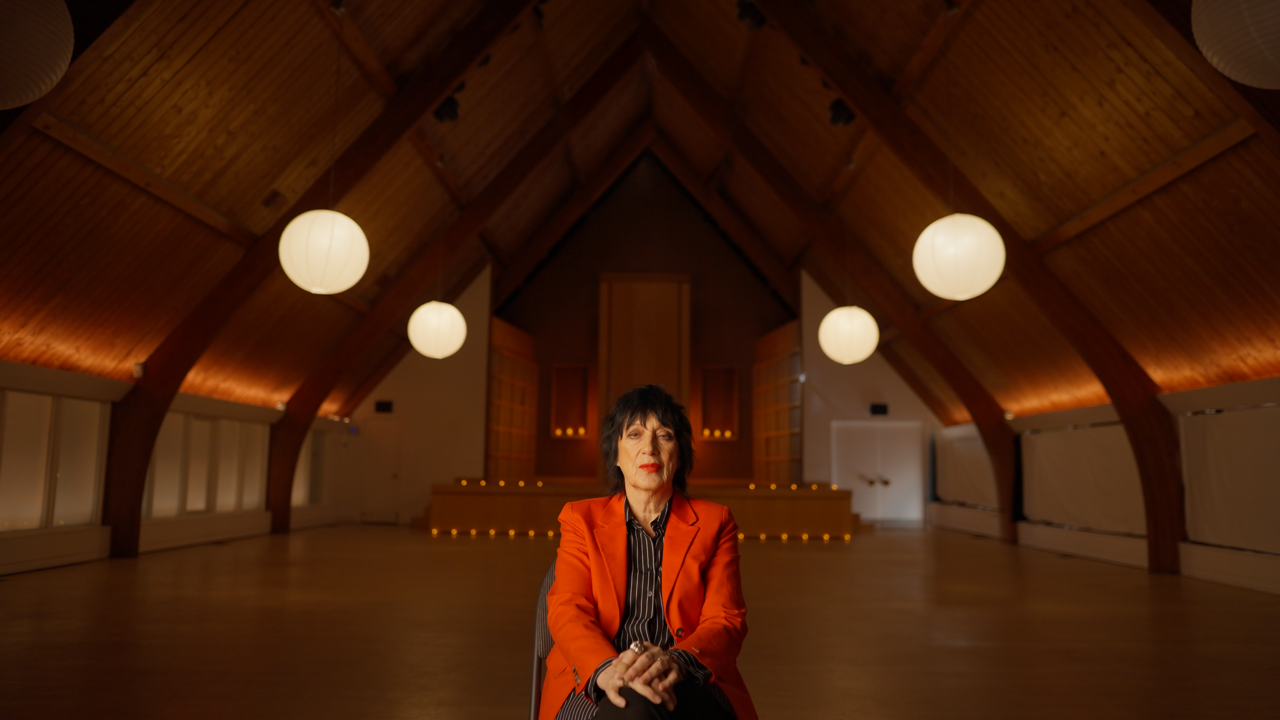
Directed by Michelle Mama (Shine True, Canada’s Drag Race), the documentary follows Pope now, as a 75-year-old artist continuing to create and perform, as well as telling the story of Pope’s life and career. Mama weaves together key threads like her partnership (both romantic and then purely creative) with bandmate Kevan Staples; coming out in the late ’70s; falling in love—and U-Hauling—with Dusty Springfield (they moved into Carole’s Toronto home together in the spring of 1981, but struggled to make it work amidst Springfield’s substance abuse); losing her brother Howard to AIDS and her solo career in the 2000s and beyond.
Antidiva aims to set the record straight (in only the linear sense). Speaking to Xtra alongside Mama, Pope says that it took her a minute to wrap her head around the idea of a documentary about her life. “It kind of freaked me out, because I don’t like being followed around,” she explains. “But I did want the story to be told.” She had been approached in the past about a possible documentary, but Mama, who co-founded LGBTQ2S+-focused production company Gay Agenda in 2023, was the first person she trusted could do it right. Mama and Pope already knew each other socially, having met through a mutual friend in the feminist art rock band Vag Halen. Mama was frustrated by the lack of contemporary reverence for Pope—especially in a moment where queer artists are breaking through in the mainstream with campy sensibilities reminiscent of her. “I want Chappell Roan to record a Carole Pope song,” Mama says.
“I want her to know who I am,” Pope says. “I want all those bitches to know who I am.”
The JUNOS performance seared into the minds of lang and Arden is just one of many stories in Antidiva that drive home Pope’s massive influence. In the film, queer artists like Peaches and Rufus Wainwright describe her impact on their developing identities, while straight guys like Skid Row’s Sebastian Bach rhapsodize about her awe-inspiring power. “I’m kind of shocked and honoured that people were inspired as much as they were,” Pope says.
Born in England, Pope grew up in the Toronto suburb of Don Mills, listening to the comedy records of Mike Nichols and Elaine May. She found her own Nichols in Staples, meeting at an audition for a band called the Diva Loca Sideshow. They were immediately drawn to each other, moving in together within a year, and eventually taking the Toronto art-punk scene of the ’70s by storm. By the mid-’70s, they were writing and performing together as Rough Trade, merging Pope’s love of pithy theatricality with Staples’s esoteric tastes. They quickly built a cult following for their blend of funk, punk and glam, injecting a countercultural thrust into the broader polite Canadian landscape. Canadian music royalty Anne Murray sent Pope a telegram after the JUNOS performance, saying that she really enjoyed watching it with her family.
Rough Trade were ahead of the curve, playing with the inherent humour of sexuality and setting it to high-octane art-rock instrumentals, like on the kinetic “All Touch” or the sordid “Crimes of Passion,” and packaging it all in a risky aesthetic world. Years after the release of “High School Confidential,” Pope saw Madonna grabbing her crotch, and wondered where she got it from. “Oh—she was at your gig in New York and saw you do that,” a friend told her.
Madonna wasn’t the only superstar to take notice. In 1983, when Rough Trade opened for David Bowie in Toronto, he wanted to take them on his world tour—an opportunity that would have launched them onto the global stage. But their Canadian label wouldn’t front the cost. “We were ahead of our time, and I know I was kind of threatening to people in the industry because I was so androgynous looking,” Pope recalls. “It’s kind of fun though, scaring guys.”
Though let down by the industry, Pope was a leading figure in a scene that has become legendary amongst Canadian arts. Toronto’s cultural sphere in the ’70s and early ’80s was a breeding ground for artistic experimentation and cross-pollination. The documentary doubles as a love letter to this period in Toronto’s history, with archival footage of hot-cashew vendors on Queen Street West, faded photos of long-standing music venue the El Mocambo and interviews with scenesters like arts patron Sandy Stagg.
“I think I got to live in Toronto during its heyday,” Pope says in Antidiva. She recalls fleeing her suburban upbringing for the café scene of Yorkville in the late ’60s, during its bohemian years, which evolved into the fertile grittiness of the downtown Queen West days. She was hanging out with the Second City comedy crowd and performed at Massey Hall with queer cinema darling Divine, helping Toronto break out of its reputation for upstanding rule-following. Now, she says, it’s hard to recognize the city. “Every time I come to Toronto, I’m like, where is Toronto?” With the massive increase in cost of living, many queer hubs have shut down, while artists have fled. “The soul of the city gets extracted,” Mama adds. “It’s depressing as hell.” It’s a familiar story for many North American cities, which once hosted vibrant underground queer scenes that have since been squeezed out or sanitized.
Antidiva channels a raw and rowdy incarnation of the city. “I just think it was a much better time, and people were certainly more intellectual and more well read,” Pope reflects. “I miss all that.”
The film follows Pope as she comes out in the ’70s, breaking up with Staples for their bandmate Jane Cessine. Pope had known she was interested in women since she saw a Wonder Woman comic as a kid, but as she puts it in the documentary, “It was the ’50s—that shit was not happening.” In the early ’80s, Pope met Springfield backstage at a show, and they fell quickly into a passionate romance, shacking up in Toronto and sharing the stage. “Two divas under one roof—bad,” Pope says in the film. Springfield was closeted and dealing with substance abuse, which would ultimately spell the end for them, but their relationship was memorialized in the dedication for Springfield’s 1982 album White Heat: “because of, and in spite of, Carole Pope.”
Mama juxtaposes these personal scenes with the broader queer context at the time, from the police raids on Toronto bathhouses in the early ’80s, to Pope’s fluid relationship with the queer scene in New York, where her brother Howard was a leading light, as a musician and early member of Act Up before his death from AIDS. Pope is working on a musical about his life. “There’s a whole generation of queer people and straight people who don’t really know about the AIDS epidemic,” she says.
Antidiva subtly contrasts that period with footage from a performance at Pride Toronto 2024, where Pope was unceremoniously cut off as the festival schedule ran late. It’s the first time that’s happened in 38 years of performing. “I’m nostalgic about the early Toronto Prides, when it was just on Church Street and you were standing on a milk carton,” she reflects. “Now, it’s more corporate.” The commercialization of queer arts has led to alienating experiences for artists like Pope.
Even today, Pope’s style and sensibility feel somewhat avant-garde. If singing about lesbian desire is no longer novel, Pope’s music has a cheeky raunchiness that’s still in short supply, as on her 2026 single “Play Fisty for Me.” She has always made music from a perspective that sees the truth of sexuality—which is that it’s very funny. Heteronormative hang-ups around sex make it even funnier. “When I asked my mother how I was born, she went, ‘Oh, some fairies … some fairies dropped seeds at the bottom of a garden.’ I was like, What? That is not helpful,” Pope recounts.
Decades on from Rough Trade, Pope is still releasing new music and still laughing at the straight and narrow. She now lives in a modest apartment in L.A.—where she first moved after Rough Trade broke up, and has recently returned “because the rent’s cheap”—and is raising funds for her musical. Over and over again in the documentary, interviewees call her a truly “authentic” artist, someone who didn’t get to climb the heights she deserved in part because she stayed so true to herself.
Making a living through authenticity is getting harder and harder, with royalties reduced to fractions of cents under the streaming economy. But watching Antidiva, it’s clear that Pope couldn’t do it any other way. “Any time I’ve tried to write something commercial, it hasn’t worked out. So I’m like, ‘I’m just gonna write what makes me happy,’” she says.
Antidiva is both a movingly intimate portrait of Pope and tribute to queer iconoclasm. Carole Pope is the woman whose crotch-grab changed lives across the country; she reshaped the world and had a good time doing it.
“You know, I don’t do this to make money,” she tells me. “It’s a struggle, but I love it. I mean, it makes me feel alive. And everybody in my band is like, the minute we stop performing live, we’re dead. That’s very life-affirming.”

 Why you can trust Xtra