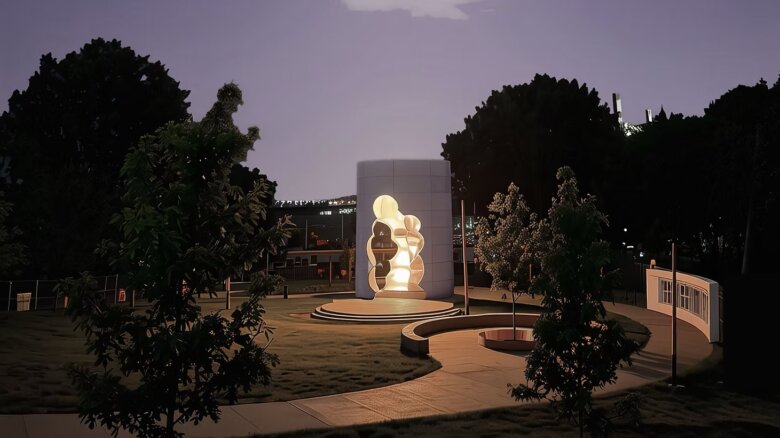
Hailed as the “mother goddess of women’s filmmaking,” Dororthy Arzner was a prolific director in Hollywood’s studio system era. Between 1928 and 1943, Arzner directed 16 feature films that explored relationships between women and challenged gender norms, like Working Girls, Merrily We Go to Hell and Dance, Girl, Dance.
Arzner was a woman of many firsts in the film industry. In 1936, she became the first woman to join the Directors Guild of America. She’s also credited with the invention of the boom microphone during the industry’s transition to “talkies.” And Arzner had a clear eye for talent, casting Lucille Ball, Katharine Hepburn and Maureen O’Hara in some of their first major roles.
And it was on the set of Arzner’s first feature film, Fashions for Women, where she met choreographer Marion Morgan. Her frequent collaborations with Arzner sparked a romance, and they would go on to be life partners for over 40 years.
Arzner and Morgan would work and live together until Arzner’s death in 1979. But it wasn’t always rosy—Arzner was often rumoured to have affairs with other women in Hollywood, including Joan Crawford, Hepburn and the original Glinda, Billie Burke.
In 1943, Arzner retired from making feature-length films due to an unknown illness and rising scrutiny under the Hays Code. She would later direct military training films, and a series of Pepsi commercials with Crawford. She was also a beloved film professor at UCLA, where she would teach a young Francis Ford Coppola.
Arzner would never receive an award for her work during her lifetime, though she was honoured with a star on the Hollywood Walk of Fame in 1986. And thanks to funds raised by Jodie Foster, many of Arzner’s letters and contributions to film history are preserved by UCLA.

 Why you can trust Xtra