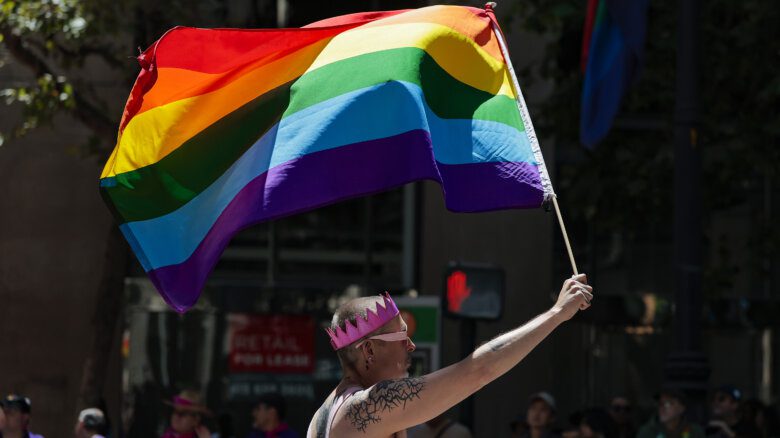
The lesser-known gay history of high-fives

Glenn Burke made history as the first Major League Baseball player to publicly come out as gay. He’s also credited with inventing the high-five

Did you know that there’s a gay history behind high-fives?

On Oct. 2, 1977, rookie Dodgers outfielder Glenn Burke raised his hand to congratulate Dusty Baker on his 30th home run during a game against the Houston Astros. In response, his slightly confused teammate smacked Burke’s hand—and the high-five was born.

Burke was also the first player in Major League Baseball to publicly come out as gay. While he didn’t come out until 1982, after his retirement, Burke was out to his teammates while he played in the league.

Burke came out via Michael J. Smith’s article “The Double Life of a Gay Dodger” in a 1982 issue of Inside Sports. In the piece, Dodgers teammate Davey Lopes said that nobody on the team cared about his “lifestyle” and that Burke was “the life of the team.” 

But he wasn’t accepted by everyone. Burke told the New York Times that prejudice ultimately drove him out of baseball. Burke also alleged that the Dodgers’ general manager offered to pay for a big honeymoon if he married a woman. He was later traded to the Oakland A’s, where he also experienced homophobia.

Burke passed away in 1995 due to AIDs complications. And while his story is not as well known as it should be, there have been efforts in the last few years to right that wrong. We looked into not just his role in creating the high-five, but also his status as a queer pioneer in sports.


Cody Corrall is Xtra's Social Video Producer. Their work has appeared in BuzzFeed News, TechCrunch, the Chicago Reader, CINE-FILE, Thrillist, Paste Magazine, and other places on the world wide web. He lives in Chicago and speaks English.

Senior editor Mel Woods is an English-speaking Vancouver-based writer, editor and audio producer and a former associate editor with HuffPost Canada. A proud prairie queer and ranch dressing expert, their work has also appeared in Vice, Slate, the Tyee, the CBC, the Globe and Mail and the Walrus.

Keep Reading

Girlguiding patches

Trans girls banned from U.K. Girl Guides following Supreme Court ruling

The U.K. Women’s Institute also announced it will ban trans women from membership

Why is everyone obsessed with this gay Canadian hockey TV show?

“Heated Rivalry” has been a breakout hit. What’s the special sauce that’s making everyone so excited?
Stills from Somebody Somewhere, Clean Slate, and Mid-Century Modern - shows with queer characters that were cancelled or ended.

Nearly half of all queer characters on TV will disappear next year

An uptick in series endings and cancellations is bad news for queer and trans representation
On the left, a black and white still from Flaming Creatures featuring a person sniffing a bouquet of flowers. On the right, an illustrated poster for the film.

‘Flaming Creatures’ and the censorship of queer art

Jack Smith’s 1963 film “Flaming Creatures” was deemed legally obscene by the U.S. Supreme Court