AIDS Action Now Day of Action on HIV criminalization

Two cases before Supreme Court of Canada

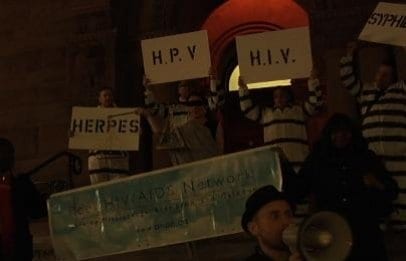
AIDS Action Now took to the streets of Toronto on Feb 6 as part of a Day of Action ahead of the Feb 8 Supreme Court of Canada hearing of two landmark cases about HIV, sex and criminal law.

“Now people who are HIV are supposed to disclose our status if we are doing anything that might involve significant risk to a partner or someone else,” said Tim McCaskell of AIDS Action Now. “However, what significant risk is has not been clearly defined, and as a result there are, or have been, almost 130 cases across the country now of people being arrested.

“Transmission has not even been alleged in about 40 percent of those cases. It’s simply a matter of not disclosing your status.”

The protest started at the Church of the Holy Trinity and ended in front of Old City Hall.

For more on AIDS Action Now, click here. And continue to check in with Xtra for our continuing coverage of this issue.

Read More About:
Video, Power, Health, News, HIV/AIDS, Canada, Human Rights

Keep Reading

On the left, Jason Collins on the cover of Sports Illustrated coming out as gay. On the right, a photo of Collins playing for the Brooklyn Nets.

Remembering Jason Collins, the gay NBA player who changed the game

The late trailblazer made history when he came out in 2013
Senior Director for Counterterrorism Sebastian Gorka speaks during the Semafor World Economy Summit.

U.S. counterterrorism strategy takes aim at ‘pro-transgender’ groups

The Trump administration’s updated counterterrorism strategy targets “left-wing extremists” and groups who are “radically pro-transgender”
Renée Richards at a tennis match

The complicated legacy of Renée Richards

The former tennis player broke barriers for trans athletes in 1977. Then she changed her tune
Supporters of HIV AIDS research participate in the 2025 Toronto Pride Parade

Toronto man set to be the first Canadian cured of HIV

The patient received a stem cell transplant for his cancer that acted as a “double cure” because it contained a rare genetic mutation resistant to HIV
Advertisement