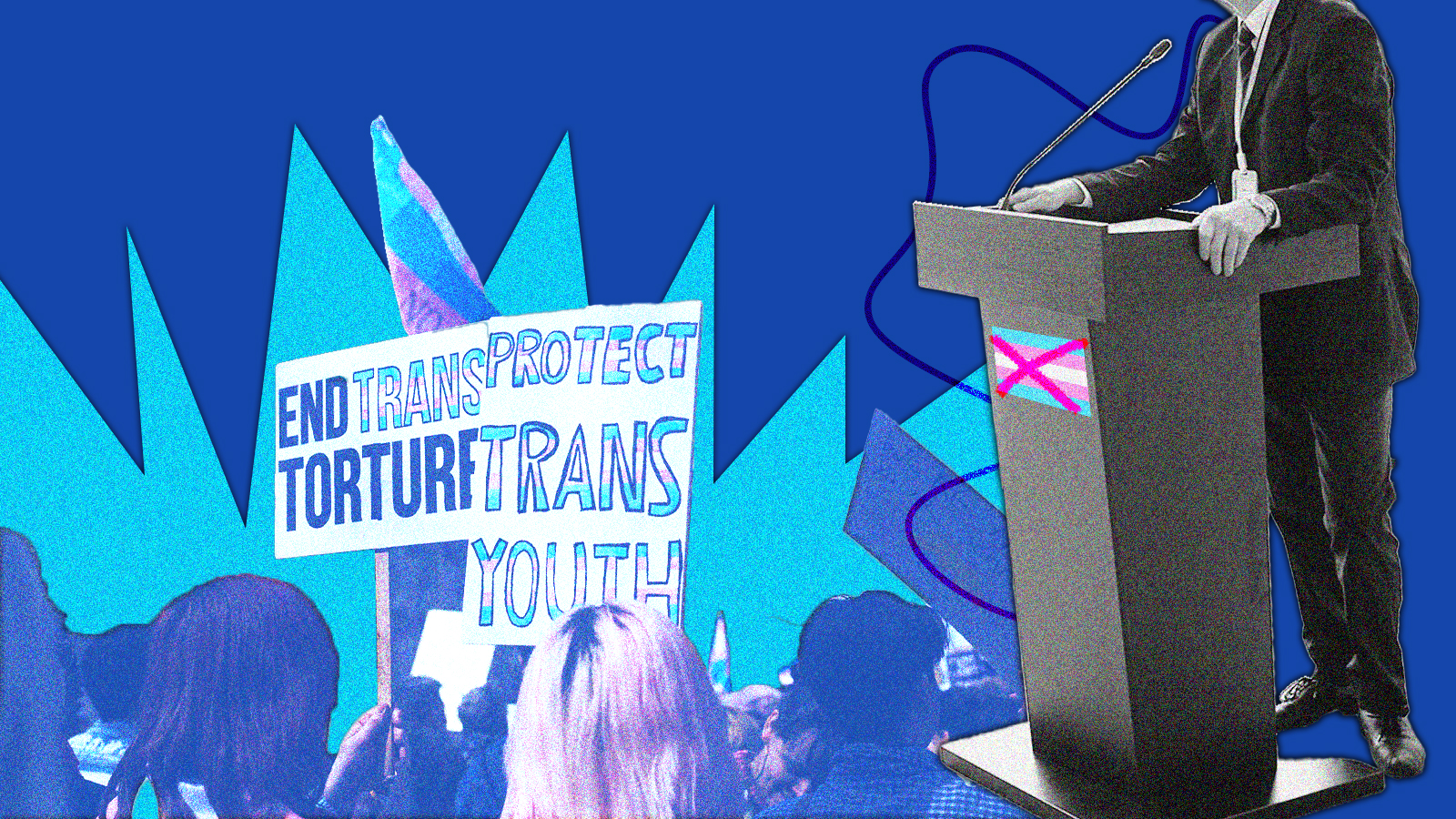
The dust has settled after a long October of elections around Canada, and the country is left to make sense of a whole slew of new governments. In British Columbia, the provincial Conservatives surged to power despite a messy summer of infighting—particularly because of a new leader who wanted to push the party further right. In Alberta, while voters largely rejected the separatist questions posed by Premier Danielle Smith, the questions about immigration reform all passed. These troubling results might illustrate that despite the Alberta separatist movement being unpopular, Smith’s brand of right-wing politics, which includes targeting trans kids and gender-affirming healthcare, still holds some favour. For some of these politicians, the internet has become the place where they start introducing such ideas.
Despite politicians like Smith and anti-“gender ideology” being common online, the vast majority of Canadians support trans rights. A new poll of 2,000 Canadians conducted by Ipsos Canada for Queer Momentum found that 76 percent of Canadian respondents believe that trans people should be able to live openly without fear of harassment. Sixty-three percent of respondents agree that no government should use override powers to target a minority and 57 percent believe that protecting trans people should be a federal priority. Meanwhile, only 14 percent were found to be firmly opposed to trans, gender-diverse and Two-Spirit rights. This is proof that online discourse and politicians’ scapegoating of trans people in Canada is a representation of a minority, rather than a popular mandate.
Fae Johnstone, Queer Momentum’s executive director, says that the group commissioned the poll after seeing negative rhetoric online and in politicians’ speeches about trans communities in Canada. At the same time, there weren’t concrete statistics on how Canadians actually stand on trans issues. “We know that in order to communicate effectively and help legislators make informed decisions, it’s important to take the pulse of the public,” she explains.
The overwhelmingly positive results of the poll surprised Johnstone, who says the negative “bot and troll ecosystem” on social media makes it really easy to believe that Canadians are less supportive. Instead, Johnstone says that most Canadians “stand behind their trans and gender-diverse neighbours and want us to be rated with dignity, be safe and have equal treatment.”
Johnstone adds that politicians target trans and queer people—despite broad general support—for two main reasons. First, because it’s easy to use queer people as a distraction when the government is failing to deliver on promises like healthcare, housing and the economy. “Turning us into a boogeyman, that’s reason number one,” she says. Second, Johnstone explains that the right has developed effective dog whistles that the general public do not yet understand as dog whistles: using phrases like “protecting the rights of parents” when wanting to pass transphobic legislation, for example. “When politicians use that language, they are cueing support from that fringe minority in their base that has an outsized degree of power and influence in their party,” she says.
These dog whistles use what scholar Kayla Preston describes as “mundane language,” which she writes about in a 2023 analysis. Preston, who is a lecturer at the University of Winnipeg’s Global College and Department of Human Rights, says that far-right groups justify contentious things they say online through common words that mislead readers into getting behind intolerant ideas.
Preston tells Xtra that a major danger in politicians and online groups using these discursive tools is that it legitimizes the ideologies and might make them seem more commonplace than they really are. The idea of “protecting kids” is, on the surface, something that more or less everyone can agree on. But what right-wing politicians and posters mean when they talk about protecting children is much more sinister.
Conversations on widely used platforms like Facebook are very effective at making fringe ideologies seem normal, Preston says. “They might be posting about something like the protection of children on a platform that is seen as extremely common, that people use to communicate with family and post vacation pictures.” It’s a good reminder that what appears online is much different from attitudes in real life.
Algorithms are also designed to feed users content that captures their attention: the more someone lingers on far-right content, perhaps at first out of curiosity, the more they’ll see. It can create the effect that more people are talking about a topic or have certain views than exist in real life.
And while it’s heartening to remember how unpopular these bigoted views actually are, this online echo chamber can still have real impacts on electoral politics. Preston points to the People’s Party of Canada (PPC) as an example. Led by Maxime Bernier, the PPC is notoriously denigrating toward trans people and immigrants. And while they’ve never won a seat at any level of government, Preston says that in 2025, the PPC won more votes than the Green Party. “It’s a small portion of Canadians, but they are making waves in ways that sometimes go unrecognized and it’s quite troubling,” she says. “We still hear about drag storytimes that get protested across Canada [by these groups], for example.”
But it’s not all doom and gloom. Being aware of the discrepancy between online discourse and what’s going on in real life is key to keeping the hope and keeping up the fight. And, to Preston, that also means seeking out community. “The biggest risk right now is people not joining in community,” Preston says, adding that being in community with people who love and respect you is much more important than what online chatter might say.
Johnstone says that the data from the Ipsos poll is important because it helps us understand that anti-trans legislation is not being made at the behest of the public. Politicians are introducing these ideas to satisfy “a fringe minority within their own party,” she says, pointing to B.C.’s new Conservative government as an example. “Only seven percent of British Columbians self-identify as opposed to trans rights—that means that if that government does anything to strip right away from trans people, they’re not doing it in the best interest of the province.”

 Why you can trust Xtra