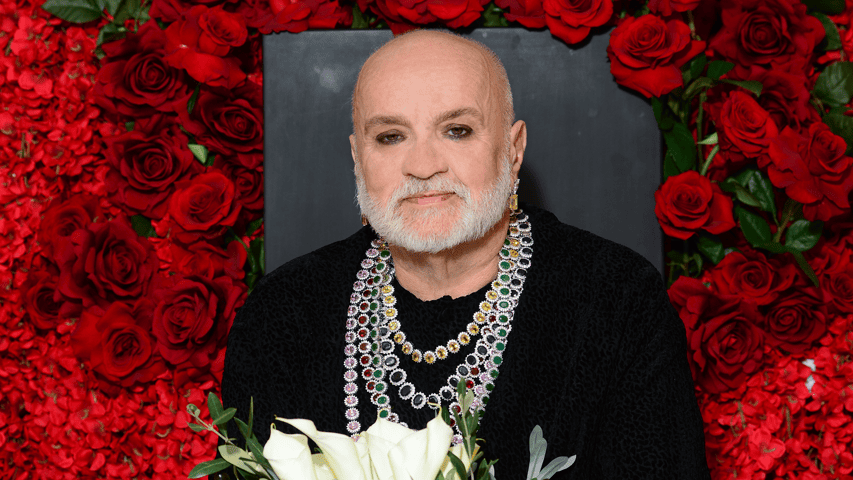
Leaving Pink Triangle Press’s Pink Awards in 2024 at the Globe and Mail Centre in Toronto, Salah Bachir ran into firebrand filmmaker Michelle Mama at the elevators. (Pink Triangle Press is Xtra’s parent company.) Salah had been presented that evening with the inaugural Legacy Award as a one-of-a-kind queer community champion. Mama tells the story of how Salah “seemed glum,” and so she asked him what was up. Salah told her he was sad because people didn’t really care about him anymore now that he didn’t have access to influence. She was flabbergasted. This hero of the community? This model of the immigrant success story? This gala king? But of course people cared! This very evening and its award was evidence of how people most certainly did care about him. He was clearly beloved, and she told him so.
In remembering that night, Mama says she realizes now that she was watching someone confront their legacy. Someone for whom legacy was culturally and spiritually significant. A person who cared about legacy and wasn’t sure what theirs would be.
Salah’s father was a union man, and Salah was a devoted son. At age 15, he was already looking for ways to contribute to the community, so when his father announced that Cesar Chavez was going to be in nearby Scarborough to support local farmer protests, Salah got involved. He took donations outside the mall all day, but only managed to raise 100 dollars for the cause. His father contributed another 50, and Salah personally presented Chavez the 150 dollars while apologizing that it wasn’t more. Chavez supplied Salah with what would become something of a mantra for him on his fundraising journey: “It’s 150 dollars more than we had this morning.”
Salah spent his life raising money. For AIDS research, for Toronto’s essential queer community centre at 519 Church Street, for hospitals and arts organizations, for community projects back in Lebanon. He was a wizard among philanthropists. And it was his own kind of philanthropy that started his jaw-dropping art collection. Salah bought from emerging Canadian artists because he liked the work, but also because he knew they needed the money. It was the luck of his excellent eye that benefited both him and the artists. Salah’s collection became a who’s who of the biggest names in art—both Canadian and globally. His final house in Paris, Ontario, was an unrivalled gallery of contemporary queer superstars, many of whom were still his friends.
Devotedly social and well-boundaried, Salah was both public and private but never fully either. He was an open book with secret chapters. Which is not to say that he was holding something back, rather, there was always some feeling of mystery with Salah. But that mystery did not create distance. Time with Salah felt like real contact. Personal. And it was always like that. No matter how long it had been since you’d seen him. No one ever had to get reacquainted with Salah. Whenever you got together, he always made you feel like an old pal.
Salah invited me and our mutual friend, the portrait photographer Guntar Kravis, and me to his home in Paris one afternoon. Guntar and I were coming back from Stratford, having seen an exhibition of Salah’s collection that was being presented by the Gallery Stratford. We told Salah we were seeing the show and he said to drop by Paris on our way back to Toronto since he’d be having lunch anyway. “Lunch anyway” turned out to be a 10-person luncheon for Margaret Atwood. There were other luminaries there too, but Atwood’s presence singed the edges of my memory.
It was delightful watching Salah so in his element. He conjured this mix of brattiness and wonder around celebrity. Not quite a fan but impressed; on the same level but wanting the dirt. For a master class in unabashed name-dropping, read his highly entertaining memoir First to Leave the Party. It’s juicy. Salah was fascinated by celebrity and loved proximity to it, but one got the sense he never really wanted it for himself.
In Salah’s episode of the Queer Joy podcast, I asked him what he was most proud of. After a long pause, he said, “I’m proud that I was able to do what I did. That I was on the street. That I was involved. That I was an activist.” It was the fight against AIDS that got Salah on the street and where he discovered, as he says on the podcast, “that we were part of a united front.” He calls it finding “our commonality.”I was part of the Pink Award planning at PTP when the idea of the Legacy Award was first being considered. A question came up about a potential recipient’s area of accomplishment. Would they be an icon from business, philanthropy or art? We determined that with Salah, we got all of those. When Michelle Mama recounted that night at the Pink Awards, she said she was initially surprised about his concern over his legacy. But then she came to understand the weight of that question for someone who grew up in war zones, “elbow to elbow with struggle,” she said. Salah was always a proud son to his family in Lebanon, to his heritage. He came from a culture that understood generosity as duty and saw profound value in legacy. Of course he might wonder how he would be remembered.
Salah Bachir lived in the space between worlds. Between being a left-leaning philanthropist and a corporate entrepreneur, a Canadian icon and a Lebanese son, down-to-earth and starstruck, the centre of the party and the first to leave. He came from elsewhere. He was foundationally queer. His unapologetic self, his lefty politics, his gleeful embracing of camp, his dinner parties, his genderfuck jewellery and caftans, his love of beauty and the dark. He was doing queer before we knew what to call it. Salah’s gift to me is the queerness he profoundly embodied. I will remember him when I remember the freedom that otherness affords me.
Over the applause after Salah’s succinct Legacy Award speech at the Pink Awards—which ended with a very Salah call to arms of “When they go low, crush them!”—he called out a list of people’s names, thanking them, grateful, generous and then finally yelled, “Michelle Mama! I’m ready for my documentary!”
 Why you can trust Xtra