With the House of Commons set to return on Sept. 15, queer and trans Canadians face a more challenging political landscape. Since the 2025 federal election, the number of out LGBTQ2S+ MPs has dropped from eight to five. There will be fewer out cabinet ministers. And out LGBTQ2S+ MPs now come from only two parties—the Liberals and Conservatives. This means fewer LGBTQ2S+ people hold positions of political power, and those who do represent a narrower range of political perspectives.
These setbacks in political representation matter. Research shows that LGBTQ2S+ MPs play an important role in advancing queer and trans rights. Their voices are especially needed now, as Parliament reconvenes in an era of policy retrenchment and public backlash targeting queer and trans communities.
Unlike previous elections, there was very little attention paid to LGBTQ2S+ candidates and issues during the 2025 campaign. Information about LGBTQ2S+ candidates was hard to come by: when journalists asked parties for information about LGBTQ2S+ candidates, they did not receive answers.
As researchers interested in LGBTQ2S+ political representation, we gathered information about which candidates were out as LGBTQ2S+ during the 2025 federal election. We trained and oversaw a team of research assistants who searched every candidate who ran for the Liberal, Conservative, NDP, Bloc and Green parties. They reviewed information about each candidate on party websites, Wikipedia and Google. The Google searches typically captured news coverage and public social media accounts. They identified candidates as LGBTQ2S+ based on identity labels (e.g., “lesbian”), general references to being part of the LGBTQ2S+ community (e.g., “As a member of the LGBTQ2S+ community …”), their pronouns and/or references to a same-gender partner. We have followed this same process for every election since 2015.
Although it might be tempting to suggest that LGBTQ2S+ representation in Parliament declined because LGBTQ2S+ Liberal MPs announced they would not run again and the NDP—which historically has run more LGBTQ2S+ candidates than other parties—did poorly in the election, our data suggest there’s more to the story.
Parties nominated fewer LGBTQ2S+ candidates
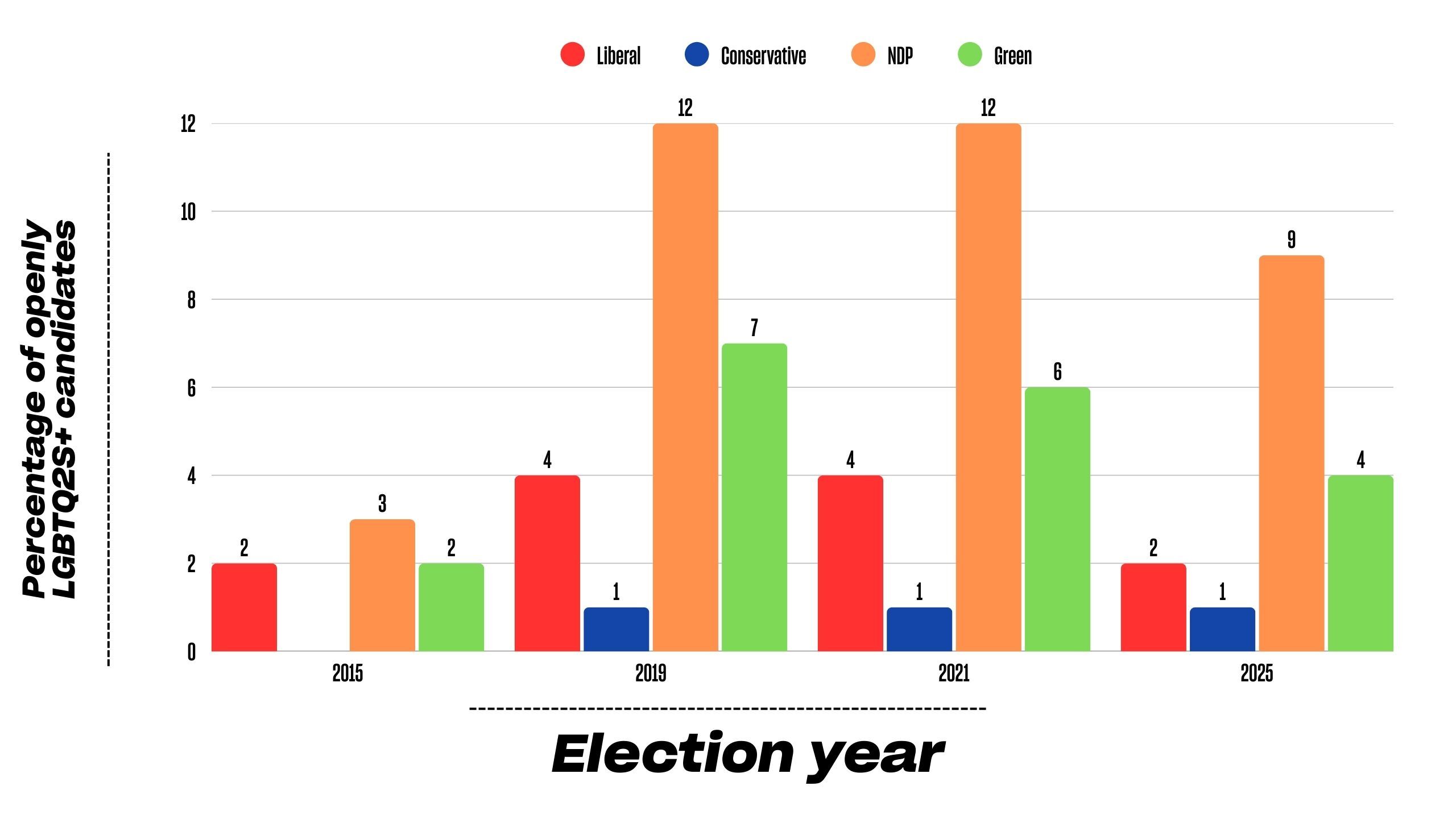
LGBTQ2S+ representation was already fighting an uphill battle before election day because parties nominated fewer LGBTQ2S+ candidates in 2025 than in previous elections. In 2019, there was a “rainbow wave”—a sharp increase in LGBTQ2S+ candidates, particularly for the NDP and the Green Party. That momentum continued into 2021 with the NDP and the Liberals nominating even more LGBTQ2S+ candidates than in past elections. However, in 2025, the NDP, Greens and Liberals all nominated smaller percentages of LGBTQ2S+ candidates than in either 2019 or 2021. (The Bloc Québécois is excluded from our analysis because we could only identify one out candidate between 2015 and 2025, Michel Duchesne.)
Parties nominated LGBTQ2S+ candidates in unwinnable ridings
Since at least 2019, journalists have raised concerns about LGBTQ2S+ candidates being nominated in ridings they cannot win—for example, an LGBTQ2S+ NDP candidate in a longtime Conservative seat. It was bad in 2019 and 2021 (as shown by Lapointe, Ferland and Turgeon and our own research), especially for trans and non-binary people, but it got even worse in 2025.
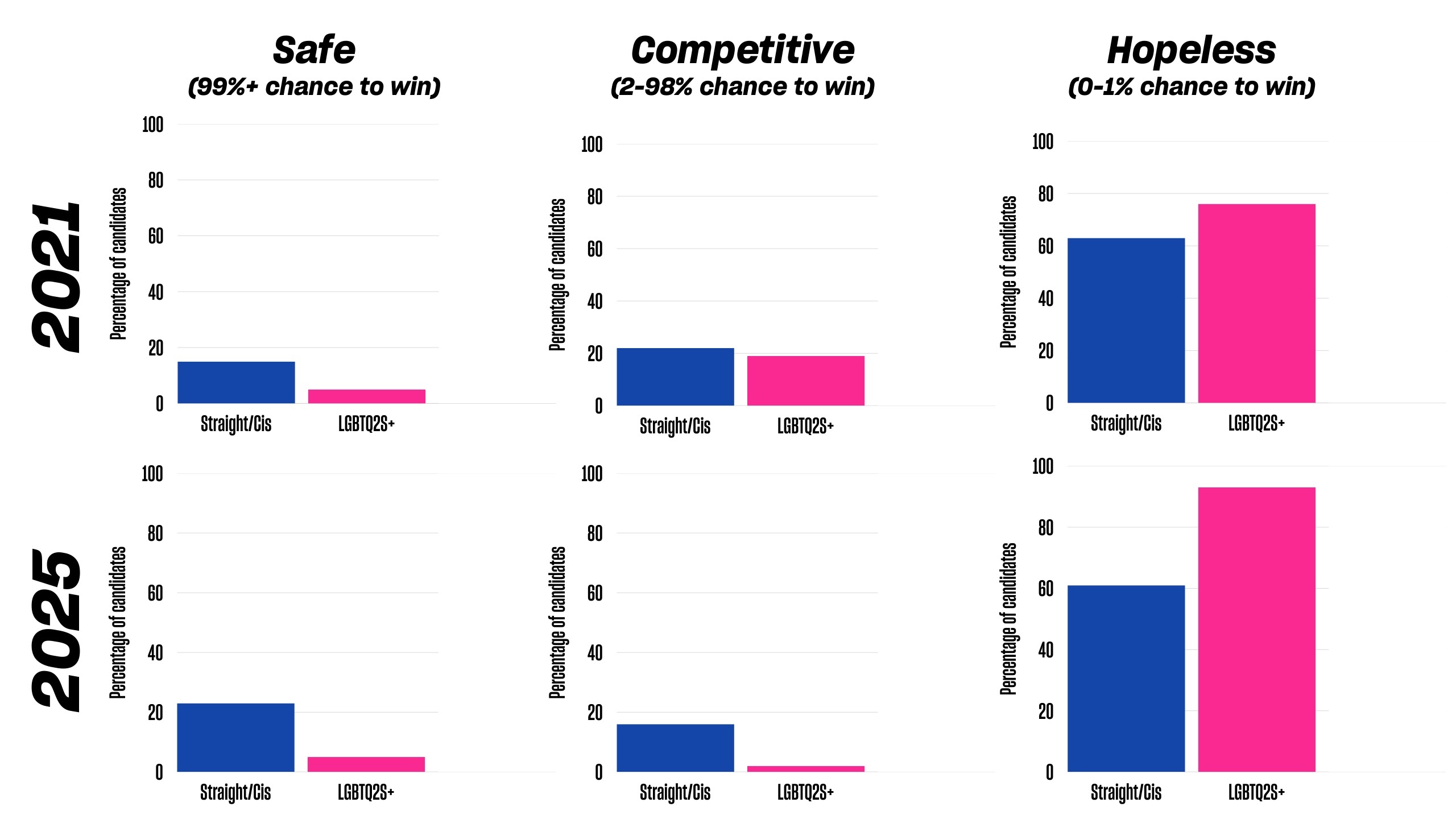
We used Philippe Fournier’s final projections for the 2021 and 2025 elections to see how competitive each party was in the ridings where they nominated straight cis and LGBTQ2S+ candidates. Parties nominated an even larger percentage of LGBTQ2S+ candidates in “hopeless ridings,” or ridings where they had a one percent chance or less to win. This was a problem across parties and was worse in all parties in 2025 than in 2021.
What can be done about this?
LGBTQ2S+ advocates have been busy responding to urgent challenges, including by launching court challenges to anti-trans policies in Saskatchewan, New Brunswick and Alberta. During the 2025 election, voter mobilization efforts—like Drag the Vote, Rainbow Equality and Vote with Pride—engaged queer and trans voters. Advocates pushed for queer and trans issues to be included in platforms. And, after the election, lobbying has continued.
It’s understandable that many are focused on pressing issues right now. But even as we respond to immediate threats, it’s important to look ahead. The next federal election might seem far off, but now’s the time to get to work. Parties are already preparing for the next election—selecting their candidates, leaders and policies. This presents opportunities for advocacy within political parties. Although political parties are far from perfect, they wield a lot of power—over the agenda, voting in the House, candidates and policies.
First, we can advocate for improved party equity policies. Most parties already have policies aimed at increasing the representation of groups that remain under-represented in politics, including LGBTQ2S+ people. Between elections, parties update these policies and set targets for nominating candidates from different marginalized groups. That makes now the right time to push parties to strengthen their commitments.
More specifically, we should ask parties to set specific targets for LGBTQ2S+ candidates. Currently, even parties that include LGBTQ2S+ people in their targets lump them together with other marginalized groups. This allows parties to meet their targets without prioritizing LGBTQ2S+ candidates. Specific targets would help ensure that LGBTQ2S+ candidates are not overlooked.
In addition, we should push parties to set clear targets for LGBTQ2S+ candidates in winnable ridings. While some parties set targets for nominating candidates from marginalized groups in winnable ridings, they do not define what a winnable riding is. Without clear criteria, we cannot hold parties accountable for where and how they support (or don’t support) LGBTQ2S+ candidates.
Queer and trans Canadians can work with advocacy organizations such as Proud Politics and Equal Voice to bring media attention to party equity policies and candidate targets. They can also raise these issues at party conventions and in questions to those running for party leadership. These are opportunities to make LGBTQ2S+ representation a meaningful priority within parties.
Second, you can exert influence by becoming a party member. You can vote in nomination contests to choose local candidates (an important opportunity to support LGBTQ2S+ contestants who share your values), vote in leadership races (which shape the direction of a party) and propose and vote on policies at conventions (including those related to LGBTQ2S+ issues). Most parties make it easy to join online, with annual fees typically ranging from $0 to $15. Eligibility requirements vary slightly but generally include agreeing with the party’s principles, being a Canadian resident and meeting a minimum age (usually 14).
Finally, you can run for office or encourage other LGBTQ2S+ people to run. Information on how to run is available on party websites, and many organizations—such as Equal Voice and Proud Politics—offer campaign training programs. These trainings provide practical guidance and insider tips from those who have run before, helping demystify the process and build confidence. Even if you’re not ready to run yourself, you can support others—by encouraging them to run, volunteering on their campaigns, donating to their campaigns or amplifying their voices. By building a pipeline of queer and trans candidates, we can strengthen LGBTQ2S+ representation.
Improving LGBTQ2S+ representation in Canadian politics will take sustained effort, but it’s within reach. From advocating for stronger equity policies to joining a party to support queer and trans candidates, there are concrete steps we can take—now, between elections—that will shape who gets nominated, elected and heard. While many are rightly focused on urgent challenges facing our communities, this is also a critical moment to build power for the future. If enough of us get involved, we can help ensure that queer and trans voices are present in Parliament to shape policies that affect our lives.


 Why you can trust Xtra